


Page 102 - Journal of Special Operations Medicine - Spring 2014
P. 102
a laceration to a complete amputation and include dam-
          age to blood vessels, vessels, tendons and bone. 3

          In a University of California study, investigators exam-
          ined the biomechanics of ring avulsion injuries using a
          cadaver simulation model and employing high-speed cin-
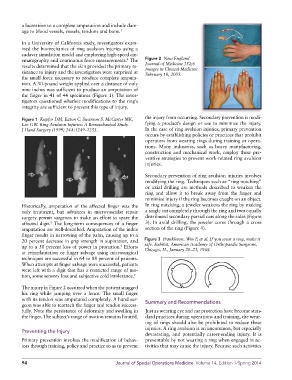
          ematography and continuous force measurements.  The   Figure 2  New England
                                                     4
          results determined that the skin provided the primary re-  Journal of Medicine 352;6
                                                             Images in Clinical Medicine
          sistance to injury and the investigators were surprised at   February 10, 2005.
          the small force necessary to produce complete amputa-
          tion. A 30-pound weight applied over a distance of only
          nine inches was sufficient to produce an amputation of
          the finger in 41 of 44 specimens (Figure 1). The inves-
          tigators questioned whether modifications to the ring’s
          integrity are sufficient to prevent this type of injury.

          Figure 1  Kupfer DM, Eaton C, Swanson S, McCarter MK,   the injury from occurring. Secondary prevention is modi-
          Lee GW. Ring Avulsion Injuries: A Biomechanical Study.    fying a product’s design or use to minimize the injury.
          J Hand Surgery (1999) 24A:1249–1253.               In the case of ring avulsion injuries, primary prevention
                                                             occurs by establishing policies or practices that prohibit
                                                             operators from wearing rings during training or opera-
                                                             tions. Many industries, such as heavy manufacturing,
                                                             construction and mechanical work, employ these pre-
                                                             ventive strategies to prevent work-related ring avulsion
                                                             injuries.
                                                             Secondary prevention of ring avulsion injuries involves
                                                             modifying the ring. Techniques such as “ring notching”
                                                             or axial drilling are methods described to weaken the
                                                             ring and allow it to break away from the finger and
                                                             minimize injury if the ring becomes caught on an object.
          Historically, amputation of the affected finger was the   In ring notching, a jeweler weakens the ring by making
          only  treatment,  but  advances in microvascular repair   a single cut completely through the ring and two equally
          surgery permit surgeons to make an effort to spare the   distributed secondary partial cuts along the sides (Figure
          affected digit.  The long-term consequences of a finger   3). In axial drilling, the jeweler cores through a cross
                      5
          amputation are well-described. Amputation of the index   section of the ring (Figure 4).
          finger results in narrowing of the palm, causing up to a
          20 percent decrease in grip strength in supination, and   Figure 3  Frankleton, Wm F, et al. If you wear a ring, make it
          up to a 50 percent loss of power in pronation.  Efforts   safe. Exhibit, American Academy of Orthopaedic Surgeons,
                                                   6
                                                             Chicago, IL, January 20–25, 1968.
          at reimplantation or finger salvage using microsurgical
          techniques are successful in 64 to 88 percent of patients.
          When attempts at finger salvage were successful, patients
          were left with a digit that has a restricted range of mo-
          tion, some sensory loss and subjective cold intolerance. 7

          The injury in Figure 2 occurred when the patient snagged
          his ring while jumping over a fence. The small finger
          with its tendon was amputated completely. A hand sur-
          geon was able to reattach the finger and tendon success-  Summary and Recommendations
          fully. Note the persistence of deformity and swelling in   Just as wearing eye and ear protection have become stan-
          the finger. The subject’s range of motion remains limited.  dard practices during operations and training, the wear-
                                                             ing of rings should also be prohibited to reduce these
                                                             injuries. A ring avulsion is an uncommon, but especially
          Preventing the Injury
                                                             devastating, and potentially career-ending injury. It is
          Primary prevention involves the modification of behav-  preventable by not wearing a ring when engaged in ac-
          iors through training, policy and practice so as to prevent   tivities that may cause the injury. Because such activities


          94                                     Journal of Special Operations Medicine  Volume 14, Edition 1/Spring 2014

