


Page 107 - Journal of Special Operations Medicine - Spring 2014
P. 107
An Ongoing Series


                                           Giant Basal Cell Carcinoma


                            Shayna C. Rivard, MD; Michael L. Crandall, MD; Neil F. Gibbs, MD


              ABSTRACT
              Servicemembers are often exposed to extreme environments   Case Report
              with sun exposure, often laying the foundation for future   A 36-year-old male active duty Seabee presents to your
              skin cancer. Basal cell carcinoma (BCC) is the most com-  office with a left shoulder plaque that initially started
              mon of skin cancers. We present the case of a 36-year-old   as an erythematous papule but has now increased to
              male active duty Seabee who presents with a left shoulder   greater than 6cm in the past 10 years. He has no signifi-
              plaque that initially started as an erythematous papule but   cant past medical history. He reports that it occasionally
              has now increased to greater than 6cm in the past 10 years   itches and burns but is overall not bothersome. He notes
              and is diagnosed as giant basal cell carcinoma (GBCC). Al-  no known inciting event and has no other symptoms.
              though only 0.5% to 1% of BCCs develop into GBCCs, there   His job occupation includes spending a lot of time in
              is the potential for metastasis and even death. This article   bright sunlight. The patient reports no other history of
              addresses the concerning and potentially fatal diagnosis of   prior skin disorders.
              GBCC, including your initial impressions and differential di-
              agnoses, available treatment options, and ways to prevent it   On examination, he has one large erythematous plaque
              from ever occurring in our military population.
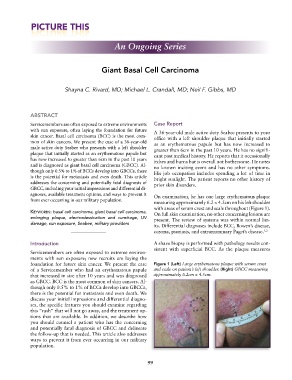
                                                                 measuring approximately 6.2 × 4.5cm on his left shoulder
                                                                 with areas of serum crust and scale throughout (Figure 1).
              Keywords: basal cell carcinoma, giant basal cell carcinoma,   On full skin examination, no other concerning lesions are
              enlarging plaque, electrodessication and curettage, UV   present. The review of systems was within normal lim-
              damage, sun exposure, Seabee, military providers
                                                                 its. Differential diagnoses include BCC, Bowen’s disease,
                                                                 eczema, psoriasis, and extramammary Paget’s disease. 1,2

              Introduction                                       A shave biopsy is performed with pathology results con-
                                                                 sistent  with  superficial  BCC.  As  the  plaque  measures
              Servicemembers are often exposed to extreme environ-
              ments with sun exposure; new recruits are laying the
              foundation for future skin cancer. We present the case   Figure 1 (Left) Large erythematous plaque with serum crust
              of a Servicemember who had an erythematous papule   and scale on patient’s left shoulder. (Right) GBCC measuring
              that increased in size after 10 years and was diagnosed   approximately 6.2cm × 4.5cm.
              as GBCC. BCC is the most common of skin cancers. Al-
              though only 0.5% to 1% of BCCs develop into GBCCs,
              there is the potential for metastasis and even death. We
              discuss your initial impressions and differential diagno-
              ses, the specific features you should examine regarding
              this “rash” that will not go away, and the treatment op-
              tions that are available. In addition, we describe how
              you should counsel a patient who has the concerning
              and potentially fatal diagnosis of GBCC and delineate
              the follow-up that is needed. This article also addresses
              ways to prevent it from ever occurring in our military
              population.


                                                              99

