


Page 112 - Journal of Special Operations Medicine - Spring 2014
P. 112
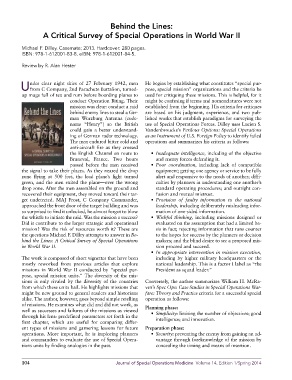
Behind the Lines:
                   A Critical Survey of Special Operations in World War II


          Michael F. Dilley. Casemate; 2013. Hardcover: 280 pages.
          ISBN: 978-1-612001-83-8. eIBN: 978-1-612001-84-5.

          Review by R. Alan Hester


             nder clear night skies of 27 February 1942, men   He begins by establishing what constitutes “special pur-
          Ufrom C Company, 2nd Parachute Battalion, turned-  pose, special mission” organizations and the criteria he
          up mugs full of tea and rum before boarding planes to   used for critiquing these missions. This is helpful, for it
                              conduct Operation Biting. Their   might be confusing if terms and nomenclatures were not
                              mission was clear: conduct a raid   established from the beginning. His criteria for critiques
                              behind enemy lines to steal a Ger-  are based on his judgment, experience, and two pub-
                              man Wurzburg Antenna (code-    lished works that establish paradigms for surveying the
                              name “Henry”) so the British   use of Special Operations Forces. Dilley uses Lucien S.
                              could gain a better understand-  Vandenbroucke’s Perilous Options: Special Operations
                              ing of German radar technology.   as an Instrument of U.S. Foreign Policy to identify failed
                              The men endured bitter cold and   operations and summarizes his criteria as follows:
                              anti-aircraft fire as they crossed
                              the English Channel en route to   •  Inadequate intelligence, including of the objective
                              Bruneval, France. Two hours        and enemy forces defending it.
                              passed before the men received   •  Poor coordination, including lack of compatible
          the signal to take their places. As they neared the drop   equipment; getting one agency or service to be fully
          zone flying at 500 feet, the lead plane’s light turned   alert and responsive to the needs of another; diffi-
          green, and the men exited the plane—over the wrong     culties by planners in understanding one another’s
          drop zone. After the men assembled on the ground and   standard operating procedures; and outright con-
          recovered their equipment, they moved toward their tar-  fusion and mutual mistrust.
          get undetected. MAJ Frost, C Company Commander,      •  Provision  of  faulty  information  to  the  national
          approached the front door of the target building and was   leadership, including deliberately misleading infor-
          so surprised to find it unlocked, he almost forgot to blow   mation of one-sided information.
          the whistle to initiate the raid. Was the mission a success?   •  Wishful thinking, including missions designed or
          Did it contribute to the larger strategic and operational   evaluated on the assumption that had a limited ba-
          mission? Was the risk of resources worth it? These are   sis in fact; rejecting information that runs counter
          the questions Michael F. Dilley attempts to answer in Be-  to the hopes for success by the planners or decision
          hind the Lines: A Critical Survey of Special Operations   makers; and the blind desire to see a proposed mis-
          in World War II.                                       sion proceed and succeed.
                                                               •  In appropriate intervention in mission execution,
          The work is composed of short vignettes that have been   including by higher military headquarters or the
          mostly reworked from previous articles that explore    national leadership. This is a factor I label as “the
          missions in World War II conducted by “special pur-    President as squad leader.”
          pose, special mission units.” The diversity of the mis-
          sions is only rivaled by the diversity of the countries   Conversely, the author summarizes William H. McRa-
          from which these units hail. He highlights missions that   ven’s Spec Ops: Case Studies in Special Operations War-
          might be new ground to general readers and historians   fare: Theory and Practice criteria for a successful special
          alike. The author, however, goes beyond simple retelling   operation as follows:
          of missions. He examines what did and did not work, as   Planning phase:
          well as successes and failures of the missions as viewed   •  Simplicity: limiting the number of objectives; good
          through his lens: predefined parameters set forth in the   intelligence; and innovation.
          first chapter, which are useful for comparing differ-
          ent types of missions and garnering lessons for future   Preparation phase:
            operations.  More  important,  he  is  imploring  planners   •  Security: preventing the enemy from gaining an ad-
          and commanders to evaluate the use of Special Opera-   vantage through foreknowledge of the mission by
          tions units by finding analogies in the past.          concealing the timing and means of insertion.


          104                                    Journal of Special Operations Medicine  Volume 14, Edition 1/Spring 2014

