


Page 95 - Journal of Special Operations Medicine - Spring 2014
P. 95
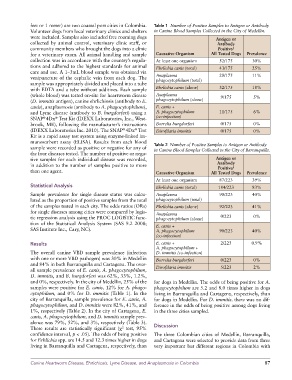
feet or 1 meter) are two coastal port cities in Colombia.   Table 1  Number of Positive Samples to Antigen or Antibody
              Volunteer dogs from local veterinary clinics and shelters   in Canine Blood Samples Collected in the City of Medellin.
              were included. Samples also included free roaming dogs                      Antigen or
              collected  by  animal  control,  veterinary  clinic  staff,  or              Antibody
              community members who brought the dogs into a clinic                         Positive/
              for a veterinary exam. All animal handling and sample   Causative Organism  All Tested Dogs  Prevalence
              collection was in accordance with the country’s regula-  At least one organism   52/175    30%
              tions and adhered to the highest standards for animal   Ehrlichia canis (total)   43/175   25%
              care and use. A 1–3mL blood sample was  obtained via
              venipuncture of the cephalic vein from each dog. The   Anaplasma              20/175       11%
                                                                 phagocytophilum (total)
              sample was appropriately divided and placed into a tube
              with EDTA and a tube without additives. Each sample   Ehrlichia canis (alone)   32/175     18%
              (whole blood) was tested on-site for heartworm disease   Anaplasma            9/175         5%
              (D. immitis antigen), canine ehrlichiosis (antibody to E.   phagocytophilum (alone)
              canis), anaplasmosis (antibody to A. phagocytophilum),   E. canis +
              and Lyme disease (antibody to B. burgdorferi) using a   A. phagocytophilum    11/175        6%
              SNAP 4Dx  Test Kit (IDEXX Laboratories, Inc., West-  (co-infection)
                        ®
                   ®
              brook, ME), following the manufacturer’s instructions   Borrelia burgdorferi   0/175        0%
              (IDEXX Laboratories Inc. 2010). The SNAP 4Dx  Test   Dirofilaria immitis      0/175         0%
                                                         ®
                                                    ®
              Kit is a rapid assay test system using enzyme-linked im-
              munosorbent  assay  (ELISA).  Results  from  each  blood   Table 2  Number of Positive Samples to Antigen or Antibody
              sample were recorded as positive or negative for any of   in Canine Blood Samples Collected in the City of Barranquilla.
              the four diseases tested. The number of positive or nega-
              tive samples for each individual disease was recorded,                      Antigen or
              in addition to the number of samples positive to more                        Antibody
                                                                                           Positive/
              than one agent.                                    Causative Organism     All Tested Dogs  Prevalence
                                                                 At least one organism      87/223       39%
              Statistical Analysis                               Ehrlichia canis (total)   184/223       83%
              Sample prevalence for single disease status was calcu-  Anaplasma             90/223       40%
              lated as the proportion of positive samples from the total   phagocytophilum (total)
              of the samples tested in each city. The odds ratios (ORs)   Ehrlichia canis (alone)  92/223   41%
              for single diseases among cities were compared by logis-  Anaplasma
              tic regression analysis using the PROC LOGISTIC func-  phagocytophilum (alone)  0/223       0%
              tion of the Statistical Analysis System (SAS 9.2 2008;   E. canis +
              SAS Institute Inc., Cary, NC).                     A. phagocytophilum         90/223       40%
                                                                 (co-infection)
              Results                                            E. canis +                 2/223        0.9%
                                                                 A. phagocytophilum +
              The overall canine VBD sample prevalence (infection   D. immitis (co-infection)
              with one or more VBD pathogen) was 30% in Medellin   Borrelia burgdorferi     0/223         0%
              and 84% in both Barranquilla and Cartagena. The over-  Dirofilaria immitis    5/223         2%
              all sample prevalence of E. canis, A. phagocytophilum,
              D. immitis, and B. burgdorferi was 62%, 33%, 1.2%,
              and 0%, respectively. In the city of Medellin, 25% of the   for dogs in Medellin. The odds of being positive for A.
              samples were positive for E. canis, 12% for A. phago-  phagocytophilum are 5.2 and 8.0 times higher in dogs
              cytophilum,  and 0%  for  D.  immitis  (Table 1).  In the   living in Barranquilla and Cartagena, respectively, than
              city of Barranquilla, sample prevalence for E. canis, A.   for dogs in Medellin. For D. immitis, there was no dif-
              phagocyto philum, and D. immitis were 82%, 41%, and   ference in the odds of being positive among dogs living
              1%, re spectively (Table 2). In the city of Cartagena, E.   in the three cities sampled.
              canis, A. phagocytophilum, and D. immitis sample prev-
              alence was 79%, 52%, and 3%, respectively (Table 3).
              These results are statistically significant (χ  test, 95%   Discussion
                                                   2
              con fidence interval, p < .05). The odds of being positive   The three Colombian cities of Medellin, Barranquilla,
              for Erhlichia spp. are 14.5 and 12.3 times higher in dogs   and Cartagena were selected to provide data from three
              living in Barranquilla and Cartagena, respectively, than   very important but different regions in Colombia with


              Canine Heartworm Disease, Ehrlichiosis, Lyme Disease, and Anaplasmosis in Colombia              87

