


Page 441 - 2021 IDMT Digital
P. 441
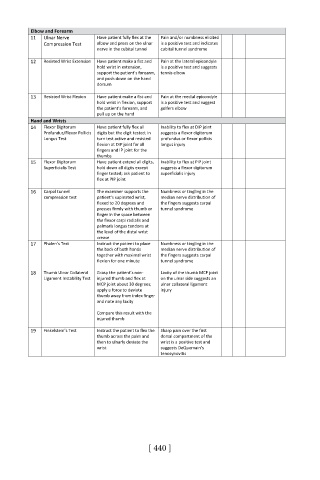
Elbow and Forearm
         11   Ulnar Nerve   Have patient fully flex at the   Pain and/or numbness elicited
             Compression Test   elbow and press on the ulnar   is a positive test and indicates
                           nerve in the cubital tunnel     cubital tunnel syndrome
         12   Resisted Wrist Extension   Have patient make a fist and   Pain at the lateral epicondyle
                           hold wrist in extension,   is a positive test and suggests
                           support the patient’s forearm,  tennis elbow
                           and push down on the hand
                           dorsum
         13   Resisted Wrist Flexion   Have patient make a fist and   Pain at the medial epicondyle
                           hold wrist in flexion, support   is a positive test and suggest
                           the patient’s forearm, and   golfers elbow
                           pull up on the hand
         Hand and Wrists
         14   Flexor Digitorum   Have patient fully flex all   Inability to flex at DIP joint
             Profundus/Flexor Pollicis  digits but the digit tested; in   suggests a flexor digitorum
             Longus Test   turn test active and resisted   profundus or flexor pollicis
                           flexion at DIP joint for all   longus injury
                           fingers and IP joint for the
                           thumbs
         15   Flexor Digitorum   Have patient extend all digits,   Inability to flex at PIP joint
             Superficialis Test   hold down all digits except   suggests a flexor digitorum
                           finger tested; ask patient to   superficialis injury
                           flex at PIP joint
         16   Carpal tunnel   The examiner supports the   Numbness or tingling in the
             compression test   patient’s supinated wrist,   median nerve distribution of
                           flexed to 20 degrees and   the fingers suggests carpal
                           presses firmly with thumb or   tunnel syndrome
                           finger in the space between
                           the flexor carpi radialis and
                           palmaris longus tendons at
                           the level of the distal wrist
                           crease
         17   Phalen’s Test   Instruct the patient to place   Numbness or tingling in the
                           the back of both hands   median nerve distribution of
                           together with maximal wrist   the fingers suggests carpal
                           flexion for one minute   tunnel syndrome
         18   Thumb Ulnar Collateral   Grasp the patient’s non-  Laxity of the thumb MCP joint
             Ligament Instability Test   injured thumb and flex at   on the ulnar side suggests an
                           MCP joint about 30 degrees;   ulnar collateral ligament
                           apply a force to deviate   injury
                           thumb away from index finger
                           and note any laxity
                           Compare this result with the
                           injured thumb
         19   Finkelstein’s Test   Instruct the patient to flex the   Sharp pain over the first
                           thumb across the palm and   dorsal compartment of the
                           then to ulnarly deviate the   wrist is a positive test and
                           wrist            suggests DeQuervain’s
                                            tenosynovitis


                                         [ 440 ]

