


Page 444 - 2021 IDMT Digital
P. 444
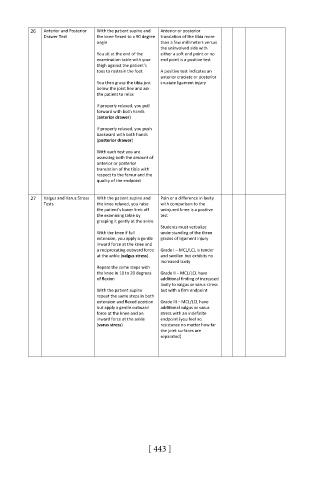
26   Anterior and Posterior   With the patient supine and   Anterior or posterior
             Drawer Test   the knee flexed to a 90 degree  translation of the tibia more
                           angle            than a few millimeters versus
                                            the uninvolved side with
                           You sit at the end of the   either a soft end point or no
                           examination table with your   end point is a positive test
                           thigh against the patient’s
                           toes to restrain the foot   A positive test indicates an
                                            anterior cruciate or posterior
                           You then grasp the tibia just   cruciate ligament injury
                           below the joint line and ask
                           the patient to relax
                           If properly relaxed, you pull
                           forward with both hands
                           (anterior drawer)
                           If properly relaxed, you push
                           backward with both hands
                           (posterior drawer)
                           With each test you are
                           assessing both the amount of
                           anterior or posterior
                           translation of the tibia with
                           respect to the femur and the
                           quality of the endpoint

         27   Valgus and Varus Stress   With the patient supine and   Pain or a difference in laxity
             Tests         the knee relaxed, you raise   with comparison to the
                           the patient’s lower limb off   uninjured knee is a positive
                           the examining table by   test
                           grasping it gently at the ankle
                                            Students must verbalize
                           With the knee if full   understanding of the three
                           extension, you apply a gentle   grades of ligament injury
                           inward force at the knee and
                           a reciprocating outward force   Grade I – MCL/LCL is tender
                           at the ankle (valgus stress)   and swollen but exhibits no
                                            increased laxity
                           Repeat the same steps with
                           the knee in 10 to 20 degrees   Grade II – MCL/LCL have
                           of flexion       additional finding of increased
                                            laxity to valgus or varus stress
                           With the patient supine    but with a firm endpoint
                           repeat the same steps in both
                           extension and flexed position   Grade III – MCL/LCL have
                           but apply a gentle outward   additional valgus or varus
                           force at the knee and an   stress with an indefinite
                           inward force at the ankle   endpoint (you feel no
                           (varus stress)   resistance no matter how far
                                            the joint surfaces are
                                            separated)


                                         [ 443 ]

