


Page 439 - 2021 IDMT Digital
P. 439
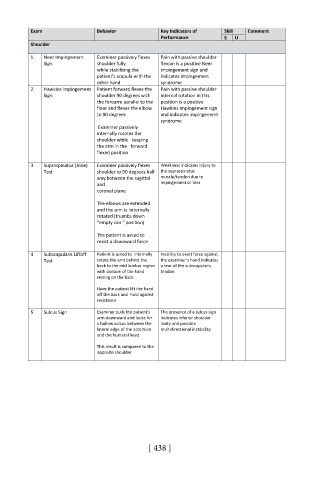
Exam              Behavior         Key Indicators of   Skill   Comment
                                            Performance       S   U
         Shoulder
         1.  Neer Impingement  Examiner passively flexes   Pain with passive shoulder
             Sign          shoulder fully   flexion is a positive Neer
                           while stabilizing the   impingement sign and
                           patient's scapula with the   indicates impingement
                           other hand       syndrome
         2.   Hawkins Impingement  Patient forward flexes the   Pain with passive shoulder
             Sign          shoulder 90 degrees with    internal rotation in this
                           the forearm parallel to the   position is a positive
                           floor and flexes the elbow   Hawkins impingement sign
                           to 90 degrees    and indicates impingement
                                            syndrome
                            Examiner passively
                           internally rotates the
                           shoulder while   keeping
                           the arm in the   forward
                           flexed position
         3   Supraspinatus (Jobe)   Examiner passively flexes   Weakness indicates injury to
             Test          shoulder to 90 degrees half   the supraspinatus
                           way between the sagittal   muscle/tendon due to
                           and              impingement or tear
                           coronal plane
                           The elbows are extended
                           and the arm is  internally
                           rotated (thumbs down
                           “empty can “ position)
                           The patient is asked to
                           resist a downward force
         4   Subscapularis Liftoff   Patient is asked to  internally   Inability to exert force against
             Test          rotate the arm behind the   the examiner’s hand indicates
                           back to the mid lumbar region  a tear of the subscapularis
                           with dorsum of the hand    tendon
                           resting on the back
                           Have the patient lift the hand
                           off the back and  hold against
                           resistance
         5   Sulcus Sign   Examiner pulls the patient’s   The presence of a sulcus sign
                           arm downward and looks for   indicates inferior shoulder
                           a hollow sulcus between the   laxity and possible
                           lateral edge of the acromion   multidirectional instability
                           and the humeral head
                           This result is compared to the
                           opposite shoulder


                                         [ 438 ]

