


Page 442 - 2021 IDMT Digital
P. 442
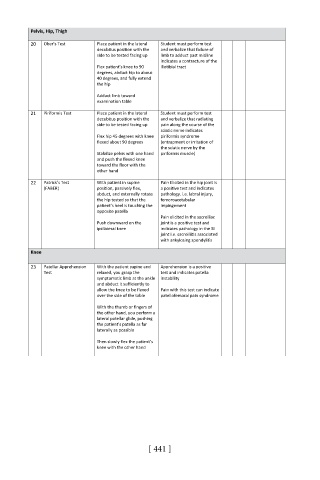
Pelvis, Hip, Thigh
         20   Ober’s Test   Place patient in the lateral   Student must perform test
                           decubitus position with the   and verbalize that failure of
                           side to be tested facing up   limb to adduct past midline
                                            indicates a contracture of the
                           Flex patient’s knee to 90   iliotibial tract
                           degrees, abduct hip to about
                           40 degrees, and fully extend
                           the hip
                           Adduct limb toward
                           examination table
         21   Piriformis Test   Place patient in the lateral   Student must perform test
                           decubitus position with the   and verbalize that radiating
                           side to be tested facing up   pain along the course of the
                                            sciatic nerve indicates
                           Flex hip 45 degrees with knee   piriformis syndrome
                           flexed about 90 degrees   (entrapment or irritation of
                                            the sciatic nerve by the
                           Stabilize pelvis with one hand   piriformis muscle)
                           and push the flexed knee
                           toward the floor with the
                           other hand
         22   Patrick’s Test   With patient in supine   Pain Elicited in the hip joint is
             (FABER)       position, passively flex,   a positive test and indicates
                           abduct, and externally rotate   pathology. i.e. labral injury,
                           the hip tested so that the   femoroacetabular
                           patient’s heel is touching the   impingement
                           opposite patella
                                            Pain elicited in the sacroiliac
                           Push downward on the   joint is a positive test and
                           ipsilateral knee   indicates pathology in the SI
                                            joint i.e. sacroiliitis associated
                                            with ankylosing spondylitis
         Knee
         23   Patellar Apprehension   With the patient supine and   Apprehension is a positive
             Test          relaxed, you grasp the   test and indicates patella
                           symptomatic limb at the ankle  instability
                           and abduct it sufficiently to
                           allow the knee to be flexed   Pain with this test can indicate
                           over the side of the table   patellofemoral pain syndrome
                           With the thumb or fingers of
                           the other hand, you perform a
                           lateral patellar glide, pushing
                           the patient’s patella as far
                           laterally as possible
                           Then slowly flex the patient’s
                           knee with the other hand


                                         [ 441 ]

