


Page 440 - 2021 IDMT Digital
P. 440
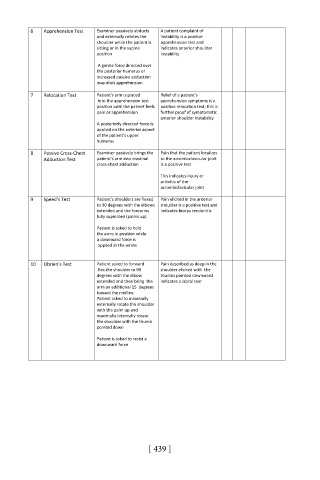
6   Apprehension Test   Examiner passively abducts   A patient complaint of
                           and externally rotates the   instability is a positive
                           shoulder while the patient is   apprehension test and
                           sitting or in the supine   indicates anterior shoulder
                           position         instability
                            A gentle force directed over
                           the posterior humerus or
                           increased passive abduction
                           may elicit apprehension
         7   Relocation Test   Patient’s arm is placed   Relief of a patient’s
                            into the apprehension test   apprehension symptoms is a
                           position until the patient feels   positive relocation test; this is
                           pain or apprehension   further proof of symptomatic
                                            anterior shoulder instability
                           A posteriorly directed force is
                           applied on the anterior aspect
                           of the patient’s upper
                           humerus
         8   Passive Cross-Chest   Examiner passively brings the   Pain that the patient localizes
             Adduction Test   patient’s arm into maximal   to the acromioclavicular joint
                           cross-chest adduction   is a positive test
                                            This indicates injury or
                                            arthritis of the
                                            acromioclavicular joint
         9   Speed’s Test   Patient’s shoulders are flexed   Pain elicited in the anterior
                           to 90 degrees with the elbows   shoulder is a positive test and
                           extended and the forearms   indicates biceps tendonitis
                           fully supinated (palms up)
                           Patient is asked to hold
                           the arms in position while
                           a downward force is
                            applied at the wrists

         10   Obrien’s Test   Patient asked to forward     Pain described as deep in the
                            flex the shoulder to 90   shoulder elicited with  the
                           degrees with the elbow       thumbs pointed downward
                           extended and then bring  the   indicates a labral tear
                           arm an additional 15  degrees
                           toward the midline
                           Patient asked to maximally
                           externally rotate the shoulder
                           with the palm up and
                           maximally internally rotate
                           the shoulder with the thumb
                           pointed down
                           Patient is asked to resist a
                           downward force


                                         [ 439 ]

