


Page 436 - 2021 IDMT Digital
P. 436
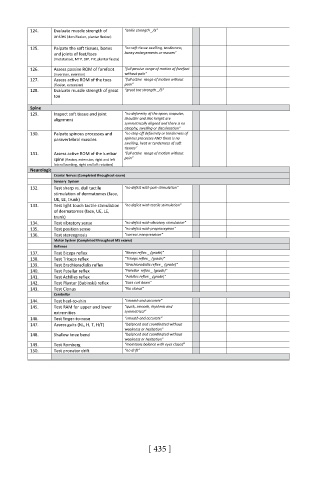
124.   Evaluate muscle strength of   “ankle strength _/5”
                ankles (dorsiflexion, plantar flexion)
         125.   Palpate the soft tissues, bones   “no soft tissue swelling, tenderness,
                and joints of feet/toes    boney enlargements or masses”
                (metatarsals, MTP, DIP, PIP, plantar fascia)
         126.   Assess passive ROM of forefoot   “full passive range of motion of forefoot
                (inversion, eversion)   without pain”
         127.   Assess active ROM of the toes   “full active  range of motion without
                (flexion, extension)   pain”
         128.   Evaluate muscle strength of great   “great toe strength _/5”
                toe
         Spine
         129.   Inspect soft tissue and joint   “no deformity of the spine; scapulae,
                alignment          shoulder and iliac height are
                                   symmetrically aligned and there is no
                                   atrophy, swelling or discoloration”
         130.   Palpate spinous processes and   “no step-off deformity or tenderness of
                paravertebral muscles   spinous processes AND there is no
                                   swelling, heat or tenderness of soft
                                   tissues”
         131.   Assess active ROM of the lumbar   “full active  range of motion without
                spine (flexion, extension, right and left   pain”
                lateral bending, right and left rotation)
         Neurologic
                Cranial Nerves (Completed throughout exam)
                Sensory  System
         132.   Test sharp vs. dull tactile   “no deficit with pain stimulation”
                stimulation of dermatomes (face,
                UE, LE, trunk)
         133.   Test light touch tactile stimulation   “no deficit with tactile stimulation”
                of dermatomes (face, UE, LE,
                trunk)
         134.   Test vibratory sense   “no deficit with vibratory stimulation”
         135.   Test position sense   “no deficit with proprioception”
         136.   Test stereognosis   “correct interpretation”
                Motor System (Completed throughout MS exams)
                Reflexes
         137.   Test Biceps reflex   “Biceps reflex _ (grade)”
         138.   Test Triceps reflex   “Triceps reflex _ (grade)”
         139.   Test Brachioradialis reflex   “Brachioradialis reflex _ (grade)”
         140.   Test Patellar reflex   “Patellar  reflex _ (grade)”
         141.   Test Achilles reflex   “Achilles reflex _ (grade)”
         142.   Test Plantar (Babinski) reflex   “toes curl down”
         143.   Test Clonus        “No clonus”
                Cerebellar
         144.   Test heel-to-shin   “smooth and accurate”
         145.   Test RAM for upper and lower   “quick, smooth, rhythmic and
                extremities        symmetrical”
         146.   Test finger-to-nose   “smooth and accurate”
         147.   Assess gaits (NL, H, T, H/T)   “balanced and coordinated without
                                   weakness or hesitation”
         148.   Shallow knee bend   “balanced and coordinated without
                                   weakness or hesitation”
         149.   Test Romberg       “maintains balance with eyes closed”
         150.   Test pronator drift   “no drift”


                                         [ 435 ]

