


Page 79 - JSOM Spring 2026
P. 79
That said, a study uncovered in our literature review by Lv
                                                                 et al. described the use of a portable ultrasound, the Philips
                                                                 CX50 (Philips Medical Systems,  Andover, MA).  Based on
                                                                                                       17
                                                                 their report, the Philips CX50 had a contrast software pack-
                                                                 age.  Philips no longer manufactures or sells this model,
                                                                    17
                                                                 which is among the reasons it was not included in our methods
                                                                 testing. Beyond this one model, however, our literature search
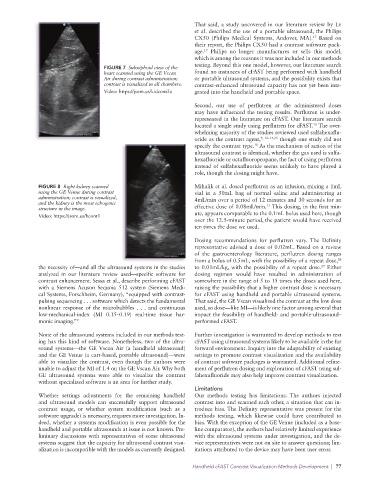
                                   FIGURE 7  Subxiphoid view of the
                                   heart scanned using the GE Vscan   found no instances of cFAST being performed with handheld
                                   Air during contrast administration;   or portable ultrasound systems, and the possibility exists that
                                   contrast is visualized in all chambers.   contrast-enhanced ultrasound capacity has not yet been inte-
                                   Video: https://jsom.us/kidcont2a  grated into the handheld and portable space.

                                                                 Second, our use of perflutren at the administered doses
                                                                 may have influenced the testing results. Perflutren is under-
                                                                 represented in the literature on cFAST. Our literature search
                                                                 located a single study using perflutren for cFAST.  The over-
                                                                                                       11
                                                                 whelming majority of the studies reviewed used sulfahexaflu-
                                                                 oride as the contrast agent, 9, 12–17,23  though one study did not
                                                                 specify the contrast type.  As the mechanism of action of the
                                                                                    10
                                                                 ultrasound contrast is identical, whether the gas used is sulfa-
                                                                 hexafluoride or octafluoropropane, the fact of using perflutren
                                                                 instead of sulfahexafluoride seems unlikely to have played a
                                                                 role, though the dosing might have.

              FIGURE 8  Right kidney scanned                     Mihalik et al. dosed perflutren as an infusion, mixing a 1mL
              using the GE Venue during contrast                 vial in a 50mL bag of normal saline and administering at
              administration; contrast is visualized,            4mL/min over a period of 12 minutes and 30 seconds for an
              and the kidney is the most echogenic                                      11
              structure in the image.                            effective dose of 0.08mL/min.  This dosing, in the first min-
              Video: https://jsom.us/hcont1                      ute, appears comparable to the 0.1mL bolus used here, though
                                                                 over the 12.5-minute period, the patient would have received
                                                                 ten times the dose we used.
                                                                 Dosing recommendations for perflutren vary.  The Definity
                                                                 representative advised a dose of 0.02mL. Based on a review
                                                                 of the gastroenterology literature, perflutren dosing ranges
                                                                 from a bolus of 0.5mL, with the possibility of a repeat dose,
                                                                                                               26
              the necessity of—and all the ultrasound systems in the studies   to 0.01mL/kg, with the possibility of a repeat dose.  Either
                                                                                                          27
              analyzed in our literature review used—specific software for   dosing regimen would have resulted in administration of
              contrast enhancement. Sessa et al., describe performing cFAST   somewhere in the range of 5 to 15 times the doses used here,
              with a Siemens  Acuson Sequoia 512 system (Siemens Medi-  raising the possibility that a higher contrast dose is necessary
              cal Systems, Forschheim, Germany), “equipped with contrast-   for cFAST using handheld and portable ultrasound systems.
              pulsing sequencing . . . software which detects the fundamental   That said, the GE Vscan visualized the contrast at the low dose
              nonlinear response of the microbubbles . . . and continuous   used, so dose—like MI—is likely one factor among several that
              low-mechanical-index (MI 0.15–0.19) real-time tissue har-  impact the feasibility of handheld- and portable- ultrasound–
              monic imaging.” 9                                  performed cFAST.

              None of the ultrasound systems included in our methods test-  Further investigation is warranted to develop methods to test
              ing has this kind of software. Nonetheless, two of the ultra-  cFAST using ultrasound systems likely to be available in the far
              sound systems—the GE  Vscan  Air (a handheld ultrasound)   forward environment. Inquiry into the adaptability of existing
              and the GE Venue (a cart-based, portable ultrasound)—were   settings to promote contrast visualization and the availability
              able to visualize the contrast, even though the authors were   of contrast software packages is warranted. Additional refine-
              unable to adjust the MI of 1.4 on the GE Vscan Air. Why both   ment of perflutren dosing and exploration of cFAST using sul-
              GE ultrasound systems were able to visualize the contrast   fahexafluoride may also help improve contrast visualization.
              without specialized software is an area for further study.
                                                                 Limitations
              Whether settings adjustments for the remaining handheld   Our methods testing has limitations.  The authors injected
              and ultrasound models can successfully support ultrasound   contrast into and scanned each other, a situation that can in-
              contrast usage, or whether system modification (such as a   troduce bias. The Definity representative was present for the
              software upgrade) is necessary, requires more investigation. In-  methods testing, which likewise could have contributed to
              deed, whether a systems modification is even possible for the   bias. With the exception of the GE Venue (included as a base-
              handheld and portable ultrasounds at issue is not known. Pre-  line comparator), the authors had relatively limited experience
              liminary discussions with representatives of some ultrasound   with the ultrasound systems under investigation, and the de-
              systems suggest that the capacity for ultrasound contrast visu-  vice representatives were not on site to answer questions; lim-
              alization is incompatible with the models as currently designed.  itations attributed to the device may have been user error.

                                                                Handheld cFAST Contrast Visualization Methods Development  |  77

