


Page 82 - JSOM Spring 2026
P. 82
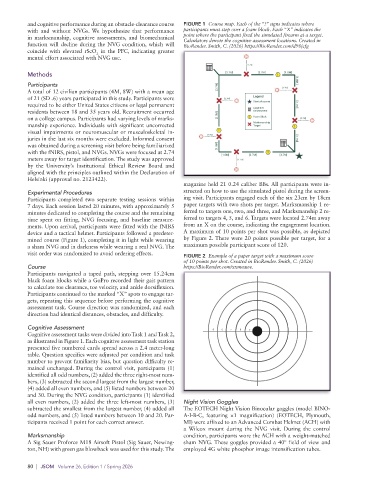
and cognitive performance during an obstacle-clearance course   FIGURE 1  Course map. Each of the “!” signs indicates where
          with and without NVGs. We hypothesize that performance   participants must step over a foam block. Each “X” indicates the
          in marksmanship, cognitive assessments, and biomechanical   point where the participant fired the simulated firearm at a target.
                                                             Calculators denote the cognitive assessment locations. Created in
          function will decline during the NVG condition, which will   BioRender. Smith, C. (2026) https://BioRender.com/d98jcfg
          coincide with elevated rScO  in the PFC, indicating greater
                                 2
          mental effort associated with NVG use.
                                                                                  [2.7M]
          Methods                                                          [3.7M]    [3.7M]   [1.8M]

          Participants                                                  [3.7M]                    [1.8M ]
          A total of 12 civilian participants (4M, 8W) with a mean age                       [2.7M]
          of 21 (SD .6) years participated in this study. Participants were   [2.7M]  Legend
          required to be either United States citizens or legal permanent           Start of course  [3.7M]
                                                                                    Cognitive
          residents between 18 and 35 years old. Recruitment occurred               Assessment
          on a college campus. Participants had varying levels of marks-  [3.7M]    Foam Block     [2.7M]
          manship experience. Individuals with significant uncorrected              Marksmanship
                                                                                    Target
          visual impairments or neuromuscular or musculoskeletal in-
                                                                     [2.7M]
          juries in the last six months were excluded. Informed consent                           [3.7M]
          was obtained during a screening visit before being familiarized   [1.8M]
          with the fNIRS, pistol, and NVGs. NVGs were focused at 2.74    [1.8M]   [3.7M]    [3.7M]
          meters away for target identification. The study was approved        [2.7 M]
          by the University’s Institutional Ethical Review Board and
          aligned with the principles outlined within the Declaration of
          Helsinki (approval no. 2123422).
                                                             magazine held 21 0.24 caliber BBs. All participants were in-
          Experimental Procedures                            structed on how to use the simulated pistol during the screen-
          Participants completed two separate testing sessions within    ing visit. Participants engaged each of the six 23cm by 18cm
          7 days. Each session lasted 20 minutes, with approximately 5   paper targets with two shots per target. Marksmanship 1 re-
          minutes dedicated to completing the course and the remaining   ferred to targets one, two, and three, and Marksmanship 2 re-
          time  spent  on  fitting,  NVG  focusing,  and  baseline  measure-  ferred to targets 4, 5, and 6. Targets were located 2.74m away
          ments. Upon arrival, participants were fitted with the fNIRS   from an X on the course, indicating the engagement location.
          device and a tactical helmet. Participants followed a predeter-  A maximum of 10 points per shot was possible, as depicted
          mined course (Figure 1), completing it in light while wearing   by Figure 2. There were 20 points possible per target, for a
          a sham NVG and in darkness while wearing a real NVG. The   maximum possible participant score of 120.
          visit order was randomized to avoid ordering effects.   FIGURE 2  Example of a paper target with a maximum score
                                                             of 10 points per shot. Created in BioRender. Smith, C. (2026)
          Course                                             https://BioRender.com/xxmeawe.
          Participants navigated a taped path, stepping over 15.24cm
          black foam blocks while a GoPro recorded their gait pattern
          to calculate toe clearance, toe velocity, and ankle dorsiflexion.
          Participants continued to the marked “X” spots to engage tar-
          gets, repeating this sequence before performing the cognitive
          assessment task. Course direction was randomized, and each
          direction had identical distances, obstacles, and difficulty.

          Cognitive Assessment                                        5  6  7  8  9
          Cognitive assessment tasks were divided into Task 1 and Task 2,
          as illustrated in Figure 1. Each cognitive assessment task station
          presented five numbered cards spread across a 2.4 meter-long
          table. Question specifics were adjusted per condition and task
          number to prevent familiarity bias, but question difficulty re-
          mained unchanged. During the control visit, participants (1)
          identified all odd numbers, (2) added the three right-most num-
          bers, (3) subtracted the second largest from the largest number,
          (4) added all even numbers, and (5) listed numbers between 20
          and 30. During the NVG condition, participants (1) identified
          all even numbers, (2) added the three left-most numbers, (3)   Night Vision Goggles
          subtracted the smallest from the largest number, (4) added all   The EOTECH Night Vision Binocular goggles (model BINO-
          odd numbers, and (5) listed numbers between 10 and 20. Par-  A-I-B-C, featuring ×1 magnification) (EOTECH, Plymouth,
          ticipants received 1 point for each correct answer.  MI) were affixed to an Advanced Combat Helmet (ACH) with
                                                             a  Wilcox mount during the NVG visit. During the control
          Marksmanship                                       condition, participants wore the ACH with a weight-matched
          A Sig Sauer Proforce M18 Airsoft Pistol (Sig Sauer, Newing-  sham NVG. These goggles provided a 40º field of view and
          ton, NH) with green gas blowback was used for this study. The   employed 4G white phosphor image intensification tubes.

          80  |  JSOM   Volume 26, Edition 1 / Spring 2026

