


Page 83 - JSOM Spring 2026
P. 83
fNIRS                                              ANOVA during the control condition (F=5.223; P=.014;
              Cerebral hemodynamic activity of the PFC was monitored   ηp =0.322), which indicated that baseline<task 1 (P=.016);
                                                                   2
              throughout each visit using two continuous-wave fNIRS   however, there was no significant difference between base-
              probes (PortaLite MkII, Artinis Medical Systems, Netherlands).   line and task 2 (P=.051) or task 1 and task 2 (P=.699). For
              A two-minute baseline measure was collected prior to the start   NVG during the cognitive assessment, there was no signifi-
              with participants at rest. Sensors were placed 2cm above each   cant one-way repeated measures ANOVA (F=1.190; P=.309;
              eyebrow (Figure 3) and secured with double-sided tape. Dis-  ηp =0.098). There were significant pairwise comparisons be-
                                                                   2
              posable black elastic wrap (3M Corporation, St. Paul, MN)   tween Conditions, which indicated control>NVG rScO  during
                                                                                                           2
              was placed around the PortaLite sensors to secure the fNIRS   task 1 (P=.014) and task 2 (P=.011). There was no significant
              sensor and reduce external light contamination. Relative he-  difference at baseline (P=.711) between the control and NVG
              modynamic and cerebral metabolic rScO  responses were mea-  conditions for rScO .
                                                                                2
                                             2
              sured using three LED light-emitting diodes and two detectors
              per sensor, sampling at 25Hz. Each sensor recorded three long   Cognitive Assessment Score
              channels (inter-optode distances of 2.90, 3.50, and 4.10cm)   For cognitive assessment scores, there was no significant condi-
              and three short channels (inter-optode distances of 0.70, 0.80,   tion × task number (F=0.184; P=.676, ηp =0.016). There was
                                                                                                 2
              and 0.74cm). A 0.14Hz low-pass filter removed physiological   no main effect for condition (F=0.006; P=.941, ηp =0.001) or
                                                                                                        2
              artifacts prior to averaging the relative concentration across   task number (F=0.061; P=.810, ηp =0.006).
                                                                                            2
              each  task.  Data  was  visualized  using  Oxysoft  software  (ver-
              sion 3.4, Artinis Medical Systems, Netherlands). Custom-built
              LabVIEW programs were used to analyze the fNIRS-derived   Marksmanship
              hemodynamic responses (LabVIEW 2022, NI, Austin, TX).   Cerebral Regional Oxygen Saturation
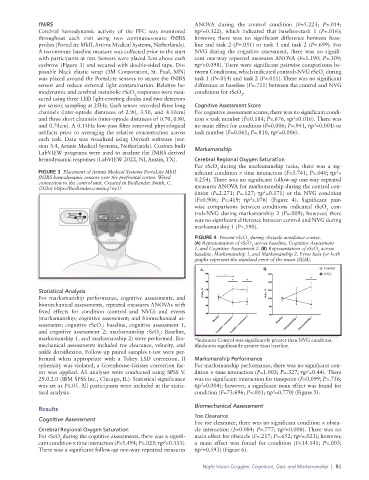
                                                                 For rScO during the marksmanship tasks, there was a sig-
                                                                        2
              FIGURE 3  Placement of Artinis Medical Systems PortaLite MkII   nificant condition × time interaction (F=3.741; P=.040; ηp =
                                                                                                               2
              fNIRS hemodynamic sensors over the prefrontal cortex. Wired   0.254). There was no significant follow-up one-way repeated
              connection to the control unit. Created in BioRender. Smith, C.   measures ANOVA for marksmanship during the control con-
              (2026) https://BioRender.com/wq7vy35
                                                                 dition (F=2.271; P=.127; ηp =0.171) or the NVG condition
                                                                                       2
                                                                 (F=0.906; P=.419;  ηp =.076) (Figure 4). Significant pair-
                                                                                   2
                                                                 wise comparisons between conditions indicated rScO  con-
                                                                                                            2
                                                                 trol>NVG during marksmanship 2 (P=.009); however, there
                                                                 was no significant difference between control and NVG during
                                                                 marksmanship 1 (P=.190).
                                                                 FIGURE 4  Percent rScO  during obstacle avoidance course.
                                                                                  2
                                                                 (A) Representation of rScO  across baseline, Cognitive Assessment
                                                                                   2
                                                                 1, and Cognitive Assessment 2. (B) Representation of rScO  across
                                                                                                         2
                                                                 baseline, Marksmanship 1, and Marksmanship 2. Error bars for both
                                                                 graphs represent the standard error of the mean (SEM).
              Statistical Analysis
              For marksmanship performance, cognitive assessments, and
              biomechanical assessments, repeated measures ANOVAs with
              fixed effects for condition (control and NVG) and events
              (marksmanship; cognitive assessment; and biomechanical as-
              sessments; cognitive rScO : baseline, cognitive assessment 1,
                                  2
              and cognitive assessment 2; marksmanship rScO : Baseline,
                                                     2
              marksmanship 1, and marksmanship 2) were performed. Bio-  *Indicates Control was significantly greater than NVG condition.
              mechanical assessments included toe clearance, velocity, and   #Indicates significantly greater than baseline.
              ankle dorsiflexion. Follow-up paired samples t-test were per-
              formed when appropriate with a  Tukey LSD correction. If   Marksmanship Performance
              sphericity was violated, a Greenhouse-Geisser correction fac-  For marksmanship performance, there was no significant con-
              tor  was  applied. All  analyses  were  conducted  using  SPSS V.   dition × time interaction (F=1.003; P=.327; ηp =0.44). There
                                                                                                     2
              29.0.2.0 (IBM SPSS Inc., Chicago, IL). Statistical significance   was no significant interaction for timepoint (F=0.099; P=.756;
              was set at P≤.05. All participants were included in the statis-  ηp =0.004); however, a significant main effect was found for
                                                                   2
              tical analysis.                                    condition (F=73.696; P<.001; ηp =0.770) (Figure 5).
                                                                                          2
                                                                 Biomechanical Assessment
              Results
                                                                 Toe Clearance
              Cognitive Assessment
                                                                 For toe clearance, there was no significant condition × obsta-
                                                                                              2
              Cerebral Regional Oxygen Saturation                cle interaction (F=0.084; P=.777; ηp =0.008). There was no
              For rScO during the cognitive assessments, there was a signifi-  main effect for obstacle (F=.217; P=.652; ηp =.021); however,
                                                                                                   2
                     2
              cant condition × time interaction (F=5.494; P=.025; ηp =0.333).   a main effect was found for condition (F=14.541; P=.003;
                                                       2
              There was a significant follow-up one-way repeated measures   ηp =0.593) (Figure 6).
                                                                   2
                                                                   Night Vision Goggles: Cognition, Gait, and Marksmanship  |  81

