


Page 77 - JSOM Spring 2026
P. 77
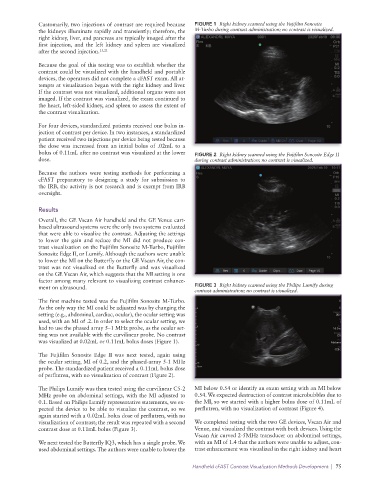
Customarily, two injections of contrast are required because   FIGURE 1  Right kidney scanned using the Fujifilm Sonosite
              the kidneys illuminate rapidly and transiently; therefore, the   M-Turbo during contrast administration; no contrast is visualized.
              right kidney, liver, and pancreas are typically imaged after the
              first injection, and the left kidney and spleen are visualized
              after the second injection. 15,21
              Because the goal of this testing was to establish whether the
              contrast could be visualized with the handheld and portable
              devices, the operators did not complete a cFAST exam. All at-
              tempts at visualization began with the right kidney and liver.
              If the contrast was not visualized, additional organs were not
              imaged. If the contrast was visualized, the exam continued to
              the heart, left-sided kidney, and spleen to assess the extent of
              the contrast visualization.

              For four devices, standardized patients received one bolus in-
              jection of contrast per device. In two instances, a standardized
              patient received two injections per device being tested because
              the dose was increased from an initial bolus of .02mL to a
              bolus of 0.11mL after no contrast was visualized at the lower   FIGURE 2  Right kidney scanned using the Fujifilm Sonosite Edge II
              dose.                                              during contrast administration; no contrast is visualized.
              Because the authors were testing methods for performing a
              cFAST  preparatory  to  designing  a  study  for  submission  to
              the IRB, the activity is not research and is exempt from IRB
              oversight.

              Results
              Overall, the GE Vscan Air handheld and the GE Venue cart-
              based ultrasound systems were the only two systems evaluated
              that were able to visualize the contrast. Adjusting the settings
              to lower the gain and reduce the MI did not produce con-
              trast visualization on the Fujifilm Sonosite M-Turbo, Fujifilm
              Sonosite Edge II, or Lumify. Although the authors were unable
              to lower the MI on the Butterfly or the GE Vscan Air, the con-
              trast was not visualized on the Butterfly and was visualized
              on the GE Vscan Air, which suggests that the MI setting is one
              factor among many relevant to visualizing contrast enhance-
              ment on ultrasound.                                FIGURE 3  Right kidney scanned using the Philips Lumify during
                                                                 contrast administration; no contrast is visualized.
              The first machine tested was the Fujifilm Sonosite M-Turbo.
              As the only way the MI could be adjusted was by changing the
              setting (e.g., abdominal, cardiac, ocular), the ocular setting was
              used, with an MI of .2. In order to select the ocular setting, we
              had to use the phased array 5–1 MHz probe, as the ocular set-
              ting was not available with the curvilinear probe. No contrast
              was visualized at 0.02mL or 0.11mL bolus doses (Figure 1).

              The Fujifilm Sonosite Edge II was next tested, again using
              the ocular setting, MI of 0.2, and the phased-array 5-1 MHz
              probe. The standardized patient received a 0.11mL bolus dose
              of perflutren, with no visualization of contrast (Figure 2).
              The Philips Lumify was then tested using the curvilinear C5-2   MI below 0.54 or identify an exam setting with an MI below
              MHz probe on abdominal settings, with the MI adjusted to   0.54. We expected destruction of contrast microbubbles due to
              0.1. Based on Philips Lumify representative statements, we ex-  the MI, so we started with a higher bolus dose of 0.11mL of
              pected the device to be able to visualize the contrast, so we   perflutren, with no visualization of contrast (Figure 4).
              again started with a 0.02mL bolus dose of perflutren, with no
              visualization of contrast; the result was repeated with a second   We completed testing with the two GE devices, Vscan Air and
              contrast dose at 0.11mL bolus (Figure 3).          Venue, and visualized the contrast with both devices. Using the
                                                                 Vscan Air curved 2-5MHz transducer on abdominal settings,
              We next tested the Butterfly IQ3, which has a single probe. We   with an MI of 1.4 that the authors were unable to adjust, con-
              used abdominal settings. The authors were unable to lower the   trast enhancement was visualized in the right kidney and heart

                                                                Handheld cFAST Contrast Visualization Methods Development  |  75

