


Page 73 - JSOM Spring 2026
P. 73
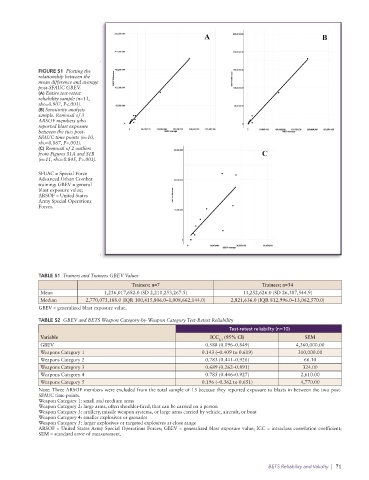
FIGURE S1  Plotting the
              relationship between the
              mean difference and average
              post-SFAUC GBEV.
              (A) Entire test-retest
              reliability sample (n=13,
              rho=0.907, P<.001).
              (B) Sensitivity analysis
              sample. Removal of 3
              ARSOF members who
              reported blast exposure
              between the two post-
              SFAUC time points (n=10,
              rho=0.867, P=.001).
              (C) Removal of 2 outliers
              from Figures S1A and S1B
              (n=11, rho=0.845, P=.001).

              SFUAC = Special Force
              Advanced Urban Combat
              training; GBEV = general
              blast exposure value;
              ARSOF = United States
              Army Special Operations
              Forces.


              TABLE S1  Trainers and Trainees GBEV Values
                                            Trainers; n=7                              Trainees; n=34
              Mean                 1,236,017,682.0 (SD 2,210,253,267.5)         13,252,626.0 (SD 26,387,544.9)
              Median         2,770,073,188.0 (IQR 100,415,806.0–1,008,662,144.0)  2,821,636.0 (IQR 812,996.0–13,062,570.0)
              GBEV = generalized blast exposure value.

              TABLE S2  GBEV and BETS Weapon Category-by-Weapon Category Test-Retest Reliability
                                                                            Test-retest reliability (n=10)
              Variable                                                ICC  (95% CI)                  SEM
                                                                         3,1
              GBEV                                                  0.588 (0.096–0.849)           4,360,000.00
              Weapons Category 1                                   0.143 (–0.409 to 0.619)        310,000.00
              Weapons Category 2                                    0.783 (0.441–0.926)             66.10
              Weapons Category 3                                    0.689 (0.262–0.891)             324.00
              Weapons Category 4                                    0.785 (0.446–0.927)            2,610.00
              Weapons Category 5                                   0.196 (–0.362 to 0.651)         4,770.00
              Note: Three ARSOF members were excluded from the total sample of 13 because they reported exposure to blasts in between the two post-
              SFAUC time points.
              Weapon Category 1: small and medium arms
              Weapon Category 2: large arms, often shoulder-fired, that can be carried on a person
              Weapon Category 3: artillery, missile weapon systems, or large arms carried by vehicle, aircraft, or boat
              Weapon Category 4: smaller explosives or grenades
              Weapon Category 5: larger explosives or targeted explosives at close range
              ARSOF = United States Army Special Operations Forces; GBEV = generalized blast exposure value; ICC = intraclass correlation coefficient;
              SEM = standard error of measurement.


                                                                                         BETS Reliability and Validity  |  71

