


Page 70 - JSOM Spring 2026
P. 70
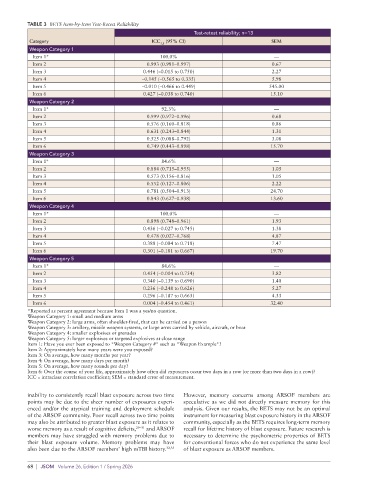
TABLE 3  BETS Item-by-Item Test-Retest Reliability
                                                                Test-retest reliability; n=13
           Category                                ICC  (95% CI)                          SEM
                                                     3,1
           Weapon Category 1
            Item 1*                                  100.0%                                —
            Item 2                               0.993 (0.981–0.997)                      0.67
            Item 3                              0.446 (–0.015 to 0.750)                   2.27
            Item 4                             –0.145 (–0.565 to 0.335)                   5.98
            Item 5                             –0.010 (–0.466 to 0.449)                  545.00
            Item 6                              0.427 (–0.038 to 0.740)                  15.10
           Weapon Category 2
            Item 1*                                   92.3%                                —
            Item 2                               0.999 (0.972–0.996)                      0.68
            Item 3                               0.576 (0.160–0.818)                      0.86
            Item 4                               0.631 (0.243–0.844)                      1.31
            Item 5                               0.525 (0.088–0.792)                      3.08
            Item 6                               0.749 (0.443–0.898)                     15.70
           Weapon Category 3
            Item 1*                                   84.6%                                —
            Item 2                               0.884 (0.715–0.955)                      1.05
            Item 3                               0.573 (0.156–0.816)                      1.05
            Item 4                               0.552 (0.127–0.806)                      2.22
            Item 5                               0.781 (0.504–0.913)                     24.70
            Item 6                               0.843 (0.627–0.938)                     13.60
           Weapon Category 4
            Item 1*                                  100.0%                                —
            Item 2                               0.898 (0.748–0.961)                      1.93
            Item 3                              0.436 (–0.027 to 0.745)                   1.38
            Item 4                               0.478 (0.027–0.768)                      4.87
            Item 5                              0.388 (–0.084 to 0.718)                   7.47
            Item 6                              0.301 (–0.181 to 0.667)                  19.70
           Weapon Category 5
            Item 1*                                   84.6%                                —
            Item 2                              0.454 (–0.004 to 0.754)                   3.82
            Item 3                              0.340 (–0.139 to 0.690)                   1.40
            Item 4                              0.236 (–0.248 to 0.626)                   5.27
            Item 5                              0.296 (–0.187 to 0.663)                   4.33
            Item 6                              0.004 (–0.454 to 0.461)                  32.40
          *Reported as percent agreement because Item 1 was a yes/no question.
          Weapon Category 1: small and medium arms
          Weapon Category 2: large arms, often shoulder-fired, that can be carried on a person
          Weapon Category 3: artillery, missile weapon systems, or large arms carried by vehicle, aircraft, or boat
          Weapon Category 4: smaller explosives or grenades
          Weapon Category 5: larger explosives or targeted explosives at close range
          Item 1: Have you ever been exposed to *Weapon Category #* such as *Weapon Example*?
          Item 2: Approximately how many years were you exposed?
          Item 3: On average, how many months per year?
          Item 4: On average, how many days per month?
          Item 5: On average, how many rounds per day?
          Item 6: Over the course of your life, approximately how often did exposures occur two days in a row (or more than two days in a row)?
          ICC = intraclass correlation coefficient; SEM = standard error of measurement.


          inability to consistently recall blast exposure across two time   However, memory concerns among  ARSOF members are
          points may be due to the sheer number of exposures experi-  speculative as we did not directly measure memory for this
          enced and/or the atypical training and deployment schedule   analysis. Given our results, the BETS may not be an optimal
          of the  ARSOF community. Poor recall across two time points   instrument for measuring blast exposure history in the ARSOF
          may also be attributed to greater blast exposure as it relates to   community, especially as the BETS requires long-term memory
          worse memory as a result of cognitive deficits, 29–31  and  ARSOF   recall for lifetime history of blast exposure. Future research is
          members may have struggled with memory problems due to   necessary to determine the psychometric properties of BETS
          their blast exposure volume. Memory problems may have   for conventional forces who do not experience the same level
          also been due to the ARSOF members’ high mTBI history. 32,33    of blast exposure as ARSOF members.

          68  |  JSOM   Volume 26, Edition 1 / Spring 2026

