


Page 68 - JSOM Spring 2026
P. 68
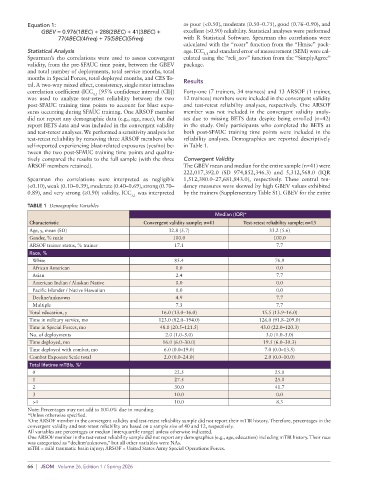
Equation 1:                                        as poor (<0.50), moderate (0.50–0.75), good (0.76–0.90), and
              GBEV = 0.976(1BEC) + 288(2BEC) + 41(3BEC) +    excellent (>0.90) reliability. Statistical analyses were performed
                    77(4BEC)(4freq) + 75(5BEC)(5freq)        with R  Statistical Software. Spearman  rho correlations were
                                                             calculated with the “rcorr” function from the “Hmisc” pack-
          Statistical Analysis                               age. ICC  and standard error of measurement (SEM) were cal-
                                                                    3,1
          Spearman’s rho correlations were used to assess convergent   culated using the “reli_aov” function from the “SimplyAgree”
          validity, from the pre-SFAUC time point, between the GBEV   package.
          and total number of deployments, total service months, total
          months in Special Forces, total deployed months, and CES To-  Results
          tal. A two-way mixed effect, consistency, single rater intraclass
          correlation coefficient (ICC  [95% confidence interval (CI)])   Forty-one (7 trainers, 34 trainees) and 13 ARSOF (1 trainer,
                               3,1
          was used to analyze test-retest reliability between the two   12 trainees) members were included in the convergent validity
          post-SFAUC training time points to account for blast expo-  and test-retest reliability analyses, respectively. One ARSOF
          sures occurring during SFAUC training. One ARSOF member   member was not included in the convergent validity analy-
          did not report any demographic data (e.g., age, race), but did   ses due to missing BETS data despite being enrolled (n=42)
          report BETS data and was included in the convergent validity   in the study. Only participants who completed the BETS at
          and test-retest analyses. We performed a sensitivity analysis for   both post-SFAUC training time points were included in the
          test-retest reliability by removing three ARSOF members who   reliability analyses. Demographics are reported descriptively
          self-reported experiencing blast-related exposures (yes/no) be-  in Table 1.
          tween the two post-SFAUC training time points and qualita-
          tively compared the results to the full sample (with the three   Convergent Validity
          ARSOF members retained).                           The GBEV mean and median for the entire sample (n=41) were
                                                             222,017,392.0 (SD 974,852,346.3) and 5,312,568.0 (IQR
          Spearman  rho  correlations  were  interpreted  as  negligible   1,512,380.0–27,681,843.0), respectively.  These central ten-
          (<0.10), weak (0.10–0.39), moderate (0.40–0.69), strong (0.70–  dency measures were skewed by high GBEV values exhibited
          0.89), and very strong (≥0.90) validity. ICC  was interpreted   by the trainers (Supplementary Table S1). GBEV for the entire
                                            3,1
          TABLE 1  Demographic Variables
                                                                       Median (IQR)*
           Characteristic                       Convergent validity sample; n=41  Test-retest reliability sample; n=13
           Age, y, mean (SD)                            32.8 (5.7)                       33.2 (5.6)
           Gender, % male                                 100.0                           100.0
           ARSOF trainer status, % trainer                17.1                             7.7
           Race, %
            White                                         85.4                             76.9
            African American                              0.0                              0.0
            Asian                                         2.4                              7.7
            American Indian / Alaskan Native              0.0                              0.0
            Pacific Islander / Native Hawaiian            0.0                              0.0
            Decline/unknown                               4.9                              7.7
            Multiple                                      7.3                              7.7
           Total education, y                         16.0 (13.0–16.0)                 15.5 (13.9–16.0)
           Time in military service, mo              123.0 (82.0–194.0)               126.0 (91.8–209.0)
           Time in Special Forces, mo                48.0 (20.5–121.5)                43.0 (22.0–120.3)
           No. of deployments                          2.0 (1.0–5.0)                    3.0 (1.0–5.0)
           Time deployed, mo                          16.0 (6.0–30.0)                  19.5 (6.0–30.3)
           Time deployed with combat, mo               6.0 (0.0–19.0)                  7.0 (0.0–13.5)
           Combat Exposure Scale total                 2.0 (0.0–24.0)                  2.0 (0.0–10.0)
           Total lifetime mTBIs, % †
            0                                             22.5                             25.0
            1                                             27.5                             25.0
            2                                             30.0                             41.7
            3                                             10.0                             0.0
            >4                                            10.0                             8.3
          Note: Percentages may not add to 100.0% due to rounding.
          *Unless otherwise specified.
          † One ARSOF member in the convergent validity and test-retest reliability sample did not report their mTBI history. Therefore, percentages in the
          convergent validity and test-retest reliability are based on a sample size of 40 and 12, respectively.
          All variables are percentages or median [interquartile range] unless otherwise indicated.
          One ARSOF member in the test-retest reliability sample did not report any demographics (e.g., age, education) including mTBI history. Their race
          was categorized as “decline/unknown,” but all other variables were NAs.
          mTBI = mild traumatic brain injury; ARSOF = United States Army Special Operations Forces.

          66  |  JSOM   Volume 26, Edition 1 / Spring 2026

