


Page 64 - JSOM Spring 2026
P. 64
of novice users. With AI assistance, military medics with lim-  4.  Monti JD, Perreault MD. Impact of a 4-hour introductory eFAST
          ited ultrasound training achieved substantial improvements in   training intervention among ultrasound-naïve U.S. military med-
          sensitivity, specificity, accuracy, and AUROC when identifying   ics.  Mil Med. 2020;185(5–6):e601–e608. doi:10.1093/milmed/
                                                                usaa014
          absent lung sliding. In addition to improving diagnostic accu-  5.  Arntfield R, Wu D, Tschirhart J, et al. Automation of lung ultra-
          racy, AI support increased user confidence, resulting in a greater   sound interpretation via deep learning for the classification of
          proportion of high-certainty assessments and a reduction in   normal versus abnormal lung parenchyma: a multicenter study.
          uncertain assessments. These findings suggest that AI-enabled   Diagnostics  (Basel). 2021;11(11):2049. doi:10.3390/diagnostics
          decision support may help bridge experience gaps in prehos-  11112049
          pital care and serve as a valuable asset for frontline providers   6.  Fiedler HC, Prager R, Smith D, et al. Automated real-time detec-
          working in resource-limited or austere environments.  tion of lung sliding using artificial intelligence: a prospective diag-
                                                                nostic accuracy study. Chest. 2024;166(2):362–370. doi:10.1016/
                                                                j.chest.2024.02.011
          Author Contributions                                7.  Wu D, Smith D, VanBerlo B, et al. Improving the generalizabil-
          All authors conceived the study and designed the method-  ity and performance of an ultrasound deep learning model using
          ology. RA obtained funding and Institutional Review Board   limited multicenter data for lung sliding artifact identification.
          approval. All authors coordinated data collection and carried   Diagnostics (Basel). 2024;14(11):1081. doi:10.3390/diagnostics
          out the experiment sessions. NO and DS performed the data   14111081
          analysis. All authors drafted the manuscript and provided crit-  8.  Tenajas R, Miraut D, Illana CI, Alonso-Gonzalez R, Arias-Valcayo
                                                                F,  Herraiz JL. Recent advances in artificial intelligence-assisted
          ical revisions. RA provided oversight throughout the project.   ultrasound scanning.  Appl Sci. 2023;13(6):3693. doi:10.3390/
          All authors reviewed and approved the final manuscript. The   app13063693
          authors would like to thank Richard Neading for his support   9.  Mongodi S,  Arioli R, Quaini  A, Grugnetti G, Grugnetti  AM,
          on this project.                                        Mojoli F. Lung ultrasound training: how short is too short? Obser-
                                                                vational study on the effects of a focused theoretical training for
                                                                novice learners. BMC Med Educ. 2024;24(1):166. doi:10.1186/
          Disclaimer                                            s12909-024-05148-0
          This study was conducted under institutional ethics approval   10.  Kim S, Fischetti C, Guy M, Hsu E, Fox J, Young SD. Artificial in-
          (Advara Research Ethics Board). The authors adhered to stan-  telligence (AI) applications for point of care ultrasound (POCUS)
          dard military Public Affairs and Operational Security guide-  in low-resource settings: a scoping review.  Diagnostics (Basel).
          lines; no sensitive unit information or tactics are disclosed. The   2024;14(15):1669. doi:10.3390/diagnostics14151669
          views expressed in this article are those of the authors and do
          not reflect the official policy or position of the U.S. Marine   PMID: 41774835;
          Corps, the U.S. Department of Defense, the Canadian Depart-  DOI: 10.55460/J.Spec.Oper.Med.2026.1SDN-NWTW
          ment of National Defence, or any other agency.
          Disclosures
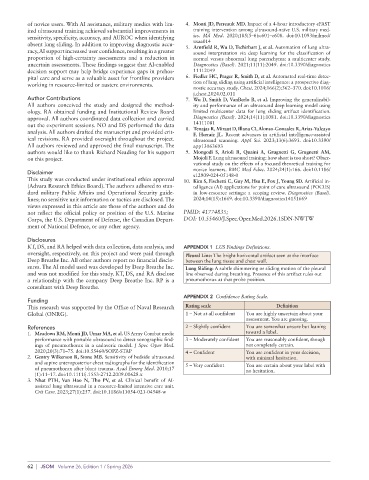
          KT, DS, and RA helped with data collection, data analysis, and   APPENDIX 1  LUS Findings Definitions.
          oversight, respectively, on this project and were paid through   Pleural Line: The bright horizontal artifact seen at the interface
          Deep Breathe Inc. All other authors report no financial disclo-  between the lung tissue and chest wall.
          sures. The AI model used was developed by Deep Breathe Inc.   Lung Sliding: A subtle shimmering or sliding motion of the pleural
          and was not modified for this study. KT, DS, and RA disclose   line observed during breathing. Presence of this artifact rules out
          a  relationship  with  the  company  Deep  Breathe  Inc.  RP  is  a   pneumothorax at that probe position.
          consultant with Deep Breathe.
                                                             APPENDIX 2  Confidence Rating Scale.
          Funding
          This research was supported by the Office of Naval Research   Rating scale       Definition
          Global (ONRG).                                      1 – Not at all confident  You are highly uncertain about your
                                                                                 assessment. You are guessing.
          References                                          2 – Slightly confident  You are somewhat unsure but leaning
          1.  Meadows RM, Monti JD, Umar MA, et al. US Army Combat medic         toward a label.
            performance with portable ultrasound to detect sonographic find-  3 – Moderately confident  You are reasonably confident, though
            ings of pneumothorax in a cadaveric  model.  J Spec Oper Med.        not completely certain.
            2020;20(3):71–75. doi:10.55460/SOPZ-STAP          4 – Confident      You are confident in your decision,
          2.  Gentry Wilkerson R, Stone MB. Sensitivity of bedside ultrasound    with minimal hesitation.
            and supine anteroposterior chest radiographs for the identification   5 – Very confident  You are certain about your label with
            of pneumothorax after blunt trauma. Acad Emerg Med. 2010;17          no hesitation.
            (1):11–17. doi:10.1111/j.1553-2712.2009.00628.x
          3.  Nhat PTH,  Van Hao  N,  Tho  PV, et al.  Clinical benefit  of  AI-
            assisted lung ultrasound in a resource-limited intensive care unit.
            Crit Care. 2023;27(1):257. doi:10.1186/s13054-023-04548-w


          62  |  JSOM   Volume 26, Edition 1 / Spring 2026

