


Page 86 - JSOM Fall 2025
P. 86
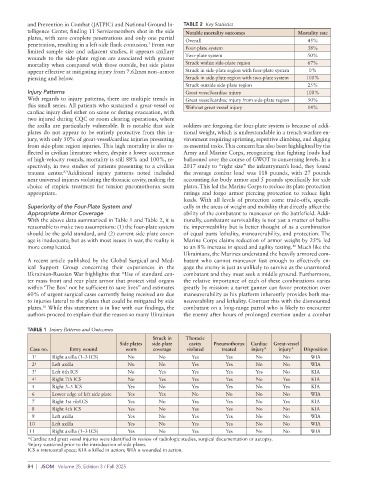
respirations of 14 breaths per minute, and blood pressure of   Case 9
              80mmHg over palpation. The medic applied occlusive dress-  The patient was wounded during insertion of a ground assault
              ing, gained intravenous (IV) access, and provided 500cc of   force by small arms fire to the left axilla while manning a ramp-
              HEXTEND and 500cc of normal saline, antibiotics, and an-  mounted, crew-served weapon on a helicopter. He was immedi-
              algesia. The patient was evacuated without incident 50 min-  ately attended to by an onboard medic who found the patient
              utes later to the forward surgical team. Follow-up care was   alert without immediate signs of shock. The medic immediately
              significant for bowel and mesenteric injuries. The patient was   applied an occlusive dressing and achieved IV access while en
              successfully evacuated from the theater. Front, rear, and side   route. No further interventions were recorded en route, and he
              plates had been worn at the time of injury. Final Disposition:   was received by the forward surgical team, which placed a left
              Wounded in Action                                  tube thoracostomy without future recorded interventions. The
                                                                 patient returned to full duty three weeks later. Front, rear, and
              Case 7                                             side plates had been worn at the time of injury. Final Disposi-
              The patient was conducting a dismounted patrol when he was   tion: Wounded in Action.
              shot through the right first rib. The first responder immediately
              applied occlusive dressing. The patient lost consciousness upon   Case 10
              evaluation by medic, and needle decompression was completed   The patient was wounded during a dismounted patrol when
              at 2nd intercostal space. Pulses were lost and patient received   he was struck in the left axilla by small arms fire resulting in a
              30 minutes of CPR on scene with a King LTS-D  Disposable   single penetrating wound. He was tended to on scene by medics
                                                    ™
              Laryngeal  Tube (Ambu, Columbia, MD) placed for airway   for 1 hour, with an occlusive dressing being the only recorded
              management. The patient was declared DOA at forward sur-  intervention. He was then evacuated to the forward surgical
              gical team. Autopsy was notable for laceration of right upper   team, which placed a left tube thoracostomy for suspected he-
              lobe of the lung, aortic laceration, left upper lobe lung lacera-  mopneumothorax. Chest tube output was not recorded. Final
              tion, and tracheal transection, as well as the thoracic needle not   recorded interventions included operating room thoracotomy
              entering the chest cavity. Front, rear, and side plates had been   with left lower lobectomy and repaired flail chest. Front, rear,
              worn at the time of injury. Final Disposition: Killed in Action.  and side plates had been worn at the time of injury. Final Dis-
                                                                 position: Wounded in Action.
              Case 8
              The patient was conducting dismounted raid operations when   Case 11
              he was shot in the right 4th ICS and wounded by an enemy   The patient sustained a penetrating wound to the right upper
              grenade while in the open. Immediate aid was rendered by   arm and axilla during dismounted patrol. The first responder
              medics on scene who found an alert and oriented patient with   placed a tourniquet to the right arm with occlusive dressing
              an axilla wound with visible air bubbling. Occlusive dressing   on the chest and performed immediate needle decompression.
              was applied to the penetrating wound, and needle decompres-  When the patient was reassessed by medics, they converted
              sion of the right 2nd ICS performed. The patient was then   the tourniquet to a pressure dressing along with obtaining IV
              moved to the casualty collection point where IV access was   access and administering analgesia. The patient was alert, ori-
              obtained and 500cc of HEXTEND was administered along   ented and ambulatory throughout. The patient was transported
              with analgesia. The patient continued to be alert. The patient   to the forward surgical team within an hour; once there they
              was then moved to the helicopter landing zone where a radial   received a right tube thoracostomy without documentation of
              pulse was noted, and three additional needle decompressions   output, and owing to concern for brachial artery injury, was
              were performed. Once transferred to the MEDEVAC aircraft,   taken to the operating room for extremity exploration. The
              the enroute medic noted that the patient had a Glasgow Coma   patient remained intubated for 48 hours for transport to Role
              Scale (GCS) 15 and was conversant. During flight, the pa-  3 for venous graft and follow-on transport to Germany. The
              tient again developed respiratory distress, which resulted in   patient was extubated without further recorded operations or
              reassessment of occlusive dressings along with two additional   complications. Front, rear, and side plates had been worn at
              needle decompressions. The medic noted no obvious signs of   the time of injury. Final Disposition: Wounded in Action.
              external hemorrhage. The patient was transferred to the for-
              ward surgical team with a GCS of 15, 70 minutes after injury,   Discussion
              with a heart rate of 118, blood pressure 107/63mmHg and
              absent peripheral pulses per surgical team documentation. The   Armor Efficacy
              airway was then secured through rapid sequence intubation   Review of the data indicates multiple trends that support the
              prior to continuing the survey. Frank blood was seen when   efficacy of the four-plate system in reducing mortality. While
              the chest seal was opened; it was resealed, and a chest tube   overall mortality was less than half, there was a 100% mortal-
              placed with 850cc of bloody output. Two units of packed red   ity for patients who sustained wounds to the side-plate region
              blood cells (PRBC) and 1 unit fresh frozen plasma (uFFP) were   while wearing the two-plate system. This compares to 25%
              infused. Ten minutes later, the patient developed Pulseless Elec-  mortality for those receiving wounds outside the side-plate
              trical Activity (PEA) arrest and received CPR and resuscitative   coverages, regardless of armor configuration. Additionally, the
              thoracotomy. ROSC was not achieved after 1mg epinephrine,   one patient who was wounded in the side-plate region while
              1g calcium chloride, 2 amps of sodium bicarbonate, 6 units of   wearing the four-plate configuration survived with the round
              PRBCs, and 4 units of FFP. Autopsy was significant for lac-  appearing to be redirected inferiorly. While the sample size is
              eration of the right lung and right liver lobe, perforated right   small, presented data support the lethality of injuries to the
              hemidiaphragm, right periadrenal hemorrhage, and 1,000cc of   area covered by side plates and, with a sample size of one, sug-
              blood in the abdomen and right chest and a posterior lumbar   gest that side plates can prevent lethal injury. This suggestion
              exit wound. Front, rear, and side plates had been worn of the   is supported by a forensic analysis on all ceramic plate im-
              time of injury. Final Disposition: Killed in Action.  pacts from 2015, conducted by the Joint Analysis of Trauma

                                                                              Axilla Injuries and Ceramic Plate Coverage  |  83

