


Page 87 - JSOM Fall 2025
P. 87
and Prevention in Combat (JATPIC) and National Ground In-  TABLE 2  Key Statistics
          telligence Center, finding 11 Servicemembers shot in the side   Notable mortality outcomes  Mortality rate
          plates, with zero complete penetrations and only one partial   Overall                      45%
          penetration, resulting in a left-side flank contusion.  From our
                                                  7
          limited sample size and adjacent studies, it appears axillary   Four-plate system           38%
          wounds to the side-plate region are associated with greater   Two-plate system              50%
          mortality when compared with those outside, but side plates   Struck within side-plate region  67%
          appear effective at mitigating injury from 7.62mm non–armor   Struck in side-plate region with four-plate system  0%
          piercing and below.                                 Struck in side-plate region with two-plate system  100%
                                                              Struck outside side-plate region        25%
          Injury Patterns                                     Great vessel/cardiac injury            100%
          With regards to injury patterns, there are multiple trends in   Great vessel/cardiac injury from side-plate region  50%
          this small series. All patients who sustained a great-vessel or   Without great vessel injury  14%
          cardiac injury died either on scene or during evacuation, with
          two injured during CQC or room clearing operations, where
          the axilla are particularly vulnerable. It is notable that side   soldiers are forgoing the four-plate system is because of addi-
          plates do not appear to be entirely protective from this in-  tional weight, which is understandable in a trench warfare en-
          jury, with only 50% of great-vessel/cardiac injuries presenting   vironment requiring sprinting, repetitive climbing, and digging
          from side-plate region injuries. This high mortality is also re-  as essential tasks. This concern has also been highlighted by the
          flected in civilian literature where, despite a lower occurrence   Army and Marine Corps, recognizing that fighting loads had
          of high-velocity rounds, mortality is still 88% and 100%, re-  ballooned over the course of GWOT to concerning levels. In a
          spectively, in two studies of patients presenting to a civilian   2017 study to “right size” the infantryman’s load, they found
          trauma  center. Additional  injury  patterns  noted  included   the average combat load was 118 pounds, with 27 pounds
                      8,9
          near universal injuries violating the thoracic cavity, making the   accounting for body armor and 5 pounds specifically for side
          choice of empiric treatment for tension pneumothorax seem   plates. This led the Marine Corps to reduce its plate protection
          appropriate.                                       ratings and forgo armor piercing protection to reduce fight
                                                             loads. With all levels of protection come trade-offs, specifi-
          Superiority of the Four-Plate System and           cally in the areas of weight and mobility that directly affect the
          Appropriate Armor Coverage                         ability of the combatant to maneuver on the battlefield. Addi-
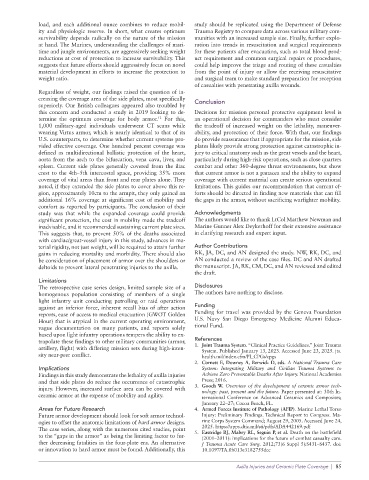
          With the above data summarized in Table 1 and Table 2, it is   tionally, combatant survivability is not just a matter of ballis-
          reasonable to make two assumptions: (1) the four-plate system   tic impermeability but is better thought of as a combination
          should be the gold standard, and (2) current side plate cover-  of equal parts lethality, maneuverability, and protection. The
          age is inadequate; but as with most issues in war, the reality is     Marine Corps claims reduction of armor weight by 25% led
          more complicated.                                  to an 8% increase in speed and agility testing.  Much like the
                                                                                                 11
                                                             Ukrainians, the Marines understand the heavily armored com-
          A recent article published by the Global Surgical and Med-  batant who cannot maneuver  fast enough to effectively  en-
          ical Support Group concerning their experiences in the   gage the enemy is just as unlikely to survive as the unarmored
          Ukrainian-Russian War highlights that “Use of standard cen-  combatant and they must seek a middle ground. Furthermore,
          ter mass front and rear plate armor that protect vital organs   the relative importance of each of these combinations varies
          within ‘The Box’ not be sufficient to save lives” and estimates   greatly by mission: a turret gunner can favor protection over
          60% of urgent surgical cases currently being received are due   maneuverability as his platform inherently provides both ma-
          to injuries lateral to the plates that could be mitigated by side   neuverability and lethality. Contrast this with the dismounted
          plates.  While this statement is in line with our findings, the   combatant on a long-range patrol who is likely to encounter
               10
          authors proceed to explain that the reason so many Ukrainian   the enemy after hours of prolonged exertion under a combat

          TABLE 1  Injury Patterns and Outcomes
                                                   Struck in    Thoracic
                                        Side plates   side-plate    cavity   Pneumothorax  Cardiac  Great-vessel
           Case no.     Entry wound       worn     coverage   violated    treated  injury*  injury*  Disposition
           1 †    Right axilla (1–3 ICS)   No        No         Yes        Yes       No      No        WIA
           2 †    Left axilla              No        No         Yes        Yes       No      No        WIA
           3 †    Left 6th ICS             No        Yes        Yes        Yes       Yes     No        KIA
           4 †    Right 7th ICS            No        Yes        Yes        Yes       No      Yes       KIA
           5      Right 3–5 ICS            Yes       No         Yes        Yes       No      Yes       KIA
           6      Lower edge of left side plate  Yes  Yes       No         No        No      No        WIA
           7      Right 1st rib/ICS        Yes       No         Yes        Yes       No      Yes       KIA
           8      Right 4th ICS            Yes       No         Yes        Yes       No      No        KIA
           9      Left axilla              Yes       No         Yes        Yes       No      No        WIA
           10     Left axilla              Yes       No         Yes        Yes       No      No        WIA
           11     Right axilla (1–3 ICS)   Yes       No         Yes        Yes       No      No        WIA
          *Cardiac and great vessel injuries were identified in review of radiologic studies, surgical documentation or autopsy.
          † Injury sustained prior to the introduction of side plates.
          ICS = intercostal space; KIA = killed in action; WIA = wounded in action.

          84  |  JSOM   Volume 25, Edition 3 / Fall 2025

