


Page 36 - JSOM Fall 2025
P. 36
Methods                                            TABLE 1  Data Collection Methods
              To determine specific barriers to REBOA in deployed environ-  Objective        Evaluation of objective
              ments, we conducted a survey of ER-REBOA placement and   Provider(s) with capability   Investigator deliberation and
              monitoring capabilities at four medical treatment locations   training? (defined as Basic   consensus based on:
                                                                                         • Focused interviews with
                                                                 Endovascular Skills for Trauma
              in Iraq and Kuwait during the spring of 2019. This project   course or familiarization   medical leadership at each
              was initiated as a quality improvement project in the Iraq/  training)       location (including available
              Syria theater. We completed site surveys, focus group discus-                additional medical assets on
              sions, and integrated a REBOA simulation curriculum with the                 post)
              ER-REBOA in-theater. Focus was placed on the physician and                 • Individual discussions with
                                                                                           providers during training
              support staff familiarity with placing the device, as well as the          • Survey results (Appendix 1)
              supply readiness at the deployment locations for REBOA.  • Equipment assessment  • Direct inspection of
                                                                 • ER-REBOA  device        resuscitation bays, intensive
                                                                           ™
              The primary objective was to evaluate each medical site’s abil-  • Compatible Introducer   care unit equipment areas,
              ity to deploy REBOA, which hinged on two factors. First, the   Catheter Kit  operating rooms, and medical
              medical site must have a provider capable of placing REBOA,   • Arterial Pressure Monitoring   storage
                                                                   Capability (Compass device or  • Interviews with on-site
              whether through attending the BEST course or familiariza-  pressure tubing, arterial line   logistics personal and relevant
              tion training. Second, there must be the minimum equipment   transducer, and a compatible   medical staff
              necessary to deploy REBOA, namely the ER-REBOA device   monitor)
              and the introducer catheter kit. The device and kit must be   • Femoral arterial lines for early
                                                                   placement
              stored according to the manufacturer’s recommendations,
              which was in a cool, dark location away from direct sunlight.   Support personnel for formal   Survey results (Appendix 1)
                                                                 training or comfort
              Familiarization training was defined as consensus agree-
              ment  by  the  investigators  KC  and  KR  for  a  provider  to  1)
              understand when to place a ER-REBOA and 2) place an ER-   hands-on simulation segment with two simulated cases (zone
              REBOA either through training other than the BEST course   1 and zone 3). Both cases required the team to correctly select
              or having successfully placed it in a patient. Investigators in-  a zone, deploy, and monitor an ER-REBOA in a pressured sim-
              terviewed medical leadership and providers and conducted   ulation mannequin model. A test was administered at the end
              surveys of providers to determine those capable of placing   for knowledge retention (Appendix 2).
              REBOA (Table 1 and Appendix 1). The secondary objectives
              included evaluating support personnel for formal training (or   The simulation mannequin model used was the Prytime
              comfort level) assisting in the management of a patient with     Medical  STAAR (Simulation Trainer for Arterial Access and
                                                                       ™
              an ER-REBOA device in place and arterial pressure monitor-  ER-REBOA), which includes a pulsatile flow loop. This model
              ing capabilities for the REBOA. Secondary objectives were   offered clinically similar conditions for arterial access train-
              evaluated by the investigators through interviews and survey   ing and simulated ER-REBOA placement. Providers placed the
              results of support personnel and visualization of arterial pres-  ER-REBOA while nurses or medics assisted in setting up an
              sure monitoring equipment.                         arterial pressure transduction/monitoring system. The arterial
                                                                 pressure monitoring device was the ZOLL  M Series  defibril-
                                                                                                 ®
                                                                                                         ®
              The investigators and advisors for this quality improvement   lator (ZOLL Medical Corporation, Chelmsford, MA).
              project consisted of two vascular surgeons, one trauma sur-
              geon (BEST course instructor), two emergency medicine phy-  The protocol was reviewed and granted exemption by the lo-
              sicians (one who had completed the BEST course and one   cal institutional review board. The manuscript was reviewed
              with familiarization training in ER-REBOA placement), and   and approved by the Public Affairs Office and the institutional
              two registered nurses with formal training in ER-REBOA   Operations Security (OPSEC) Representative.
              placement.
                                                                 Results
              We completed four site surveys (three in Iraq, one in Kuwait)
              during the spring of 2019.  These sites were selected based   We evaluated four deployed locations: two Role 2 medical
              on their critical access and location in theater at that time   treatment  facilities  (MTFs)  with  Forward  Resuscitative  Sur-
              (within range of readily available transportation/project time   gical Team (FRST) augmentation in Iraq: one Role 3 MTF in
              constraints).                                      Iraq, and one Role 3 MTF in Kuwait.

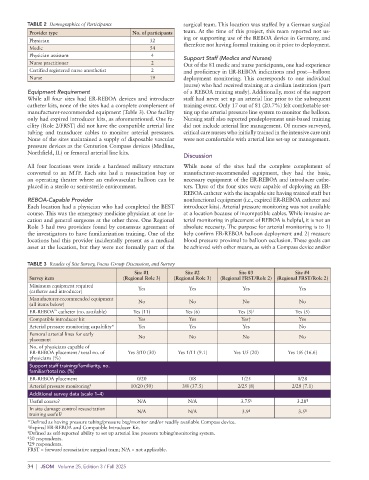
              Data was collected and stored in Excel 16 (Microsoft, Red-  A total of 113 individuals participated in the evaluation and
              mond, WA) and reviewed by two investigators after completion.  training (Table 2). While all sites had the minimum training
                                                                 and equipment requirements to complete the procedure (one
              While not a primary or secondary objective, the study inves-  REBOA-capable provider, an ER-REBOA device, and an intro-
              tigators created a training curriculum to educate participants   ducer catheter kit in proper storage), one site only had expired
              on ER-REBOA placement and monitoring as part of a quality   ER-REBOA devices and kits.  This site was deemed unable
              improvement initiative. After completing the site survey, the   to deploy a REBOA. Overall, 6 of 32 (18.7%) of physicians
              investigators gave a didactic-simulation session for physicians   were capable of placing an ER-REBOA, whether attending the
              and support staff. The curriculum consisted of 1.5 hours of   BEST course or with familiarization. Of 81 medical support
              lecture describing pathophysiology, indications, contraindica-  staff (nurses and medics), 1 (1.3%) reported ER-REBOA sup-
              tions, complications, management, transport considerations,   port proficiency, and 17 (20.9%) reported proficiency with
              and discontinuation of ER-REBOA. It was followed by a   arterial pressure transducer set-up and management.


                                                                   In-Theater Assessment of REBOA Capabilities and Training  |  33

