


Page 31 - JSOM Fall 2025
P. 31
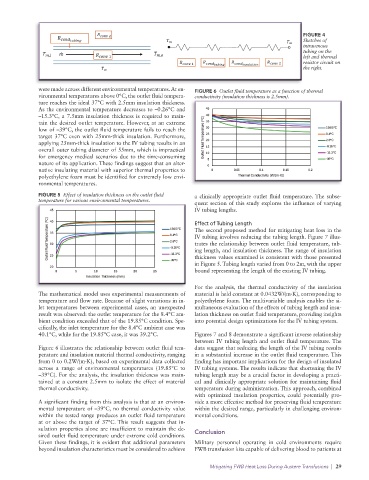
FIGURE 2  Fluid temperatures at the inlet and outlet of the   risk increases with colder environmental temperatures, precise
          intravenous tubing for the environmental temperature range of    quantification is challenging, as the impact of colder intra-
          –39°C to 20°C.
                                                             venous fluid on a patient depends on the administered fluid
                                                             volume and individual patient characteristics.

                                                             Figure 3b illustrates the relationship between heat loss and the
                                                             volumetric flow rate of the glycerol solution. Lower flow rates
                                                             result in increased heat loss, corroborating Bissonnette and
                                                             Paut’s findings. This creates a compounding effect: lower flow
                                                             rates extend the fluid’s exposure to environmental tempera-
                                                             ture, further decreasing fluid temperature and subsequently
                                                             reducing flow rates.


                                                             Mitigation Methods
          In addition to temperature measurements, the volumetric flow   Insulating IV Tubing
          rate of the glycerol solution is monitored. Heat loss through   One of the proposed methods of reducing heat loss through
          the  IV  tubing is  calculated  using  the  mass  flow rate  of  the   the IV tubing is to add insulation to the IV tubing. The effect
          glycerol solution, specific heat capacity, and temperature dif-  of two parameters, the thickness of the insulation and the in-
          ferentials between the inlet and outlet. Figure 3 depicts the   sulation material, are investigated in this research study. Fig-
          relationship between heat loss and environmental temperature   ure 4 illustrates a sketch of IV tubing. In this figure, T  and
                                                                                                        m,i
          across the range of 20°C to –39°C.                 T m,o  represent the inlet and outlet fluid temperatures while
                                                             R condtubing , R conv1 , R conv2  refer to the thermal resistances due to
          At an environmental temperature of 20°C, a heat loss of 40.9   conduction through the tubing, convection to the tubing, and
          (SD 3.4) W is observed. This heat loss increases linearly with   convection from the tubing to the environment, correspond-
                                                                                   ·
          decreasing environmental temperature, as illustrated in Fig-  ingly. The mass flow rate is m and the environmental tempera-
          ure 3a. The maximum heat loss of 168 (SD 17.4) W occurs   ture is denoted with T . In the mathematical model, insulation
                                                                              ∞
          at –39°C. Notably, the uncertainty in heat loss calculations   materials are differentiated by their thermal conductivities.
          increases at lower environmental temperatures, primarily due   Both insulation thickness and insulation thermal conductivity
          to increased uncertainty in temperature measurements.  are variables within the thermal resistance of the insulation.
          The significance of this increasing heat loss is evident in Figure   The  overall  heat  transfer  coefficient  takes  into  account  the
          2, which depicts the resulting outlet fluid temperatures. None   convection and conduction resistances outlined above, and the
          of the tested environmental temperatures yielded an outlet   insulation as shown in Equation 1 as follows:
          fluid temperature of 37°C or higher. The average outlet fluid   R total  =   –1
          temperature even reached a minimum of 9.1°C (SD 0.35°C) at   mC 1n( T ∞  – T m,o )  = R cond 1  + R cond tubing + R cond insulation + R cond 2
                                                                   ·
                                                                    p
          an environmental temperature of –39°C. Considering healthy   T ∞  – T m,i
          core body temperature, transfusion administered through   The thermal resistance of the insulation is calculated by using
          the IV tubing at the tested environmental temperatures may   Equation 2 as follows:
          present a risk of hypothermia to trauma patients. While the                  ln(r /r )
                                                                                          2 1
                                                                            R cond insulation  =
                                                                                        2πLk
          FIGURE 3  Heat loss through the intravenous tubing as a function
          of (A) environment temperatures between –39°C and 20°C and (B)   In that equation, the thickness of the insulation and the ther-
          volumetric flowrate.                               mal conductivity of the insulation material are varied by se-
                                                             lecting different insulation materials.
           (A)
                                                             Varying insulation thickness and the thermal conductivity of
                                                             the insulation material impact the total thermal resistance
                                                             which in turn affects the outlet fluid temperature of the mod-
                                                             eled IV tubing as shown in Equation 3 as follows:
                                                                                          –     1
                                                                                            ·
                                                                         T m,o  = T ∞  – (T ∞  – T m,i )e  mc R total
                                                                                             p
                                                             The outlet fluid temperature can be calculated as a function
                                                             of the overall heat transfer coefficient, given the known mass
                                                             flow rate (m) and mean inlet temperature T  from experimen-
                                                                     ·
           (B)                                                                                m,i
                                                             tal testing. The thermal conductivity of the insulation mate-
                                                             rial is held constant at 0.0432  �  , the thermal conductivity
                                                                                      m·K
                                                             of polyethylene foam. Polyethylene foam is selected due to its
                                                             common use for medical applications.
                                                             In Figure 5, the fluid temperature at the inlet of the IV tubing is
                                                             38°C (SD 3.3°C). Considering that fluids in blood transfusions
                                                             should ideally enter the patient’s body at a normal body tem-
                                                             perature of 37°C to prevent hypothermia, several observations

          28  |  JSOM   Volume 25, Edition 3 / Fall 2025

