


Page 32 - JSOM Fall 2025
P. 32
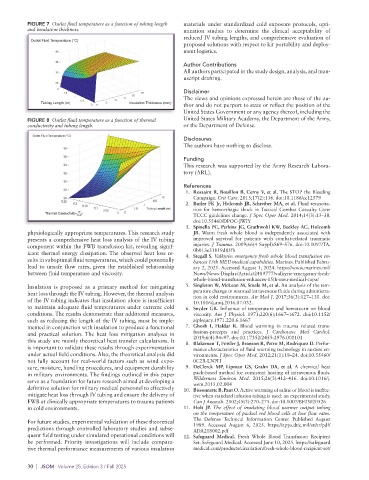
FIGURE 4
                                      !"#$ &
                         !"#* !"#$%&                                                                Sketches of
                                                            *
                                                                                                    '
                                                                                                    intravenous
                    ṁ                                                                               tubing on the
                    ',)                                 ',"
                                     !"#$ &                                                         left and thermal
                                                                                                    resistor circuit on
                                                                 !"#$ )       !"#( !"#$%&       !"#( $%'"()!$*%       !"#$ &
                                                                                                    the right.
                                       '
              were made across different environmental temperatures. At en-  FIGURE 6  Outlet fluid temperature as a function of thermal
              vironmental temperatures above 0°C, the outlet fluid tempera-  conductivity (insulation thickness is 2.5mm).
              ture reaches the ideal 37°C with 2.5mm insulation thickness.
              As the environmental temperature decreases to –0.26°C and
              –15.3°C, a 7.5mm insulation thickness is required to main-
              tain the desired outlet temperature. However, at an extreme
              low of –39°C, the outlet fluid temperature fails to reach the
              target 37°C even with 25mm-thick insulation. Furthermore,
              applying 25mm-thick insulation to the IV tubing results in an
              overall outer tubing diameter of 55mm, which is impractical
              for emergency medical scenarios due to the time-consuming
              nature of its application. These findings suggest that an alter-
              native insulating material with superior thermal properties to
              polyethylene foam must be identified for extremely low envi-
              ronmental temperatures.
              FIGURE 5  Effect of insulation thickness on the outlet fluid   a clinically appropriate  outlet  fluid temperature. The  subse-
              temperature for various environmental temperatures.
                                                                 quent section of this study explores the influence of varying
                                                                 IV tubing lengths.

                                                                 Effect of Tubing Length
                                                                 The second proposed method for mitigating heat loss in the
                                                                 IV tubing involves reducing the tubing length. Figure 7 illus-
                                                                 trates the relationship between outlet fluid temperature, tub-
                                                                 ing length, and insulation thickness. The range of insulation
                                                                 thickness values examined is consistent with those presented
                                                                 in Figure 5. Tubing length varied from 0 to 2m, with the upper
                                                                 bound representing the length of the existing IV tubing.


                                                                 For  the  analysis,  the  thermal  conductivity  of  the  insulation
              The mathematical model uses experimental measurements of   material is held constant at 0.0432W/(m·K), corresponding to
              temperature and flow rate. Because of slight variations in in-  polyethylene foam. The multivariable analysis enables the si-
              let temperatures between experimental cases, an unexpected   multaneous evaluation of the effects of tubing length and insu-
              result was observed: the outlet temperature for the 8.4°C am-  lation thickness on outlet fluid temperature, providing insights
              bient condition exceeded that of the 19.85°C condition. Spe-  into potential design optimizations for the IV tubing system.
              cifically, the inlet temperature for the 8.4°C ambient case was
              40.1°C, while for the 19.85°C case, it was 39.2°C.  Figures 7 and 8 demonstrate a significant inverse relationship
                                                                 between IV tubing length and outlet fluid temperature. The
              Figure 6 illustrates the relationship between outlet fluid tem-  data suggest that reducing the length of the IV tubing results
              perature and insulation material thermal conductivity, ranging   in a substantial increase in the outlet fluid temperature. This
              from 0 to 0.2W/(m·K), based on experimental data collected   finding has important implications for the design of insulated
              across a range of environmental temperatures (19.85°C to   IV tubing systems. The results indicate that shortening the IV
              –39°C). For the analysis, the insulation thickness was main-  tubing length may be a crucial factor in developing a practi-
              tained at a constant 2.5mm to isolate the effect of material   cal and clinically appropriate solution for maintaining fluid
              thermal conductivity.                              temperature during administration. This approach, combined
                                                                 with optimized insulation properties, could potentially pro-
              A significant finding from this analysis is that at an environ-  vide a more effective method for preserving fluid temperature
              mental temperature of –39°C, no thermal conductivity value   within the desired range, particularly in challenging environ-
              within the tested range produces an outlet fluid temperature   mental conditions.
              at or above the target of 37°C. This result suggests that in-
              sulation properties alone are insufficient to maintain the de-  Conclusion
              sired outlet fluid temperature under extreme cold conditions.
              Given these findings, it is evident that additional parameters   Military personnel operating in cold environments require
              beyond insulation characteristics must be considered to achieve   FWB transfusion kits capable of delivering blood to patients at

                                                                      Mitigating FWB Heat Loss During Austere Transfusions  |  29

