


Page 104 - JSOM Fall 2025
P. 104
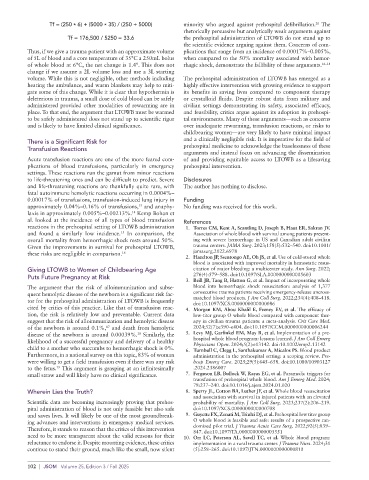
Tf = (250  *  6) + (5000  *  35) / (250 + 5000)  minority who argued against prehospital defibrillation.  The
                                                                                                        20
                                                             rhetorically persuasive but analytically weak arguments against
                       Tf = 176,500 / 5250 = 33.6            the prehospital administration of LTOWB do not stand up to
                                                             the scientific evidence arguing against them. Concerns of com-
          Thus, if we give a trauma patient with an approximate volume   plications that range from an incidence of 0.00017%–0.005%,
          of 5L of blood and a core temperature of 35°C a 250mL bolus   when compared to the 50% mortality associated with hemor-
          of whole blood at 6°C, the net change is 1.4°. This does not   rhagic shock, demonstrate the fallibility of these arguments. 16–18
          change if we assume a 2L volume loss and use a 3L starting
          volume. While this is not negligible, other methods including   The prehospital administration of LTOWB has emerged as a
          heating the ambulance, and warm blankets may help to miti-  highly effective intervention with growing evidence to support
          gate some of this change. While it is clear that hypothermia is   its benefits in saving lives compared to component therapy
          deleterious in trauma, a small dose of cold blood can be safely   or crystalloid fluids. Despite robust data from military and
          administered provided other modalities of rewarming are in   civilian  settings  demonstrating  its  safety,  associated  efficacy,
          place. To that end, the argument that LTOWB must be warmed   and feasibility, critics argue against its adoption in prehospi-
          to be safely administered does not stand up to scientific rigor   tal environments. Many of these arguments—such as concerns
          and is likely to have limited clinical significance.  over inadequate rewarming, transfusion reactions, or risks to
                                                             childbearing women—are very likely to have minimal impact
          There is a Significant Risk for                    and a clinically negligible risk. It is imperative for the field of
          Transfusion Reactions                              prehospital medicine to acknowledge the baselessness of these
                                                             arguments and instead focus on advancing the dissemination
          Acute transfusion reactions are one of the more feared com-  of and providing equitable access to LTOWB as a lifesaving
          plications  of  blood  transfusions,  particularly  in  emergency   prehospital intervention.
          settings. These reactions run the gamut from minor reactions
          to life-threatening ones and can be difficult to predict. Severe   Disclosures
          and life-threatening reactions are thankfully quite rare, with   The author has nothing to disclose.
          fatal autoimmune hemolytic reactions occurring in 0.0004%–
          0.00017% of transfusions, transfusion-induced lung injury in   Funding
          approximately 0.04%–0.16% of transfusions,  and anaphy-  No funding was received for this work.
                                              13
          laxis in approximately 0.005%–0.00213%.  Kemp Bohan et
                                            14
          al. looked at the incidence of all types of blood transfusion   References
          reactions in the prehospital setting of LTOWB administration   1.  Torres CM, Kent A, Scantling D, Joseph B, Haut ER, Sakran JV.
          and found a similarly low incidence.  In comparison, the   Association of whole blood with survival among patients present-
                                        15
          overall mortality from hemorrhagic shock rests around 50%.   ing with severe hemorrhage in US and Canadian adult civilian
          Given the improvements in survival for prehospital LTOWB,   trauma centers. JAMA Surg. 2023;158(5):532–540. doi:10.1001/
          these risks are negligible in comparison. 16          jamasurg.2022.6978
                                                              2.  Hazelton JP, Ssentongo AE, Oh JS, et al. Use of cold-stored whole
                                                                blood is associated with improved mortality in hemostatic resus-
          Giving LTOWB to Women of Childbearing Age             citation of major bleeding: a multicenter study. Ann Surg. 2022;
          Puts Future Pregnancy at Risk                         276(4):579–588. doi:10.1097/SLA.0000000000005603
                                                              3.  Brill JB, Tang B, Hatton G, et al. Impact of incorporating whole
          The argument that the risk of alloimmunization and subse-  blood into hemorrhagic shock resuscitation: analysis of 1,377
          quent hemolytic disease of the newborn is a significant risk fac-  consecutive trauma patients receiving emergency-release uncross-
          tor for the prehospital administration of LTOWB is frequently   matched blood products. J Am Coll Surg. 2022;234(4):408–418.
                                                                doi:10.1097/XCS.0000000000000086
          cited by critics of this practice. Like that of transfusion reac-  4.  Morgan KM, Abou Khalil E, Feeney EV, et al.  The efficacy of
          tion, the risk is relatively low and preventable. Current data   low-titer group O whole blood compared with component ther-
          suggest that the risk of alloimmunization and hemolytic disease   apy in civilian trauma patients: a meta-analysis. Crit Care Med.
          of the newborn is around 0.1%,  and death from hemolytic   2024;52(7):e390–e404. doi:10.1097/CCM.0000000000006244
                                    17
          disease of the newborn is around 0.00039%.  Similarly, the   5.  Levy MJ, Garfinkel EM, May R, et al. Implementation of a pre-
                                              18
          likelihood of a successful pregnancy and delivery of a healthy   hospital whole blood program: lessons learned. J Am Coll Emerg
                                                                Physicians Open. 2024;5(2):e13142. doi:10.1002/emp2.13142
          child to a mother who succumbs to hemorrhagic shock is 0%.   6.  Turnbull C, Clegg L, Santhakumar A, Micalos PS. Blood product
          Furthermore, in a national survey on this topic, 83% of woman   administration in the prehospital setting: a scoping review. Pre-
          were willing to get a field transfusion even if there was any risk   hosp Emerg Care. 2025;29(5):645–658. doi:10.1080/10903127
          to the fetus.  This argument is grasping at an infinitesimally   .2024.2386007
                   19
          small straw and will likely have no clinical significance.  7.  Ferguson LB, Bullock W, Rayas EG, et al. Paramedic triggers for
                                                                transfusion of prehospital whole blood. Am J Emerg Med. 2024;
                                                                78:237–240. doi:10.1016/j.ajem.2024.01.020
          Wherein Lies the Truth?                             8.  Sperry JL, Cotton BA, Luther JF, et al. Whole blood resuscitation
                                                                and association with survival in injured patients with an elevated
          Scientific data are becoming increasingly proving that prehos-  probability of mortality. J Am Coll Surg. 2023;237(2):206–219.
          pital administration of blood is not only feasible but also safe   doi:10.1097/XCS.0000000000000708
          and saves lives. It will likely be one of the most groundbreak-  9.  Guyette FX, Zenati M, Triulzi DJ, et al. Prehospital low titer group
          ing advances and interventions in emergency medical services.   O whole blood is feasible and safe: results of a prospective ran-
          Therefore, it stands to reason that the critics of this intervention   domized pilot trial. J Trauma Acute Care Surg. 2022;92(5):839–
                                                                847. doi:10.1097/TA.0000000000003551
          need to be more transparent about the valid reasons for their   10.  Orr LC, Peterson AL, Savell TC, et al.  Whole blood program:
          reluctance to endorse it. Despite mounting evidence, these critics   implementation in a rural trauma center. J Trauma Nurs. 2024;31
          continue to stand their ground, much like the small, now silent   (5):258–265. doi:10.1097/JTN.0000000000000810

          102  |  JSOM   Volume 25, Edition 3 / Fall 2025

