


Page 99 - JSOM Fall 2025
P. 99
to the standard Doppler ultrasonography measurements. Ob-  Procedure
          taining and scoring two-dimensional ultrasound recordings is   Two test stations were set up; each attended by a vascular
          easier to master due to its visual nature.  Recent developments,   surgeon and an assistant.  The participants entered the test
                                        4
          such as ultrasound probe connectivity to smartphones and   stations in randomly assigned buddy pairs and received in-
          tablets, have made ultrasound devices portable and therefore   structions regarding the study protocol. The aforementioned
          more usable in operational settings outside of hospitals, such   pairs performed the measurements on each other.
          as on the waterside. Given the strategic importance of target-
          ing critical infrastructure in underwater operations, exploring   First, the performing participant  was allowed 2 minutes of
          innovative approaches to enhance operational readiness could   practice time with the abdominal ultrasound probe on their
          significantly strengthen the competitive advantage of maritime   buddy, receiving feedback from the instructor. The participant
          special operations forces (SOF) units.             was then asked to remove the probe from the patient and start
                                                             the official procedure. The buddy was positioned on the ex-
          Submitted data obtained  by our study  group suggests that   amination bench in the supine position. The performer was
          bubble scores of the inferior vena cava (IVC) and popliteal   allowed a maximum of 2 minutes to obtain a 5-second video
          vein (PV) show a significant correlation with the bubble-load   of the IVC. Subsequently, the patient stood up, and the per-
          of the diver, as determined by Doppler analysis. Thus, we hy-  former was again allowed a maximum of 2 minutes to obtain
          pothesized that with the accumulation of additional scientific   a 5-second video of the PV. The performers were tasked with
          evidence, vascular ultrasonography of these vessels may be-  identifying the correct vessel themselves and did not receive
          come an alternative method for detection of elevated decom-  any instructions regarding identification during the procedure.
          pression stress levels in the future. This could allow military   Once the performers stated that they felt confident that they
          (SOF) divers to become less dependent on scarce Doppler   had identified the correct vessel, they recorded and saved the
          analysis experts and enhance operational readiness.  5-second video.

          The first step in evaluating the viability of self-monitoring of   Scoring
          decompression stress, and possibly on-site titration of dive   Three outcomes were measured in this study: (1) observer
          profiles, performed by dive teams on the waterside involves   assessment of the performance, (2) self-perceived procedure
          assessing the capacity of military combat medics to acquire   experience (supplemental Figure 1), and (3) video recording
          proficiency in generating high-quality vascular ultrasound   quality. Performers were assessed by a vascular surgeon on
          recordings.                                        their preparation of the procedure, knowledge of materials
                                                             and instruments, time and motion, the progression of the pro-
          The primary aim of this study was to assess the feasibility   cedure and forward planning, their ability to adapt to individ-
          of training  combat  medics to  perform  ultrasound measure-  ual anatomical circumstances, and their overall performance
          ments of the IVC and the PV with the use of a microteaching   (Supplemental  Table 1); adapted from the Objective Struc-
          program. The secondary aim was to evaluate the quality of   tured Assessment of Technical Skills [OSATS]). 5
          two-dimensional recordings made by combat medics.
                                                             Participants were asked to fill in a scoring sheet about their
                                                             self-perceived experience, visibility of the vessels, and opinion
          Methods
                                                             on performing vascular ultrasound on the waterside. Scoring
          Participants                                       options ranged from 1 (strongly disagree/very challenging) to
          The group consisted of 26 SOF combat medics, some of whom   5 (strongly agree/very easy) (Appendix 1).
          were also SOF divers. Five participants were certified NATO
          Special Operations Combat Medics (NSOCMs). An NSOCM   Recording quality was scored by a blinded vascular surgeon and
          is a servicemember who provides TCCC and advanced tactical   another ultrasound specialist. An important note and subject for
          medical support directly to SOF units. SOF medics are SOF   future research is that there is not currently a gold standard for
          Operators, designated combatants, as defined by the Geneva   diagnosing high decompression stress using ultrasonography in
          Conventions, with specific medical education and training.  the field. We scored the videos on recording clarity, gain, bright-
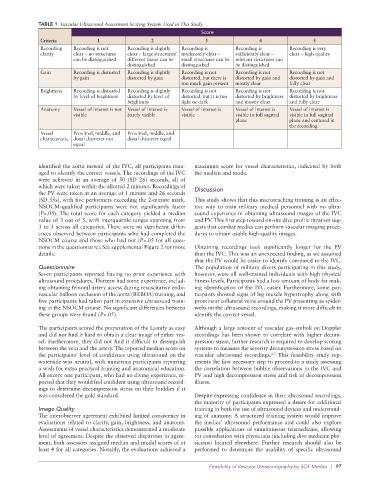
                                                             ness, anatomy, and vessel characteristics on a scoring sheet (Ta-
          Microteaching                                      ble 1). The full videos were assessed instead of stills to gain a
          A microteaching course was given to combat medics of the   better indication of the sonographer’s performance.
          Netherlands  Armed  Forces  by two vascular  surgeons.  The
          course consisted of a theoretical part lasting 10 minutes, which   Statistical Analysis
          included the basic principles and technique of ultrasonogra-  All analyses were performed using IBM SPSS Statistics for
          phy, supported by a PowerPoint presentation.  Afterwards,   Mac, version 27 (IBM Corp., Armonk, NY). The observer and
          a 5-minute hands-on demonstration was given on how to   performer scores distribution and recording quality scores
          achieve recordings of the IVC and PV.              were  generated.  Normality  was assessed  using  the Shapiro-
                                                             Wilk test. A Mann-Whitney U test was performed to assess
          Materials                                          differences in recording times and scores between NSOCMs
          Two Lumify  (Philips Medical Systems International B.V.,   and other participants.
                    ™
          Best,  The Netherlands)  handheld ultrasound devices were
          used, connected to a Samsung Galaxy  Tab  A  (generation   Results
                                               ™
          10.5, Samsung, Suwon, South-Korea) or a Panasonic FZ-A2
                                                         ™
          tablet (Panasonic, Kadoma, Japan). The IVC was examined us-  Performance Assesment
          ing the C5-2 abdominal probe, and the PV was assessed using   One  participant  was excluded  due  to  overqualification,  as
          the L12-4 linear probe.                            he was a registered nurse. Except for one participant who
          96  |  JSOM   Volume 25, Edition 3 / Fall 2025

