


Page 72 - JSOM Summer 2025
P. 72
Patient 2 is a 20-year-old male, lethargic and not answering   >4s and the fingers appear cyanotic in color. Head-to-toe sec-
          questions. He is unable to give his medical history but a fel-  ondary survey reveals a large hematoma to the right parietal
          low Marine from his berthing indicates he takes an unknown   scalp and a grossly deformed right midshaft humerus fracture
          medicine for migraines. He is placed on a stretcher and taken   with intact overlying skin and a palpable distal pulse. The re-
          to the ship’s ICU.                                 maining extremities are assessed to have normal exams and no
                                                             obvious torso abnormalities are identified. The patient’s pupils
                                                             are equal and sluggishly reactive from 5 to 2mm. He expels
          Time 00 minutes
                                                             a large volume of pink frothy emesis towards the end of the
          Patient 1                                          examination.
          Patient 1’s vital signs are: heart rate (HR), 62 beats per min-
          ute (bpm); blood pressure (BP), 105/62mmHg; respiratory rate   Initial recommended interventions include the following:
          (RR), 24 breaths/min; peripheral O  saturations (SpO ), 99%;
                                     2
                                                    2
          temperature, 33°C; and weight, 82kg.               •  Suction the emesis and keep suction readily available, ide-
                                                               ally designate another individual to focus solely on airway
          The physical exam is unremarkable and no traumatic injuries   suctioning.
          were identified during the head-to-toe secondary exam. The   •  Obtain two points of vascular access. If unable to obtain
          patient is cold to the touch, neurologic exam is unremarkable,   an IV access quickly, then obtain intraosseous (IO) access
          and peripheral capillary refill time (CRT) is greater than 3 sec-  (proximal humerus preferred, proximal tibia backup loca-
          onds, assessed at the ventral surface of his right index finger.  tion). Once resuscitation has started via IO, IV lines can
                                                               subsequently be placed for additional access.
          Initial recommended interventions include the following:  •  Be gentle with the patient and do not jostle, as this may
                                                               cause a fatal arrhythmia in a hypothermic patient.
          •  Remove all wet clothes and dry the patient; implement ex-  •  Remove all wet clothes and attempt to warm the patient.
            ternal warming measures. Turn up room temperature. It is   If unable to remove wet clothes for any reason, wrap the
            recommended to use normal blankets to warm and con-  patient in an impermeable enclosure/layer. Raise the room
            sider using a forced warm air blanket (e.g., Bair Hugger). If   temperature. A Bair Hugger, is recommended, if available.
            an active warming blanket is used, avoid placing it directly   If not available, a Hypothermia Prevention and Manage-
            on the skin to avoid burn injury.                  ment Kit (HPMK) is recommended; otherwise, use multiple
          •  Allow the patient to take in warm fluids by mouth, such as   wool blankets inside of a sleeping bag. Be sure to focus on
            hot chocolate or warm chicken broth.               warming the core first, as rapid warming of the extremities
                                                               can cause vasodilation, allowing cold blood to return to the
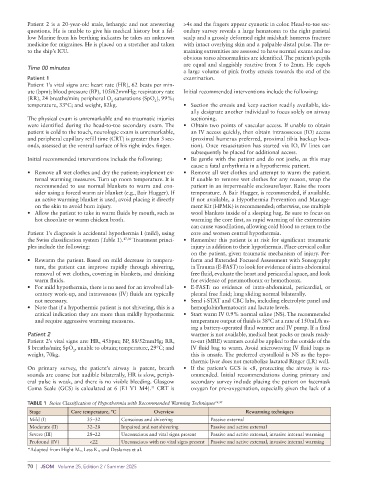
          Patient 1’s diagnosis is accidental hypothermia I (mild), using   core and worsen central hypothermia.
          the Swiss classification system (Table 1). 17,30  Treatment princi-  •  Remember this patient is at risk for significant traumatic
          ples include the following:                          injury in addition to their hypothermia. Place cervical collar
                                                               on the patient, given traumatic mechanism of injury. Per-
          •  Rewarm the patient. Based on mild decrease in tempera-  form and Extended Focused Assessment with Sonography
            ture, the patient can improve rapidly through shivering,   in Trauma (E-FAST) to look for evidence of intra- abdominal
            removal of wet clothes, covering in blankets, and drinking   free fluid, evaluate the heart and pericardial space, and look
            warm fluids.                                       for evidence of pneumothorax or hemothorax.
          •  For mild hypothermia, there is no need for an involved lab-  •  E-FAST: no evidence of intra-abdominal, pericardial, or
            oratory work-up, and intravenous (IV) fluids are typically   pleural free fluid; lung sliding normal bilaterally.
            not necessary.                                   •  Send i-STAT and CBC labs, including electrolyte panel and
          •  Note that if a hypothermic patient is not shivering, this is a   hemoglobin/hematocrit and lactate levels.
            critical indication they are more than mildly hypothermic   •  Start warm IV 0.9% normal saline (NS). The recommended
            and require aggressive warming measures.           temperature output of fluids is 38°C at a rate of 150mL/h us-
                                                               ing a battery-operated fluid warmer and IV pump. If a fluid
          Patient 2                                            warmer is not available, medical heat packs or meals ready-
          Patient 2’s vital signs are: HR, 45bpm; BP, 88/52mmHg; RR,     to-eat (MRE) warmers could be applied to the outside of the
          8 breaths/min; SpO , unable to obtain; temperature, 29°C; and   IV fluid bag to warm. Avoid microwaving IV fluid bags as
                         2
          weight, 70kg.                                        this is unsafe. The preferred crystalloid is NS as the hypo-
                                                               thermic liver does not metabolize lactated Ringer (LR) well.
          On  primary  survey,  the  patient’s  airway  is  patent,  breath   •  If the patient’s GCS is <8, protecting the airway is rec-
          sounds are coarse but audible bilaterally, HR is slow, periph-  ommended. Initial recommendations during primary and
          eral pulse is weak, and there is no visible bleeding. Glasgow   secondary survey include placing the patient on facemask
          Coma Scale (GCS) is calculated at 6 (E1 V1 M4).  CRT is   oxygen for pre-oxygenation, especially given the lack of a
                                                  31

          TABLE 1  Swiss Classification of Hypothermia with Recommended Warming Techniques 16,30
           Stage        Core temperature, °C       Overview                      Rewarming techniques
           Mild (I)          35–32       Conscious and shivering      Passive external
           Moderate (II)     32–28       Impaired and not shivering   Passive and active external
           Severe (III)      28–22       Unconscious and vital signs present  Passive and active external, invasive internal warming
           Profound (IV)      <22        Unconscious with no vital signs present  Passive and active external, invasive internal warming
          *Adapted from Hight M., Less K., and Deslarzes et al.

          70  |  JSOM   Volume 25, Edition 2 / Summer 2025

