


Page 74 - JSOM Summer 2025
P. 74
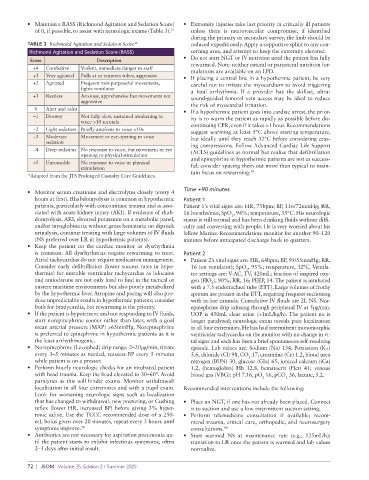
•  Maintain a RASS (Richmond Agitation and Sedation Score)   •  Extremity injuries take last priority in critically ill patients
            of 0, if possible, to assist with neurologic exams (Table 3). 31  unless there is neurovascular compromise; if identified
                                                               during the primary or secondary survey, the limb should be
          TABLE 3  Richmond Agitation and Sedation Score 30    reduced expeditiously. Apply a supportive splint to any con-
           Richmond Agitation and Sedation Score (RASS)        cerning area, and attempt to keep the extremity elevated.
           Score                 Description                 •  Do not start NGT or IV nutrition until the patient has fully
            +4  Combative  Violent, immediate danger to staff  rewarmed. Note: neither enteral or parenteral nutrition for-
                                                               mulations are available on an LPD.
            +3  Very agitated  Pulls at or removes tubes, aggressive  •  If placing a central line in a hypothermic patient, be very
            +2  Agitated   Frequent non-purposeful movements,   careful not to irritate the myocardium to avoid triggering
                           fights ventilator                   a fatal arrhythmia. If a provider has the skillset, ultra-
            +1  Restless   Anxious, apprehensive but movements not   sound-guided femoral vein access may be ideal to reduce
                           aggressive                          the risk of myocardial irritation.
            0   Alert and calm                               •  If a hypothermic patient goes into cardiac arrest, the prior-
            –1  Drowsy     Not fully alert, sustained awakening to   ity is to warm the patient as rapidly as possible before dis-
                           voice >10 seconds                   continuing CPR, even if it takes >1 hour. Recommendations
            –2  Light sedation Briefly awakens to voice <10s   suggest warming at least 5°C above starting temperature,
            –3  Moderate   Movement or eye-opening to voice    but ideally until they reach 32°C before considering ceas-
                sedation                                       ing compressions. Follow Advanced Cardiac Life Support
            –4  Deep sedation  No response to voice, but movement or eye   (ACLS) guidelines as normal but realize that defibrillation
                           opening to physical stimulation
            –5  Unrousable  No response to voice or physical   and epinephrine in hypothermic patients are not as success-
                           stimulation                         ful; consider spacing them out more than typical to main-
                                                                                   39
          *Adapted from the JTS Prolonged Casualty Care Guidelines.  tain focus on rewarming.
                                                             Time +90 minutes
          •  Monitor serum creatinine and electrolytes closely (every 4
            hours at first). Rhabdomyolysis is common in hypothermic   Patient 1
            patients, particularly with concomitant trauma and is asso-  Patient 1’s vital signs are: HR, 75bpm; BP, 116/72mmHg; RR,
            ciated with acute kidney injury (AKI). If evidence of rhab-  16 breaths/min, SpO , 94%; temperature, 35°C. His neurologic
                                                                             2
            domyolysis, AKI, elevated potassium on a metabolic panel,   status is still normal and has been drinking fluids without diffi-
            and/or myoglobinuria without gross hematuria on dipstick   culty and conversing with people. He is very worried about his
            urinalysis, continue treating with large volumes of IV fluids   fellow Marine. Recommendation: monitor for another 90–120
            (NS preferred over LR in hypothermic patients).  minutes before anticipated discharge back to quarters.
          •  Keep the patient on the cardiac monitor as dysrhythmia
            is common. All dysrhythmias require rewarming to treat.   Patient 2
            Atrial tachycardias do not require medication management.   •  Patient 2’s vital signs are: HR, 64bpm; BP, 95/55mmHg; RR,
            Consider early defibrillation (lower success rates in hypo-  16 (on ventilator); SpO , 95%; temperature, 32°C. Ventila-
                                                                                 2
            thermia) for unstable ventricular tachycardias as lidocaine   tor settings are: V-AC, TV, 420mL; fraction of inspired oxy-
            and amiodarone are not only hard to find in the tactical or   gen (FIO ), 90%; RR, 16; PEEP, 14. The patient is intubated
                                                                      2
            austere maritime environments but also poorly metabolized   with a 7.5 endotracheal tube (ETT). Large volumes of frothy
            by the hypothermic liver. Atropine and pacing will also pro-  sputum are present in the ETT, requiring frequent suctioning
            duce unpredictable results in hypothermic patients; consider   with in-line cannula. Cumulative IV fluids are 2L NS. Nor-
            both for bradycardia, but rewarming is the priority.  epinephrine drip infusing through peripheral IV at 5µg/min.
          •  If the patient is hypotensive and not responding to IV fluids,   UOP is 450mL clear urine (>1mL/kg/h). The patient no is
            start norepinephrine sooner rather than later, with a goal   longer paralyzed; neurologic exam reveals pain localization
            mean arterial pressure (MAP) >65mmHg. Norepinephrine   in all four extremities. He has had intermittent monomorphic
            is preferred to epinephrine in hypothermic patients as it is   ventricular tachycardia on the monitor with no change in vi-
            the least arrhythmogenic.                          tal signs and each has been a brief spontaneous self-resolving
          •  Norepinephrine (Levophed) drip range: 2–20µg/min, titrate   episode. Lab values are: Sodium (Na) 134, Potassium (K+)
            every 3–5 minutes as needed, reassess BP every 5 minutes   5.6, chloride (Cl) 98, CO  17, creatinine (Cr) 1.2, blood urea
                                                                                  2
            while patient is on a pressor.                     nitrogen (BUN) 30, glucose (Glu) 65, ionized calcium (iCa)
          •  Perform hourly neurologic checks for an intubated patient   1.2,  (hemoglobin)  Hb  12.8,  hematocrit  (Hct)  41;  venous
            with head trauma. Keep the head elevated to 30–60°. Avoid   blood gas (VBG): pH 7.16, pO  16, pCO  36, lactate, 5.2.
                                                                                       2
                                                                                              2
            paralytics as this will hinder exams. Monitor withdrawal/
            localization in all four extremities and with a pupil exam.   Recommended interventions include the following:
            Look for worsening neurologic signs such as localization
            that has changed to withdrawal, new posturing, or Cushing   •  Place an NGT, if one has not already been placed. Connect
            reflex (lower HR, increased BP) before giving 3% hyper-  it to suction and use a low intermittent suction setting.
            tonic saline. Use the TCCC recommended dose of a 250-  •  Perform  telemedicine  consultation if  available;  recom-
            mL bolus given over 20 minutes, repeat every 3 hours until   mend trauma, critical care, orthopedic, and neurosurgery
            symptoms improve. 38                               consultations. 40
          •  Antibiotics are not necessary for aspiration pneumonia un-  •  Start  warmed  NS  at  maintenance  rate  (e.g., 125mL/h);
            til the patient starts to exhibit infectious symptoms, often   transition to LR once the patient is warmed and lab values
            2–3 days after initial insult.                     normalize.

          72  |  JSOM   Volume 25, Edition 2 / Summer 2025

