


Page 62 - JSOM Summer 2025
P. 62
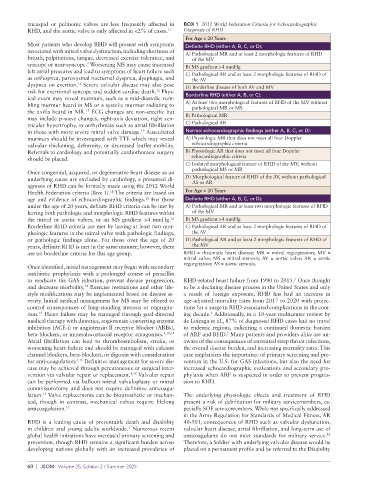
tricuspid or pulmonic valves are less frequently affected in   BOX 1  2012 World Federation Criteria for Echocardiographic
          RHD, and the aortic valve is only affected in <2% of cases. 11  Diagnosis of RHD
                                                              For Age < 20 Years
          Most patients who develop RHD will present with symptoms   Definite RHD (either A, B, C, or D):
          associated with mitral valve dysfunction, including shortness of   A)  Pathological MR and at least 2 morphologic features of RHD
          breath, palpitations, fatigue, decreased exercise tolerance, and   of the MV
                             4
          syncope or near-syncope.  Worsening MS may cause increased   B) MS gradient >4 mmHg
          left atrial pressures and lead to symptoms of heart failure such   C)  Pathological AR and at least 2 morphologic features of RHD of
          as orthopnea, paroxysmal nocturnal dyspnea, dysphagia, and   the AV
          dyspnea on exertion.  Severe valvular disease may also pose   D) Borderline disease of both AV and MV
                          12
          risk for exertional syncope and sudden cardiac death.  Phys-
                                                    12
          ical exam may reveal murmurs, such as a mid-diastolic rum-  Borderline RHD (either A, B, or C):

          bling murmur heard in MS or a systolic murmur radiating to   A)  At least two morphological features of RHD of the MV without
                                                                pathological MR or MS
          the axilla heard in MR.  ECG changes are non-specific but
                             13
          may include p-wave changes, right-axis deviation, right ven-  B) Pathological MR
          tricular hypertrophy, or arrhythmias such as atrial fibrillation   C) Pathological AR
                                               13
          in those with more severe mitral valve damage.  Auscultated   Normal echocardiographic findings (either A, B, C, or D):
          murmurs should be investigated with TTE which may reveal   A)  Physiologic MR that does not meet all four Doppler
          valvular thickening, deformity, or decreased leaflet mobility.   echocardiographic criteria
          Referrals to cardiology and potentially cardiothoracic surgery   B)  Physiologic AR that does not meet all four Doppler
          should be placed.                                     echocardiographic criteria
                                                              C)  Isolated morphological feature of RHD of the MV, without
                                                                pathological MS or MR
          Once congenital, acquired, or degenerative heart disease as an
          underlying cause are excluded by cardiology, a presumed di-  D)  Morphological feature of RHD of the AV, without pathological
                                                                AS or AR
          agnosis of RHD can be formally made using the 2012 World
          Health Federation criteria (Box 1).  The criteria are based on   For Age > 20 Years
                                     11
          age and evidence of echocardiographic findings.  For those   Definite RHD (either A, B, C, or D):
                                                 10
          under the age of 20 years, definite RHD criteria can be met by   A)  Pathological MR and at least two morphologic features of RHD
          having both pathologic and morphologic RHD features within   of the MV
          the mitral or aortic valves, or an MS gradient >4 mmHg.    B) MS gradient >4 mmHg
                                                         10
          Borderline RHD criteria are met by having at least two mor-  C)  Pathological AR and at least 2 morphologic features of RHD of
          phologic features in the mitral valve with pathologic findings,   the AV
          or pathologic findings alone. For those over the age of 20   D)  Pathological AR and at least 2 morphologic features of RHD of
          years, definite RHD is met in the same manner; however, there   the MV
          are no borderline criteria for this age group.     RHD = rheumatic heart disease; MR = mitral regurgitation; MV =
                                                             mitral valve; MS = mitral stenosis; AV = aortic valve; AR = aortic
                                                               regurgitation; AS = aortic stenosis.
          Once identified, initial management may begin with secondary
          antibiotic prophylaxis with a prolonged course of penicillin
          to eradicate the GAS infection, prevent disease progression,   RHD-related heart failure from 1990 to 2015.  Once thought
                                                                                                 5
          and decrease morbidity.  Exercise restrictions and other life-  to be a declining disease process in the United States and only
                             14
          style modifications may be implemented based on disease se-  a result of foreign exposure, RHD has had an increase in
          verity. Initial medical management for MS may be offered to   age-adjusted mortality rates from 2017 to 2020 with projec-
          control consequences of long-standing stenosis or regurgita-  tions for a surge in RHD-associated complications in the com-
                                                                      3
              15
          tion.  Heart failure may be managed through goal-directed   ing decade.  Additionally, in a 10-year multicenter review by
          medical therapy with diuretics, angiotensin-converting enzyme   de Loizaga et al., 87% of diagnosed RHD cases had no travel
          inhibition (ACE-i) or angiotensin II receptor blocker (ARBs),   to endemic regions, indicating a continued domestic burden
          beta-blockers, or mineralocorticoid receptor antagonists. 4,11,15    of ARF and RHD.  Many patients and providers alike are un-
                                                                           2
          Atrial fibrillation can lead to thromboembolism, stroke, or   aware of the consequences of untreated strep throat infections,
          worsening heart failure and should be managed with calcium   the overall disease burden, and increasing mortality rates. This
          channel blockers, beta-blockers, or digoxin with consideration   case emphasizes the importance of primary screening and pre-
          for anti-coagulation. 4,15  Definitive management for severe dis-  vention in the U.S. for GAS infections, but also the need for
          ease may be achieved through percutaneous or surgical inter-  increased echocardiographic evaluations and secondary pro-
          vention via valvular repair or replacement. 4,15  Valvular repair   phylaxis when ARF is suspected in order to prevent progres-
          can be performed via balloon mitral valvuloplasty or mitral   sion to RHD.
          commissurotomy and does not require definitive anticoagu-
               15
          lation.  Valve replacements can be bioprosthetic or mechan-  The underlying physiologic effects and treatment of RHD
          ical, though in contrast, mechanical valves require lifelong   present a risk of debilitation for military servicemembers, es-
          anticoagulation. 15                                pecially SOF servicemembers. While not specifically addressed
                                                             in the Army Regulation for Standards of Medical Fitness, AR
          RHD is a leading cause of preventable death and disability   40-501, consequences of RHD such as valvular dysfunction,
          in children and young adults worldwide.  Numerous recent   valvular heart disease, atrial fibrillation, and long-term use of
                                           1
                                                                                                            16
          global health initiations have increased primary screening and   anticoagulants do not meet standards for military service.
          prevention, though RHD remains a significant burden across   Therefore, a Soldier with underlying valvular disease would be
          developing nations globally with an increased prevalence of   placed on a permanent profile and be referred to the Disability
          60  |  JSOM   Volume 25, Edition 2 / Summer 2025

