


Page 66 - JSOM Summer 2025
P. 66
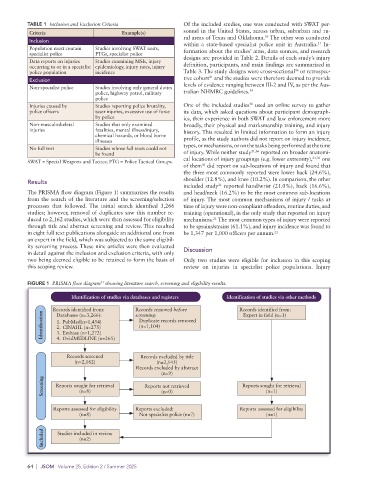
TABLE 1  Inclusion and Exclusion Criteria          Of the included studies, one was conducted with SWAT per-
           Criteria                      Example(s)          sonnel in the United States, across urban, suburban and ru-
                                                                                        36
                                                             ral areas of Texas and Oklahoma.  The other was conducted
           Inclusion                                         within a state-based specialist police unit in Australia.  In-
                                                                                                         21
           Population must contain   Studies involving SWAT units,   formation about the studies’ aims, data sources, and research
           specialist police    PTGs, specialist police      designs are provided in Table 2. Details of each study’s injury
           Data reports on injuries   Studies examining MSIs, injury
           occurring to or in a specialist  epidemiology, injury rates, injury   definition, participants, and main findings are summarized in
                                                                                                 36
           police population    incidence                    Table 3. The study designs were cross-sectional  or retrospec-
                                                                     21
           Exclusion                                         tive cohort  and the studies were therefore deemed to provide
           Non-specialist police  Studies involving only general duties   levels of evidence ranging between III-2 and IV, as per the Aus-
                                                                                   54
                                police, highway patrol, military   tralian NHMRC guidelines.
                                police
                                                                                   36
           Injuries caused by    Studies reporting police brutality,   One of the included studies  used an online survey to gather
           police officers      taser injuries, excessive use of force   its data, which asked questions about participant demograph-
                                by police                    ics, their experience in both SWAT and law enforcement more
           Non-musculoskeletal    Studies that only examined   broadly, their physical and marksmanship training, and injury
           injuries             fatalities, mental illness/injury,   history. This resulted in limited information to form an injury
                                chemical hazards, or blood borne
                                illnesses                    profile, as the study authors did not report on injury incidence,
           No full text         Studies whose full texts could not   types, or mechanisms, or on the tasks being performed at the time
                                                                                   21,36
                                be found                     of injury. While neither study   reported on broader anatomi-
                                                                                                       21,36
          SWAT = Special Weapons and Tactics; PTG = Police Tactical Groups.  cal locations of injury groupings (e.g. lower extremity),   one
                                                             of them  did report on sub-locations of injury and found that
                                                                   36
                                                             the three most commonly reported were lower back (24.6%),
          Results                                            shoulder (12.8%), and knee (10.2%). In comparison, the other
                                                                        21
                                                             included study  reported hand/wrist (21.0%), back (16.6%),
          The PRISMA flow diagram (Figure 1) summarizes the results   and head/neck (16.2%) to be the most common sub-locations
          from the search of the literature and the screening/selection   of injury. The most common mechanisms of injury / tasks at
          processes that followed.  The initial search identified 3,266   time of injury were non-compliant offenders, routine duties, and
          studies; however, removal of duplicates saw this number re-  training (operational), in the only study that reported on injury
          duced to 2,162 studies, which were then assessed for eligibility   mechanisms.  The most common types of injury were reported
                                                                       21
          through title and abstract screening and review. This resulted   to be sprains/strains (61.1%), and injury incidence was found to
          in eight full text publications alongside an additional one from   be 1,347 per 1,000 officers per annum. 21
          an expert in the field, which was subjected to the same eligibil-
          ity screening process. These nine articles were then evaluated
          in detail against the inclusion and exclusion criteria, with only   Discussion
          two being deemed eligible to be retained to form the basis of   Only two studies were eligible for inclusion in this scoping
          this scoping review.                               review  on injuries  in  specialist  police populations.  Injury

          FIGURE 1  PRISMA flow diagram  showing literature search, screening and eligibility results.
                                  43
                        Identification of studies via databases and registers  Identification of studies via other methods
                  Records identified from:   Records removed before            Records identified from:
               Identification  1.  PubMed(n=1,454)  Duplicate records removed
                   Databases (n=3,266):
                                             screening:
                                                                                Expert in field (n=1)
                                               (n=1,104)
                   2.  CINAHL (n=275)
                   3.  Embase (n=1,272)
                   4.  OvidMEDLINE (n=265)
                       Records screened        Records excluded by title
                         (n=2,162)                  (n=2,145)
                                             Records excluded by abstract
                                                      (n=9)
               Screening  Reports sought for retrieval    Reports not retrieved    Reports sought for retrieval
                                                                                        (n=1)
                           (n=8)
                                                      (n=0)
                  Reports assessed for eligibility   Reports excluded:         Reports assessed for eligibility
                           (n=8)               Not specialist police (n=7)              (n=1)

               Included  Studies included in review
                           (n=2)


          64  |  JSOM   Volume 25, Edition 2 / Summer 2025

