


Page 57 - JSOM Summer 2025
P. 57
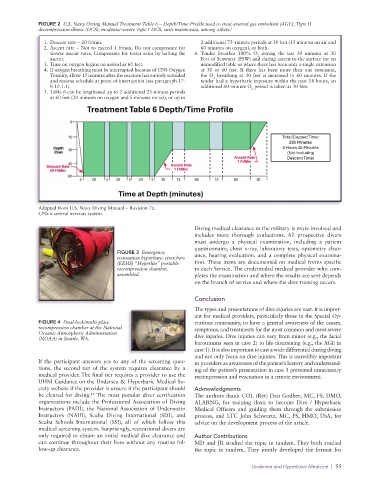
FIGURE 2  U.S. Navy Diving Manual Treatment Table 6 – Depth/Time Profile used to treat arterial gas embolism (AGE), Type II
              decompression illness (DCS), moderate-severe Type I DCS, cutis marmorata, among others. 1

               1.  Descent rate – 20 ft/min.                       2 additional 75–minute periods at 30 feet (15 minutes on air and
               2.  Ascent rate – Not to exceed 1 ft/min. Do not compensate for   60 minutes on oxygen), or both.
                 slower ascent rates. Compensate for faster rates by halting the   6.  Tender breathes 100% O  during the last 30 minutes at 30
                                                                                     2
                 ascent.                                           Feet of Seawater (FSW) and during ascent to the surface for an
               3.  Time on oxygen begins on arrival at 60 feet.    unmodified table or where there has been only a single extension
               4.  If oxygen breathing must be interrupted because of CNS Oxygen   at 30 or 60 feet. If there has been more than one extension,
                 Toxicity, allow 15 minutes after the reaction has entirely subsided   the O  breathing at 30 feet is increased to 60 minutes. If the
                                                                       2
                 and resume schedule at point of interruption (see paragraph 17-  tender had a hyperbaric exposure within the past 18 hours, an
                 8.10.1.1).                                        additional 60–minute O  period is taken at 30 feet.
                                                                                   2
               5.  Table 6 can be lengthened up to 2 additional 25-minute periods
                 at 60 feet (20 minutes on oxygen and 5 minutes on air), or up to


              Adapted from U.S. Navy Diving Manual – Revision 7a.
              CNS = central nervous system.

                                                                 Diving medical clearance in the military is more involved and
                                                                 includes more thorough evaluations.  All prospective divers
                                                                 must undergo a physical examination, including a patient
                                                                 questionnaire, chest x-ray, laboratory tests, optometry clear-
                                       FIGURE 3  Emergency       ance, hearing evaluation, and a complete physical examina-
                                       evacuation hyperbaric stretchers
                                       (EEHS) “Hyperlite” portable   tion. These items are documented on medical forms specific
                                       recompression chamber,    to each Service. The credentialed medical provider who com-
                                       assembled.                pletes the examination and where the results are sent depends
                                                                 on the branch of service and where the dive training occurs.

                                                                 Conclusion
                                                                 The types and presentations of dive injuries are vast. It is import-
                                                                 ant for medical providers, particularly those in the Special Op-
              FIGURE 4  Dual-lock/multi-place                    erations community, to have a general awareness of the causes,
              recompression chamber at the National              symptoms, and treatments for the most common and most severe
              Oceanic Atmospheric Administration
              (NOAA) in Seattle, WA.                             dive injuries. Dive injuries can vary from minor (e.g., the facial
                                                                 barotrauma seen in case 2) to life-threatening (e.g., the AGE in
                                                                 case 1). It is also important to cast a wide differential during diving
                                                                 and not only focus on dive injuries. This is incredibly important
              If the participant answers yes to any of the screening ques-  to providers as awareness of the patient’s history and understand-
              tions, the second tier of the system requires clearance by a   ing of the patient’s presentation in case 3 prevented unnecessary
              medical provider. The final tier requires a provider to use the   recompression and evacuation in a remote environment.
              UHM Guidance on the Undersea & Hyperbaric Medical So-
              ciety website if the provider is unsure if the participant should   Acknowledgments
              be cleared for diving.  The most popular diver certification   The authors thank COL (Ret) Dan Godbee, MC, FS, DMO,
                               12
              organizations include the Professional Association of Diving   ALARNG, for training them to become Dive / Hyperbaric
              Instructors (PADI), the National Association of Underwater   Medical Officers and guiding them through the submission
              Instructors (NAUI), Scuba Diving International (SDI), and   process, and LTC John Schwartz, MC, FS, HMO, USA, for
              Scuba Schools International (SSI), all of which follow this   advice on the development process of the article.
              medical screening system. Surprisingly, recreational divers are
              only required to obtain an initial medical dive clearance and   Author Contributions
              can continue throughout their lives without any routine fol-  MD and JR studied the topic in tandem. They both studied
              low-up clearance.                                  the topic in tandem. They jointly developed the format for

                                                                                   Undersea and Hyperbaric Medicine  |  55

