


Page 56 - JSOM Summer 2025
P. 56
1
          dive.  As a safety precaution, divers must continuously breathe   Decompression Sickness: Treatment
          out as they ascend from depth.                     Treatment for type I DCS varies by severity. According to the
                                                             U.S. Navy treatment tables, type II DCS is treated with 100%
          POIS includes AGE, pneumothorax, and mediastinal or sub-  oxygen and immediate recompression.  Recompression involves
                                                                                          1
          cutaneous emphysema. In addition to not exhaling during the   taking a diver back to “depth” under pressure (hyperbaric) to
          ascent, these injuries can also occur in individuals with asthma   increase the partial pressure of oxygen (PO ) at treatment depth,
                                                                                             2
          or chronic obstructive pulmonary disease, which causes air   thus increasing the oxygen gradient and pulling nitrogen (N )
                                                                                                            2
          trapping and local pulmonary obstructions. This overinflation   out of the system, followed by slow ascension with safety stops
          can lead to AGE, which may include apnea, unconsciousness,   to prevent bubble formation in the bloodstream and tissues.
          seizure, vertigo, sensory changes, confusion, loss of coordina-  This can be done at depth or out of water in a hyperbaric cham-
          tion, visual changes, weakness, numbness, and/or convulsions,   ber,  although chamber recompression is preferred. Recompres-
                                                                7
          which can manifest within minutes of surfacing.  This was ev-  sion should be done as quickly as possible, as delays of over 24
                                               3
          ident in case 1, where the patient began developing symptoms   hours are associated with a far higher rate of residual symptoms
          13 minutes after surfacing.                        after recompression therapy.  As seen in Figure 2, the U.S. Navy
                                                                                  8
                                                             Diving Manual has a series of treatment tables that describe
          Treatment for POIS includes 100% oxygen, basic first aid, and   indications and treatment strategies for injured divers using hy-
                                         6
          immediate recompression as necessary.  Application  of Ad-  perbaric chambers to achieve recompression. 1
          vanced Cardiac Life Support protocols, needle chest decom-
          pression, and tube or open thoracostomy may also be required   The preferred method for out-of-water recompression is the
          to treat POIS.  The best strategy is POIS prevention, which   dual-lock/multi-place recompression chamber (Figure 4). This
                     1
          highlights the importance of well-trained and calm divers who   chamber allows inside tenders to be changed out if needed and
          do not panic and continually exhale during ascent. Equally im-  allows supplies larger than the med-lock to be locked into the
          portant is the diver’s need to report any current illness or med-  treatment lock. Unfortunately, these are located at fixed facil-
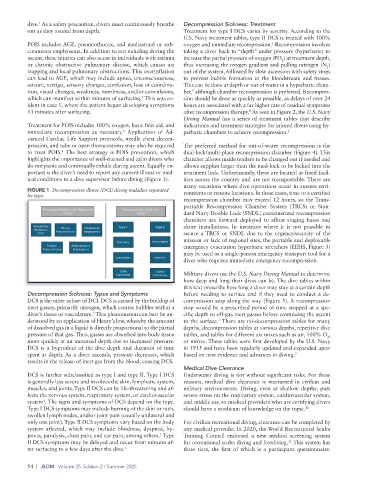
          ical conditions to a dive supervisor before diving (Figure 1).  ities across the country and are not transportable. There are
                                                             many occasions where dive operations occur in austere envi-
          FIGURE 1  Decompression illness (DCI) diving maladies separated   ronments or remote locations. In these cases, time to a certified
          by type.
                                                             recompression chamber may exceed 12 hours, so the Trans-
                                                             portable Recompression Chamber System (TRCS) or Stan-
               Pulmonary Overinflation Syndrome   Decompression Sickness
                     “POIS”                   “DCS”          dard Navy Double Lock (SNDL) containerized recompression
                                                             chambers are forward deployed to afloat staging bases and
            Arterial Gas   Simple   Mediastinal   Type 1  Type 2  shore installations. In instances where it is not possible to
            Embolism   Pneumothorax  Emphysema
             “AGE”                                           secure  a TRCS  or  SNDL  due  to  the  urgency/security  of  the
                                                             mission or lack of regional sites, the portable and deployable
                                       Pain Only   Neurological
                Tension   Subcutaneous                       emergency evacuation hyperbaric stretchers (EEHS, Figure 3)
               Pneumothorax  Emphysema
                                                             may be used as a single-person emergency transport tool for a
                                       Lymphatics  Inner Ear
                                                             diver who requires immediate emergency recompression.
                                        Cutis       Cardio
                                       Marmorata   Pulmonary  Military divers use the U.S. Navy Diving Manual to determine
                                                             how deep and long their dives can be. The dive tables within
                                                             this text prescribe how long a diver may stay at a certain depth
          Decompression Sickness: Types and Symptoms         before needing to surface and if they need to conduct a de-
          DCS is the other subset of DCI. DCS is caused by the buildup of   compression stop along the way (Figure 5). A recompression
          inert gasses, primarily nitrogen, which creates bubbles within a   stop would be a prescribed period of time stopped at a spe-
                               3
          diver’s tissue or vasculature.  This phenomenon can best be un-  cific depth to off-gas inert gasses before continuing the ascent
          derstood by an application of Henry’s law, whereby the amount   to the surface.  There are no-decompression tables for many
                                                                        1
          of dissolved gas in a liquid is directly proportional to the partial   depths, decompression tables at various depths, repetitive dive
          pressure of that gas. Thus, gasses are absorbed into body tissue   tables, and tables for different air mixes such as air, 100% O ,
                                                                                                            2
          more quickly at an increased depth due to increased pressure.   or nitrox. These tables were first developed by the U.S. Navy
          DCS is a byproduct of the dive depth and duration of time   in 1915 and have been regularly updated and expanded upon
          spent at depth. As a diver ascends, pressure decreases, which   based on new evidence and advances in diving. 9
          results in the release of inert gas from the blood, causing DCS.
                                                             Medical Dive Clearance
          DCS is further subclassified as type I and type II. Type I DCS   Underwater diving is not without significant risks. For these
          is generally less severe and involves the skin, lymphatic system,   reasons, medical dive clearance is warranted in civilian and
          muscles, and joints. Type II DCS can be life-threatening and af-  military environments. Diving, even at shallow depths, puts
          fects the nervous system, respiratory system, or cardiovascular   severe stress on the respiratory system, cardiovascular system,
          system . The signs and symptoms of DCS depend on the type.   and middle ear, so medical providers who are certifying divers
               1
          Type I DCS symptoms may include burning of the skin or rash,   should have a modicum of knowledge on the topic. 10
          swollen lymph nodes, and/or joint pain (usually unilateral and
          only one joint). Type II DCS symptoms vary based on the body   For civilian recreational diving, clearance can be completed by
          system affected, which may include blindness, dyspnea, hy-  any medical provider. In 2020, the World Recreational Scuba
          poxia, paralysis, chest pain, and ear pain, among others.  Type   Training Council endorsed a new medical screening system
                                                     1
          II DCS symptoms may be delayed and occur from minutes af-  for recreational scuba diving and freediving.  This system has
                                                                                               11
          ter surfacing to a few days after the dive. 1      three tiers, the first of which is a participant questionnaire.
          54  |  JSOM   Volume 25, Edition 2 / Summer 2025

