


Page 124 - JSOM Winter 2024
P. 124
40
          cope with a broader range of stress-inducing demands.  In-  the third most common domains. Finally, domains 6 and 8
          dividuals with higher levels of general self-efficacy tend to be   were the least common domains to have an increase in self-
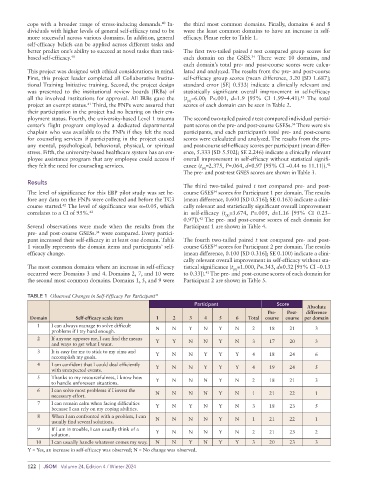
          more successful across various domains. In addition, general   efficacy. Please refer to Table 1.
          self-efficacy beliefs can be applied across different tasks and
          better predict one’s ability to succeed at novel tasks than task-  The first two-tailed paired t test compared group scores for
                                                                                   34
          based self-efficacy. 40                            each domain on the GSES.   There were 10 domains, and
                                                             each domain’s total pre- and post-course scores were calcu-
          This project was designed with ethical considerations in mind.   lated and analyzed. The results from the pre- and post-course
          First, this project leader completed all Collaborative Institu-  self- efficacy group scores (mean difference, 3.20 [SD 1.687];
          tional Training Initiative training. Second, the project design   standard error [SE] 0.533) indicate a clinically relevant and
          was presented to the institutional review boards (IRBs) of   statistically significant overall improvement in self-efficacy
                                                                                                   42
          all the involved institutions for approval. All IRBs gave the   (t =6.00;  P<.001,  d=1.9 [95% CI 1.99–4.41).  The  total
                                                              (8)
                              41
          project an exempt status.  Third, the FNPs were assured that   scores of each domain can be seen in Table 2.
          their participation in the project had no bearing on their em-
          ployment status. Fourth, the university-based Level 1 trauma   The second two-tailed paired t test compared individual partici-
          center’s flight program employed a dedicated departmental   pant scores on the pre- and post-course GSESs.  There were six
                                                                                                34
          chaplain who was available to the FNPs if they felt the need   participants, and each participant’s total pre- and post-course
          for counseling services if participating in the project caused   scores were calculated and analyzed. The results from the pre-
          any mental, psychological, behavioral, physical, or spiritual   and post-course self-efficacy scores per participant (mean differ-
          stress. Fifth, the university-based healthcare system has an em-  ence, 5.333 [SD 5.502]; SE 2.246) indicate a clinically relevant
          ployee assistance program that any employee could access if   overall improvement in self-efficacy without statistical signifi-
                                                                                                            42
          they felt the need for counseling services.        cance (t =2.375, P=.064, d=0.97 [95% CI –0.44 to 11.11]).
                                                                   (4)
                                                             The pre- and post-test GSES scores are shown in Table 3.
          Results
                                                             The third two-tailed paired  t test compared pre- and post-
                                                                       34
          The level of significance for this EBP pilot study was set be-  course GSES  scores for Participant 1 per domain. The results
          fore any data on the FNPs were collected and before the TC3   (mean difference, 0.600 [SD 0.516]; SE 0.163) indicate a clini-
          course started.  The level of significance was a=0.05, which   cally relevant and statistically significant overall improvement
                     42
          correlates to a CI of 95%. 42                      in self-efficacy (t =3.674,  P=.005,  d=1.16 [95% CI 0.23–
                                                                           (8)
                                                                  42
                                                             0.97]).  The pre- and post-course scores of each domain for
          Several observations were made when the results from the   Participant 1 are shown in Table 4.
                                34
          pre- and post-course GSESs.  were compared. Every partici-
          pant increased their self-efficacy in at least one domain. Table   The fourth two-tailed paired t test compared pre- and post-
                                                                       34
          1 visually represents the domain items and participants’ self-   course GSES  scores for Participant 2 per domain. The results
          efficacy change.                                   (mean difference, 0.100 [SD 0.316]; SE 0.100) indicate a clini-
                                                             cally relevant overall improvement in self-efficacy without sta-
          The most common domains where an increase in self-efficacy   tistical significance (t =1.000, P=.343, d=0.32 [95% CI –0.13
                                                                             (8)
          occurred were Domains 3 and 4. Domains 2, 7, and 10 were   to 0.33]).  The pre- and post-course scores of each domain for
                                                                    42
          the second most common domains. Domains 1, 5, and 9 were   Participant 2 are shown in Table 5.
          TABLE 1  Observed Changes in Self-Efficacy Per Participant 34
                                                                 Participant               Score     Absolute
                                                                                         Pre-  Post-  difference
           Domain         Self-efficacy scale item  1    2     3    4    5    6   Total  course   course   per domain
             1    I can always manage to solve difficult
                  problems if I try hard enough.    N    N     Y    N    Y    N    2     18     21      3
             2    If anyone opposes me, I can find the means
                  and ways to get what I want.      Y    Y     N    N    Y    N    3     17     20      3
             3    It is easy for me to stick to my aims and
                  accomplish my goals.              Y    N     N    Y    Y    Y    4     18     24      6
             4    I am confident that I could deal efficiently   Y  N  N  Y  Y  Y  4     19     24      5
                  with unexpected events.
             5    Thanks to my resourcefulness, I know how   Y  N  N  N  Y    N    2     18     21      3
                  to handle unforeseen situations.
             6    I can solve most problems if I invest the   N  N  N  N  Y   N    1     21     22      1
                  necessary effort.
             7    I can remain calm when facing difficulties   Y  N  Y  N  Y  N    3     18     23      5
                  because I can rely on my coping abilities.
             8    When I am confronted with a problem, I can
                  usually find several solutions.   N    N     N    N    Y    N    1     21     22      1
             9    If I am in trouble, I can usually think of a
                  solution.                         Y    N     N    N    Y    N    2     21     23      2
             10   I can usually handle whatever comes my way.  N  N  Y  N  Y  Y    3     20     23      3
          Y = Yes, an increase in self-efficacy was observed; N = No change was observed.

          122  |  JSOM   Volume 24, Edition 4 / Winter 2024

