


Page 126 - JSOM Winter 2024
P. 126
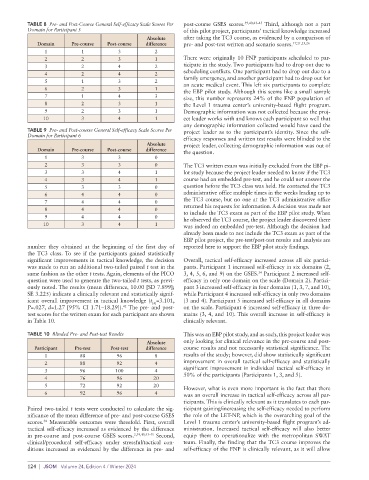
TABLE 8  Pre- and Post-Course General Self-efficacy Scale Scores Per   post-course  GSES scores. 39,40,43–45  Third,  although not a part
          Domain for Participant 5                           of this pilot project, participants’ tactical knowledge increased
                                                 Absolute    after taking the TC3 course, as evidenced by a comparison of
             Domain     Pre-course   Post-course   difference  pre- and post-test written and scenario scores. 17,21,23,26
                1           1           3           2
                2           2           3           1        There were originally 10 FNP participants scheduled to par-
                3           2           4           2        ticipate in the study. Two participants had to drop out due to
                4           2           4           2        scheduling conflicts. One participant had to drop out due to a
                                                             family emergency, and another participant had to drop out for
                5           1           3           2        an acute medical event. This left six participants to complete
                6           2           3           1        the EBP pilot study. Although this seems like a small sample
                7           1           4           3        size, this number represents 24% of the FNP population of
                8           2           3           1        the Level 1 trauma center’s university-based flight program.
                9           2           3           1        Demographic information was not collected because the proj-
               10           3           4           1        ect leader works with and knows each participant so well that
                                                             any demographic information collected would have cued the
          TABLE 9  Pre- and Post-course General Self-efficacy Scale Scores Per   project leader as to the participant’s identity. Since the self-
          Domain for Participant 6
                                                             efficacy responses and written test results were blinded to the
                                                 Absolute    project leader, collecting demographic information was out of
             Domain     Pre-course   Post-course   difference  the question.
                1           3           3           0
                2           3           3           0        The TC3 written exam was initially excluded from the EBP pi-
                3           3           4           1        lot study because the project leader needed to know if the TC3
                4           3           4           1        course had an embedded pre-test, and he could not answer the
                5           3           3           0        question before the TC3 class was held. He contacted the TC3
                6           4           4           0        administrative office multiple times in the weeks leading up to
                7           4           4           0        the TC3 course, but no one at the TC3 administrative office
                                                             returned his requests for information. A decision was made not
                8           4           4           0        to include the TC3 exam as part of the EBP pilot study. When
                9           4           4           0        he observed the TC3 course, the project leader discovered there
               10           3           4           1        was indeed an embedded pre-test. Although the decision had
                                                             already been made to not include the TC3 exam as part of the
                                                             EBP pilot project, the pre-test/post-test results and analysis are
          number they obtained at the beginning of the first day of    reported here to support the EBP pilot study findings.
          the TC3 class. To see if the participants gained statistically
          significant improvements in tactical knowledge, the decision   Overall, tactical self-efficacy increased across all six partici-
          was made to run an additional two-tailed paired t test in the   pants. Participant 1 increased self-efficacy in six domains (2,
                                                                                     34
          same fashion as the other t tests. Again, elements of the PICO   3, 4, 5, 6, and 9) on the GSES.  Participant 2 increased self-
          question were used to generate the two-tailed t tests, as previ-  efficacy in only one domain on the scale (Domain 2). Partici-
          ously noted. The results (mean difference, 10.00 [SD 7.899];   pant 3 increased self-efficacy in four domains (1, 3, 7, and 10),
          SE 3.225) indicate a clinically relevant and statistically signif-  while Participant 4 increased self-efficacy in only two domains
          icant  overall improvement  in tactical knowledge  (t =3.101,   (3 and 4). Participant 5 increased self-efficacy in all domains
                                                   (4)
                                         42
          P=.027, d=1.27 [95% CI 1.71–18.29]).  The pre- and post-  on the scale. Participant 6 increased self-efficacy in three do-
          test scores for the written exam for each participant are shown   mains (3, 4, and 10). This overall increase in self-efficacy is
          in Table 10.                                       clinically relevant.
          TABLE 10  Blinded Pre- and Post-test Results       This was an EBP pilot study, and as such, this project leader was
                                                 Absolute    only looking for clinical relevance in the pre-course and post-
            Participant  Pre-test    Post-test   difference  course results and not necessarily statistical significance. The
                1          88          96           8        results of the study; however, did show statistically significant
                2          88          92           4        improvement in overall tactical self-efficacy and statistically
                3          96          100          4        significant improvement in individual tactical self-efficacy in
                                                             50% of the participants (Participants 1, 3, and 5).
                4          76          96          20
                5          72          92          20        However, what is even more important is the fact that there
                6          92          96           4        was an overall increase in tactical self-efficacy across all par-
                                                             ticipants. This is clinically relevant as it translates to each par-
          Paired two-tailed t tests were conducted to calculate the sig-  ticipant gaining/increasing the self-efficacy needed to perform
          nificance of the mean difference of pre- and post-course GSES   the role of the LET-NP, which is the overarching goal of the
          scores.  Measurable outcomes were threefold. First, overall   Level 1 trauma center’s university-based flight program’s ad-
               34
          tactical self-efficacy increased as evidenced by the difference   ministration. Increased tactical self-efficacy will also better
          in pre-course and post-course GSES scores. 2,39,40,43-45  Second,   equip them to operationalize with the metropolitan SWAT
          clinical/procedural  self-efficacy  under  stressful/tactical  con-  team. Finally, the finding that the TC3 course improves the
          ditions increased as evidenced by the difference in pre- and   self- efficacy of the FNP is clinically relevant, as it will allow

          124  |  JSOM   Volume 24, Edition 4 / Winter 2024

