


Page 90 - JSOM Winter 2023
P. 90
and accessories useful  in  the times of turmoil.  Using rapid   https://nkhome.com/) to ensure all tests were conducted in
          manufacturing methods and quick research and development   similar conditions, including temperature and humidity.
          processes, they have manufactured tens of thousands of parts
          for Ukrainian nongovernmental organizations (NGOs), med-  Before every test, ambient atmospheric pressure was measured
          ical facilities, the army, and many others. Among them is a   as a baseline, and this was subtracted from the absolute pres-
          3D-printed tourniquet.                             sure recorded by the transducer to give gauge pressure. The
                                                             tourniquet,  with the  pressure  cuff  situated  underneath, was
          Therefore, this study aimed to investigate how the 3D-printed   then tightened around a minimally compressible, water-filled
          tourniquet compared to the existing and recommended com-  bottle representative in the dimensions of a male adult upper
          mercially available tourniquets with respect to how effectively   limb and recording of pressure commenced. Each tourniquet
          it attains and maintains effective pressure for an extended pe-  was positioned and tightened by the same expert provider on
          riod of time.                                      every occasion. Once correctly in place, we aimed to tighten to a
                                                             starting pressure of more than 300mmHg above baseline. This
                                                             should be sufficient to stop arterial circulation in humans. 9,10
          Methods
                                                             Most starting pressures were between 200−400mmHg above
          Experimental Overview                              baseline. When beginning the test, all three tourniquets were
          We compared three types of tourniquets for their ability to   new and had never been before used. Each was tested 15 times
          attain effective arterial occlusion pressure and sustain that   for the full 120-minute period.
          pressure thereafter. Two tourniquets were commercially avail-
          able models and the third was a 3D-printed version based on   Tourniquets
          an open-source design. Each tourniquet was placed around a   Three types of tourniquets were investigated in this project.
          minimally compressible cylinder (Nalgene 32-oz Wide Mouth   Each broadly consisted of a minimally-elongating, flexible
          Tritan Water Bottle (diameter 8.9 cm), https://nalgene.com/)   webbing strap used to encircle a limb, and a locking windlass
          in accordance with the manufacturer’s instructions for appli-  system capable of generating and maintaining tension within
          cation. The 3D-printed version was placed according to the   the webbing strap.
          instructions of the C-A-T as no instruction has been provided
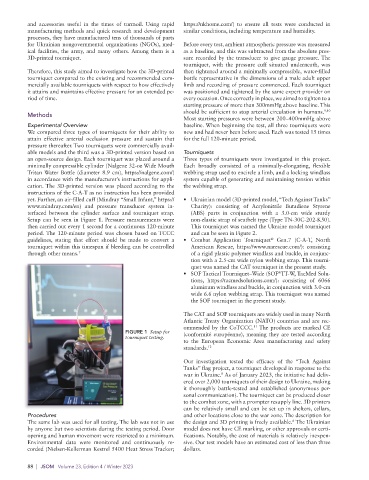
          yet. Further, an air-filled cuff (Mindray “Small Infant,” https://  •  Ukrainian model (3D-printed model, “Tech Against Tanks”
          www.mindray.com/en) and pressure transducer system in-  Charity): consisting of  Acrylonitrile Butadiene Styrene
          terfaced  between the  cylinder surface  and  tourniquet strap.   (ABS) parts in conjunction with a 3.0-cm wide sturdy
          Setup can be seen in Figure 1. Pressure measurements were   non-elastic strap of seatbelt type (Type TN-30C-202-K50).
          then carried out every 1 second for a continuous 120-minute   This tourniquet was named the Ukraine model tourniquet
          period. The 120-minute period was chosen based on TCCC   and can be seen in Figure 2.
                                                                                          ®
          guidelines, stating that effort should be made to convert a   •  Combat Application Tourniquet  Gen.7 (C-A-T, North
          tourniquet within this timespan if bleeding can be controlled   American  Rescue,  https://www.narescue.com/):  consisting
          through other means. 7                               of a rigid plastic polymer windlass and buckle, in conjunc-
                                                               tion with a 2.5-cm wide nylon webbing strap. This tourni-
                                                               quet was named the CAT tourniquet in the present study.
                                                                                            ®
                                                             •  SOF Tactical Tourniquet–Wide (SOF TT-W, TacMed Solu-
                                                               tions,  https://tacmedsolutions.com/): consisting of 6066
                                                               aluminum windlass and buckle, in conjunction with 3.0-cm
                                                               wide 6.6 nylon webbing strap. This tourniquet was named
                                                               the SOF tourniquet in the present study.
                                                             The CAT and SOF tourniquets are widely used in many North
                                                             Atlantic Treaty Organization (NATO) countries and are rec-
                                                             ommended by the CoTCCC.  The products are marked CE
                                                                                    11
                                          FIGURE 1  Setup for   (conformité européenne), meaning they are tested according
                                          tourniquet testing.
                                                             to  the European  Economic  Area manufacturing  and  safety
                                                             standards. 12
                                                             Our investigation tested the efficacy of the  “Tech  Against
                                                             Tanks” flag project, a tourniquet developed in response to the
                                                                         8
                                                             war in Ukraine.  As of January 2023, the initiative had deliv-
                                                             ered over 2,000 tourniquets of their design to Ukraine, making
                                                             it thoroughly battle-tested and established (anonymous per-
                                                             sonal communication). The tourniquet can be produced closer
                                                             to the combat zone, with a prompter resupply line. 3D printers
                                                             can be relatively small and can be set up in shelters, cellars,
          Procedures                                         and other locations close to the war zone. The description for
          The same lab was used for all testing. The lab was not in use   the design and 3D printing is freely available.  The Ukrainian
                                                                                                 8
          by anyone but two scientists during the testing period. Door   model does not have CE marking, or other approvals or certi-
          opening and human movement were restricted to a minimum.   fications. Notably, the cost of materials is relatively inexpen-
          Environmental data were monitored and continuously re-  sive. Our test models have an estimated cost of less than three
          corded (Nielsen-Kellerman Kestrel 5400 Heat Stress Tracker;   dollars.

          88  |  JSOM   Volume 23, Edition 4 / Winter 2023

