


Page 92 - JSOM Winter 2023
P. 92
Pressure Data                                      There are reports of counterfeit tourniquets. 18,19  While tourni-
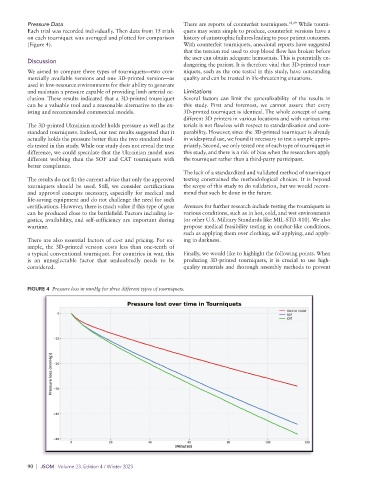
          Each trial was recorded individually. Then data from 15 trials   quets may seem simple to produce, counterfeit versions have a
          on each tourniquet was averaged and plotted for comparison   history of catastrophic failures leading to poor patient outcomes.
          (Figure 4).                                        With counterfeit tourniquets, anecdotal reports have suggested
                                                             that the tension rod used to stop blood flow has broken before
                                                             the user can obtain adequate hemostasis. This is potentially en-
          Discussion
                                                             dangering the patient. It is therefore vital that 3D-printed tour-
          We aimed to compare three types of tourniquets—two com-  niquets, such as the one tested in this study, have outstanding
          mercially available versions and one 3D-printed version—as   quality and can be trusted in life-threatening situations.
          used in low-resource environments for their ability to generate
          and maintain a pressure capable of providing limb arterial oc-  Limitations
          clusion. These results indicated that a 3D-printed tourniquet   Several factors can limit the generalizability of the results in
          can be a valuable tool and a reasonable alternative to the ex-  this study. First and foremost, we cannot assure that every
          isting and recommended commercial models.          3D-printed tourniquet is identical. The whole concept of using
                                                             different 3D printers in various locations and with various ma-
          The 3D-printed Ukrainian model holds pressure as well as the   terials is not flawless with respect to standardization and com-
          standard tourniquets. Indeed, our test results suggested that it   parability. However, since the 3D-printed tourniquet is already
          actually holds the pressure better than the two standard mod-  in widespread use, we found it necessary to test a sample appro-
          els tested in this study. While our study does not reveal the true   priately. Second, we only tested one of each type of tourniquet in
          difference, we could speculate that the Ukrainian model uses   this study, and there is a risk of bias when the researchers apply
          different webbing than the SOF and CAT tourniquets with   the tourniquet rather than a third-party participant.
          better compliance.
                                                             The lack of a standardized and validated method of tourniquet
          The results do not fit the current advice that only the approved   testing constrained the methodological choices. It is beyond
          tourniquets should be used. Still, we consider certifications   the scope of this study to do validation, but we would recom-
          and approval concepts necessary, especially for medical and   mend that such be done in the future.
          life-saving equipment and do not challenge the need for such
          certifications. However, there is much value if this type of gear   Avenues for further research include testing the tourniquets in
          can be produced close to the battlefield. Factors including lo-  various conditions, such as in hot, cold, and wet environments
          gistics, availability, and self-sufficiency are important during   (or other U.S. Military Standards like MIL-STD-810). We also
          wartime.                                           propose medical feasibility testing in combat-like conditions,
                                                             such as applying them over clothing, self-applying, and apply-
          There are also essential factors of cost and pricing. For ex-  ing in darkness.
          ample, the 3D-printed version costs less than one-tenth of
          a typical conventional tourniquet. For countries in war, this   Finally, we would like to highlight the following points. When
          is an unneglectable factor that undoubtedly needs to be   producing 3D-printed tourniquets, it is crucial to use high-
          considered.                                        quality materials and thorough assembly methods to prevent


          FIGURE 4  Pressure loss in mmHg for three different types of tourniquets.


                                                          (


          90  |  JSOM   Volume 23, Edition 4 / Winter 2023

