


Page 85 - JSOM Winter 2023
P. 85
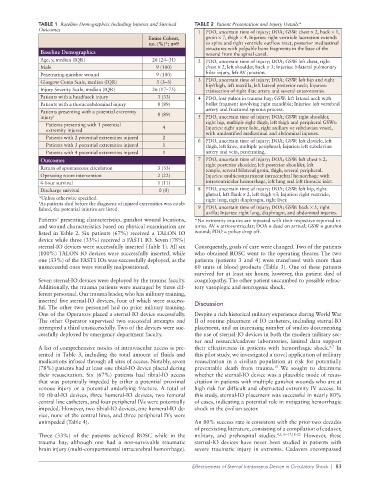
TABLE 1  Baseline Demographics Including Injuries and Survival   TABLE 2  Patient Presentation and Injury Details*
              Outcomes                                            1  PDO, uncertain time of injury; DOA; GSW: chest × 2, back × 1,
                                                  Entire Cohort,    groin × 7, thigh × 4. Injuries: right ventricle laceration extends
                                                  no. (%)*; n=9     to spine and right ventricle outflow tract, posterior mediastinal
              Baseline Demographics                                 structures with palpable bone fragments in the base of the
                                                                    wound from the spinal canal.
              Age, y, median (IQR)                 26 (24–31)     2  PDO, uncertain time of injury; DOA; GSW: left chest, right
              Male                                  9 (100)         chest × 2, left shoulder, back × 3; Injuries: bilateral pulmonary
              Penetrating-gunshot wound             9 (100)         hilar injury, left AV junction.
              Glasgow Coma Scale, median (IQR)      3 (3–3)       3  PDO, uncertain time of injury; DOA; GSW: left hip and right
                                                                    hip/thigh, left maxilla, left lateral posterior neck; Injuries:
              Injury Severity Scale, median (IQR)  26 (17–75)       transection of right iliac artery and several enterotomies.
              Patients with a head/neck injury       3 (33)       4  PDO, lost pulses in trauma bay; GSW: left lateral neck with
              Patients with a thoracoabdominal injury  8 (89)       bullet fragment involving right mandible; Injuries: left vertebral
              Patients presenting with a potential extremity        artery and fractured spinous process.
              injury †                               8 (89)       5  PDO, uncertain time of injury; DOA; GSW: right shoulder,
                Patients presenting with 1 potential                right hip, multiple right thigh, left thigh and peripheral GSWs:
                extremity injured                     4             Injuries: right upper lobe, right axillary or subclavian vessel,
                                                                    with unidentified mediastinal and abdominal injuries.
                Patients with 2 potential extremities injured  2
                                                                  6  PDO, uncertain time of injury; DOA; GSW: left clavicle, left
                Patients with 3 potential extremities injured  1    thigh, left knee, multiple peripheral; Injuries: left subclavian
                Patients with 4 potential extremities injured  1    artery and vein, penetrating,
              Outcomes                                            7  PDO, uncertain time of injury; DOA; GSW: left chest × 2,
              Return of spontaneous circulation      3 (33)         right posterior shoulder, left posterior shoulder, left
                                                                    temple, several bilateral groin, thigh, several peripheral.
              Operating room intervention            2 (22)         Injuries: multicompartment intracerebral hemorrhage with
              6-hour survival                        1 (11)         intraventricular hemorrhage, left lung and left thoracic inlet.
              Discharge survival                     0 (0)        8  PDO, uncertain time of injury; DOA; GSW: left hip, right
              *Unless otherwise specified.                          gluteal, left flank × 2, left thigh ×3; Injuries: right ventricle,
                                                                    right lung, right diaphragm, right liver.
              † As patients died before the diagnosis of injured extremities was estab-
              lished, the potential injuries are listed.          9  PDO, uncertain time of injury; DOA; GSW: back × 5, right
                                                                    axilla; Injuries: right lung, diaphragm, and abdominal injuries.
              Patients’ presenting characteristics, gunshot wound locations,   *No extremity injuries are repeated with their respective reported in-
              and wound characteristics based on physical examination are   juries. AV = atrioventricular; DOA = dead on arrival; GSW = gunshot
              listed in Table 2. Six patients (67%) received a TALON IO   wound; PDO = police drop off.
              device while three (33%) received a FAST1 IO. Seven (78%)
              sternal-IO devices were successfully inserted (Table 1). All six   Consequently, goals of care were changed. Two of the patients
              (100%) TALON IO devices were successfully inserted, while   who obtained ROSC went to the operating theater. The two
              one (33%) of the FAST1 IOs was successfully deployed, as the   patients (patients 3 and 4) were transfused with more than
              unsuccessful ones were visually malpositioned.     60 units of blood products (Table 3). One of these patients
                                                                 survived for at least six hours; however, this patient died of
              Seven sternal-IO devices were deployed by the trauma faculty.   coagulopathy. The other patient succumbed to possible refrac-
              Additionally, the trauma patients were managed by three dif-  tory vasoplegic and neurogenic shock.
              ferent personnel. Our trauma leader, who has military training,
              inserted five sternal-IO devices, four of which were success-  Discussion
              ful. The other two personnel had no prior military training.
              One of the Operators placed a sternal-IO device successfully.   Despite a rich historical military experience during World War
              The other Operator supervised two successful attempts and   II of routine placement of IO catheters, including sternal-IO
              attempted a third unsuccessfully. Two of the devices were suc-  placement, and an increasing number of studies documenting
              cessfully deployed by emergency department faculty.  the use of sternal-IO devices in both the modern military sec-
                                                                 tor  and  research/cadaver  laboratories,  limited  data  support
                                                                                                             6,7
              A list of comprehensive modes of intravascular access is pre-  their effectiveness in patients with hemorrhagic shock.  In
              sented in Table 3, including the total amount of fluids and   this pilot study, we investigated a novel application of military
              medications infused through all sites of access. Notably, seven   resuscitation  in  a  civilian  population  at  risk  for  potentially
                                                                                           15
              (78%) patients had at least one tibial-IO device placed during   preventable death from trauma.   We sought to determine
              their resuscitation. Six (67%) patients had tibial-IO access   whether the sternal-IO device was a plausible mode of resus-
              that was potentially impeded by either a potential proximal   citation in patients with multiple gunshot wounds who are at
              venous injury or a potential underlying fracture. A total of   high risk for difficult and obstructed extremity IV access. In
              10 tibial-IO devices, three humeral-IO devices, two femoral   this study, sternal-IO placement was successful in nearly 80%
              central line catheters, and four peripheral IVs were potentially   of cases, indicating a potential role in mitigating hemorrhagic
              impeded. However, two tibial-IO devices, one humeral-IO de-  shock in the civilian sector.
              vice, none of the central lines, and three peripheral IVs were
              unimpeded (Table 4).                               An 80% success rate is consistent with the prior two decades
                                                                 of preexisting literature, consisting of a compilation of cadaver,
              Three (33%) of the patients achieved ROSC while in the   military, and prehospital studies. 4,5,16–17,18–22  However, these
              trauma bay, although one had a non-survivable traumatic     sternal-IO  devices  have  never  been  studied  in  patients  with
              brain injury (multi-compartmental intracerebral hemorrhage).   severe traumatic injury in extremis. Cadavers encompassed

                                                                Effectiveness of Sternal Intraosseus Device in Circulatory Shock  |  83

