


Page 86 - JSOM Winter 2023
P. 86
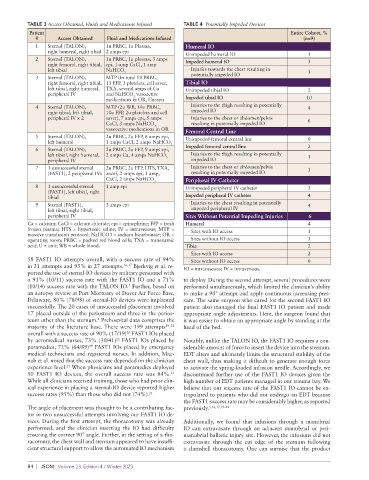
TABLE 3 Access Obtained, Fluids and Medications Infused  TABLE 4  Potentially Impeded Devices
           Patient                                                                              Entire Cohort, %
             #      Access Obtained  Fluid and Medications Infused                                  (n=9)
             1   Sternal (TALON),    1u PRBC, 1u Plasma,      Humeral IO
                 right humeral, right tibial 2 amps epi       Unimpeded humeral IO                    1
             2   Sternal (TALON),    1u PRBC, 1u plasma, 3 amps   Impeded humeral IO
                 right femoral, right tibial,  epi, 1-amp CaCl, 1 amp                                 3
                 left tibial        NaHCO                      Injuries towards the chest resulting in
                                          3                    potentially impeded IO                 3
             3   Sternal (TALON),    MTP (In total 19 PRBC,
                 right femoral, right tibial,  13 FFP, 3 platelets, cell saver,   Tibial IO
                 left tibial, right humeral,   TXA, several amps of Ca   Unimpeded tibial IO          2
                 peripheral IV      and NaHCO vasoactive
                                             3,
                                    medications in OR, Unasyn  Impeded tibial IO                     10
             4   Sternal (TALON),   MTP (2u WB, 14u PRBC,      Injuries to the thigh resulting in potentially   4
                 right tibial, left tibial,   10u FFP, 2u platelets and cell   impeded IO
                 peripheral IV × 2  saver), 7 amps epi, 5 amps   Injuries to the chest or abdomen/pelvis   6
                                    CaCl, 3 amps NaHCO 3,      resulting in potentially impeded IO
                                    vasoactive medications in OR  Femoral Central Line
             5   Sternal (TALON),    2u PRBC, 2u FFP, 6 amps epi,    Unimpeded femoral central line   0
                 left humeral       1 amps CaCl, 2 amps NaHCO
                                                         3    Impeded femoral central line            2
             6   Sternal (TALON),    2u PRBC, 2u FFP, 9 amps epi,
                 left tibial, right humeral,   2 amps Ca, 4 amps NaHCO 3  Injuries to the thigh resulting in potentially   1
                 peripheral IV                                 impeded IO
             7   1 unsuccessful sternal   2u PRBC, 2u FFP, HTS, TXA,   Injuries to the chest or abdomen/pelvis   1
                 (FAST1), 2 peripheral IVs ancef, 2 amps epi, 1 amp,   resulting in potentially impeded IO
                                    CaCl, 2 amps NaHCO 3      Peripheral IV Catheter
             8   1 unsuccessful sternal   1 amp epi           Unimpeded peripheral IV catheter        3
                 (FAST1), left tibial, right
                 tibial                                       Impeded peripheral IV catheter          4
             9   Sternal (FAST1),    3 amps epi                Injuries to the chest resulting in potentially   4
                 left tibial, right tibial,                    impeded peripheral IV
                 peripheral IV                                Sites Without Potential Impeding Injuries  6
          Ca = calcium; CaCl = calcium chloride; epi = epinephrine; FFP = fresh   Humeral             4
          frozen plasma; HTS = hypertonic saline; IV = intravenous; MTP =   Sites with IO access      1
          massive transfusion protocol; NaHCO3 = sodium bicarbonate; OR =
          operating room; PRBC = packed red blood cells; TXA = tranexamic   Sites without IO access   3
          acid; U = unit; WB = whole blood.                   Tibia                                   2
                                                               Sites with IO access                   2
          58 FAST1 IO attempts overall, with a success rate of 94%   Sites without IO access          0
          in 31 attempts and 95% in 27 attempts. 16,17  Bjerkvig et al. re-  IO = intraosseous; IV = intravenous.
          ported the use of sternal-IO devices by military personnel with
          a 91% (10/11) success rate with the FAST1 IO and a 71%   to deploy. During the second attempt, several procedures were
          (10/14) success rate with the TALON IO.  Further, based on   performed simultaneously, which limited the clinician’s ability
                                           5
          an autopsy review at Port Mortuary of Dover Air Force Base,   to make a 90° attempt and apply continuous increasing pres-
          Delaware, 80% (78/98) of sternal-IO devices were implanted   sure. The same surgeon who cared for the second FAST1 IO
          successfully. The 20 cases of unsuccessful placement involved   patient also managed the final FAST1 IO patient and made
          17 placed outside of the periosteum and three in the perios-  appropriate angle adjustments. Here, the surgeon found that
          teum other than the sternum.  Prehospital data comprises the   it was easier to obtain an appropriate angle by standing at the
                                 4
          majority of the literature base. There were 199 attempts 19–22   head of the bed.
          overall with a success rate of 90% (17/19)  FAST1 IOs placed
                                          20
          by aeromedical nurses, 73% (30/41)  FAST1 IOs placed by   Notably, unlike the TALON IO, the FAST1 IO requires a con-
                                       22
          paramedics, 72% (64/89)  FAST1 IOs placed by emergency   siderable amount of force to insert the device into the sternum.
                              19
          medical technicians and registered nurses. In addition, Mac-  EDT alters and ultimately limits the structural stability of the
          nab et al. noted that the success rate depended on the clinician   chest wall, thus making it difficult to generate enough force
          experience level.  When physicians and paramedics deployed   to activate the spring-loaded infusion needle. Accordingly, we
                       21
          50 FAST1 IO devices, the overall success rate was 84%.    discontinued further use of the FAST1 IO devices given the
                                                         21
          While all clinicians received training, those who had prior clin-  high number of EDT patients managed in our trauma bay. We
          ical experience in placing a sternal-IO device reported higher   believe that our success rate of the FAST1 IO cannot be ex-
          success rates (95%) than those who did not (74%). 21  trapolated to patients who did not undergo an EDT because
                                                             the FAST1 success rate may be considerably higher, as reported
          The angle of placement was thought to be a contributing fac-  previously. 5,16,17,19–22
          tor in two unsuccessful attempts involving our FAST1 IO de-
          vices. During the first attempt, the thoracotomy was already   Additionally, we found that infusions through a manubrial
          performed, and the clinician inserting the IO had difficulty   IO can extravasate through an adjacent manubrial or peri-
          ensuring the correct 90° angle. Further, in the setting of a tho-  manubrial ballistic injury site. However, the infusions did not
          racotomy, the chest wall and sternum appeared to have insuffi-  extravasate through the cut edge of the sternum following
          cient structural support to allow the automated IO mechanism   a clamshell thoracotomy. One can surmise that the product

          84  |  JSOM   Volume 23, Edition 4 / Winter 2023

