


Page 84 - JSOM Winter 2023
P. 84
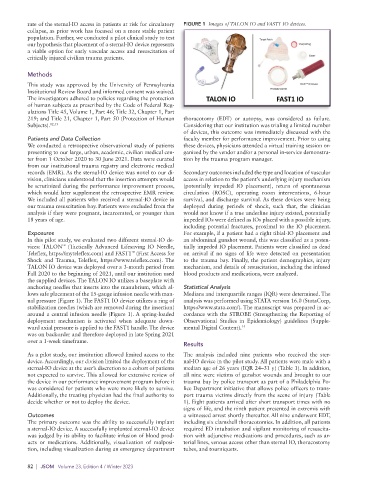
rate of the sternal-IO access in patients at risk for circulatory   FIGURE 1  Images of TALON IO and FAST1 IO devices.
          collapse, as prior work has focused on a more stable patient
          population. Further, we conducted a pilot clinical study to test
          our hypothesis that placement of a sternal-IO device represents
          a viable option for early vascular access and resuscitation of
          critically injured civilian trauma patients.

          Methods

          This study was approved by the University of Pennsylvania
          Institutional Review Board and informed consent was waived.
          The investigators adhered to policies regarding the protection
          of human subjects as prescribed by the Code of Federal Reg-
          ulations Title 45, Volume 1, Part 46; Title 32, Chapter 1, Part
          219; and Title 21, Chapter 1, Part 50 (Protection of Human   thoracotomy (EDT) or autopsy, was considered as failure.
          Subjects). 12,13                                   Considering that our institution was trialing a limited number
                                                             of devices, this outcome was immediately discussed with the
          Patients and Data Collection                       faculty member for performance improvement. Prior to using
          We conducted a retrospective observational study of patients   these devices, physicians attended a virtual training session or-
          presenting to our large, urban, academic, civilian medical cen-  ganized by the vendor and/or a personal in-service demonstra-
          ter from 1 October 2020 to 30 June 2021. Data were curated   tion by the trauma program manager.
          from our institutional trauma registry and electronic medical
          records (EMR). As the sternal-IO device was novel to our di-  Secondary outcomes included the type and location of vascular
          vision, clinicians understood that the insertion attempts would   access in relation to the patient’s underlying injury mechanism
          be scrutinized during the performance improvement process,   (potentially impeded IO placement), return of spontaneous
          which would later supplement the retrospective EMR review.   circulation (ROSC), operating room interventions, 6-hour
          We included all patients who received a sternal-IO device in   survival, and discharge survival. As these devices were being
          our trauma resuscitation bay. Patients were excluded from the   deployed during periods of shock, such that, the clinician
          analysis if they were pregnant, incarcerated, or younger than   would not know if a true underline injury existed, potentially
          18 years of age.                                   impeded IOs were defined as IOs placed with a possible injury,
                                                             including potential fractures, proximal to the IO placement.
          Exposures                                          For example, if a patient had a right tibial-IO placement and
          In this pilot study, we evaluated two different sternal-IO de-  an abdominal gunshot wound, this was classified as a poten-
                     ™
          vices: TALON  (Tactically Advanced Lifesaving IO Needle,   tially impeded IO placement. Patients were classified as dead
                                            ™
          Teleflex, https://myteleflex.com) and FAST1  (First Access for   on arrival if no signs of life were detected on presentation
          Shock  and Trauma, Teleflex,  https://www.teleflex.com). The   to the trauma bay. Finally, the patient demographics, injury
          TALON IO device was deployed over a 3-month period from   mechanism, and details of resuscitation, including the infused
          Fall 2020 to the beginning of 2021, until our institution used   blood products and medications, were analyzed.
          the supplied devices. The TALON IO utilizes a baseplate with
          anchoring needles that inserts into the manubrium, which al-  Statistical Analysis
          lows safe placement of the 15-gauge infusion needle with man-  Medians and interquartile ranges (IQR) were determined. The
          ual pressure (Figure 1). The FAST1 IO device utilizes a ring of   analysis was performed using STATA version 16.0 (StataCorp,
          stabilization needles (which are removed during the insertion)   https://www.stata.com/). The manuscript was prepared in ac-
          around a central infusion needle (Figure 1). A spring-loaded   cordance with the STROBE (Strengthening the Reporting of
          deployment mechanism is activated when adequate down-  Observational Studies in Epidemiology) guidelines (Supple-
          ward axial pressure is applied to the FAST1 handle. The device   mental Digital Content). 14
          was on backorder and therefore deployed in late Spring 2021
          over a 1-week timeframe.
                                                             Results
          As a pilot study, our institution allowed limited access to the   The analysis included nine patients who received the ster-
          device. Accordingly, our division limited the deployment of the   nal-IO device in the pilot study. All patients were male with a
          sternal-IO device at the user’s discretion to a cohort of patients   median age of 26 years (IQR 24–31 y) (Table 1). In addition,
          not expected to survive. This allowed for extensive review of   all nine were victims of gunshot wounds and brought to our
          the device in our performance improvement program before it   trauma bay by police transport as part of a Philadelphia Po-
          was considered for patients who were more likely to survive.   lice Department initiative that allows police officers to trans-
          Additionally, the treating physician had the final authority to   port trauma victims directly from the scene of injury (Table
          decide whether or not to deploy the device.        1). Eight patients arrived after short transport times with no
                                                             signs of life, and the ninth patient presented in extremis with
          Outcomes                                           a witnessed arrest shortly thereafter. All nine underwent EDT,
          The primary outcome was the ability to successfully implant   including six clamshell thoracotomies. In addition, all patients
          a sternal-IO device. A successfully implanted sternal-IO device   required ED intubation and vigilant monitoring of resuscita-
          was judged by its ability to facilitate infusion of blood prod-  tion with adjunctive medications and procedures, such as ar-
          ucts or medications.  Additionally, visualization of malposi-  terial lines, venous access other than sternal IO, thoracostomy
          tion, including visualization during an emergency department   tubes, and tourniquets.

          82  |  JSOM   Volume 23, Edition 4 / Winter 2023

