


Page 79 - JSOM Winter 2023
P. 79
Timers were positioned adjacent to each team member to   handoff was compared separately across groups for both the
              record the time for each patient handoff to be received. All   ramp handoff and internal team handoff using a one-way
              timers and the SOF medic were in direct view of the study   analysis of variance (ANOVA) with alpha set at 0.05. When
              coordinator to trigger the start of each scenario. When the   a difference was identified between groups, methods of com-
              handoff was completed and the team member received what   munication were then compared using a single-tailed, paired
              they perceived as all the relevant information, they signaled   t test for continuous variables with a Bonferroni-adjusted al-
              their time to stop, which was recorded. No further documen-  pha set at 0.0125. Accuracy, as measured by the percentage
              tation was allowed after the time was stopped. The patient   of correct information transcribed, was compared between
              handoff was performed by the medic twice in each scenario,   methods of communication also using an ANOVA with alpha
              once at the ramp intended for the team member positioned   set at 0.05.
              at the base of the ramp and once at the center of the aircraft
              intended for the remainder of the medical team within the   Results
              aircraft. There were six different patient scenarios; each was
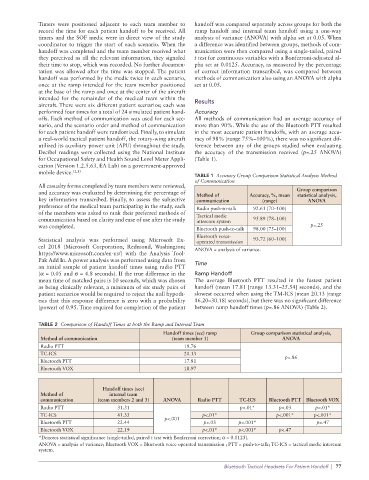
              performed four times for a total of 24 simulated patient hand-  Accuracy
              offs. Each method of communication was used for each sce-  All methods of communication had an average accuracy of
              nario, and the scenario order and method of communication   more than 90%. While the use of the Bluetooth PTT resulted
              for each patient handoff were randomized. Finally, to simulate   in the most accurate patient handoffs, with an average accu-
              a real-world tactical patient handoff, the rotary-wing aircraft   racy of 98% (range 75%–100%), there was no significant dif-
              utilized its auxiliary power unit (APU) throughout the study.   ference between any of the groups studied when evaluating
              Decibel readings were collected using the National Institute   the accuracy of the transmission received (p=.25 ANOVA)
              for Occupational Safety and Health Sound Level Meter Appli-  (Table 1).
              cation (Version 1.2.5.63, EA Lab) on a government-approved
              mobile device. 12,13
                                                                 TABLE 1  Accuracy Group Comparison Statistical Analysis Method
                                                                 of Communication
              All casualty forms completed by team members were reviewed,
              and accuracy was evaluated by determining the percentage of   Method of   Accuracy, %, mean   Group comparison
                                                                                                  statistical analysis,
              key information transcribed. Finally, to assess the subjective   communication  (range)  ANOVA
              preference of the medical team participating in the study, each   Radio push-to-talk  92.61 (70–100)
              of the members was asked to rank their preferred methods of   Tactical medic
              communication based on clarity and ease of use after the study   intercom system  95.89 (78–100)
              was completed.                                     Bluetooth push-to-talk  98.00 (75–100)  p=.25
                                                                 Bluetooth voice-
              Statistical analysis was performed using Microsoft Ex-  operated transmission  93.72 (60–100)
              cel 2018 (Microsoft Corporation, Redmond,  Washington;   ANOVA = analysis of variance.
              https://www.microsoft.com/en-us/)  with  the Analysis Tool-
              Pak Add In. A power analysis was performed using data from   Time
              an initial sample of patient handoff times using radio PTT
              (α = 0.05 and σ = 4.8 seconds). If the true difference in the   Ramp Handoff
              mean time of matched pairs is 10 seconds, which was chosen   The average Bluetooth PTT resulted in the fastest patient
              as being clinically relevant, a minimum of six study pairs of   handoff (mean 17.81 [range 13.31–25.54] seconds), and the
              patient scenarios would be required to reject the null hypoth-  slowest occurred when using the TM-ICS (mean 20.13 [range
              esis that this response difference is zero with a probability   16.20–30.18] seconds), but there was no significant difference
              (power) of 0.95. Time required for completion of the patient   between ramp handoff times (p=.86 ANOVA) (Table 2).


              TABLE 2  Comparison of Handoff Times at both the Ramp and Internal Team
                                                      Handoff times (sec) ramp     Group comparison statistical analysis,
              Method of communication                    (team member 1)                     ANOVA
              Radio PTT                                      19.76
              TC-ICS                                         20.13                            p=.86
              Bluetooth PTT                                  17.81
              Bluetooth VOX                                  18.97


                                   Handoff times (sec)
              Method of              internal team
              communication      (team members 2 and 3)  ANOVA    Radio PTT    TC-ICS    Bluetooth PTT  Bluetooth VOX
              Radio PTT                31.31                                   p<.01*       p<.03       p<.01*
              TC-ICS                   41.33           p<.001      p<.01*                  p<.001*      p<.001*
              Bluetooth PTT            22.44                        p<.03      p<.001*                  p<.47
              Bluetooth VOX            22.19                       p<.01*      p<.001*      p<.47
              *Denotes statistical significance (single-tailed, paired t test with Bonferroni correction; α = 0.0125).
              ANOVA = analysis of variance; Bluetooth VOX = Bluetooth voice operated transmission ; PTT = push-to-talk; TC-ICS = tactical medic intercom
              system.

                                                                          Bluetooth Tactical Headsets For Patient Handoff  |  77

