


Page 78 - JSOM Winter 2023
P. 78
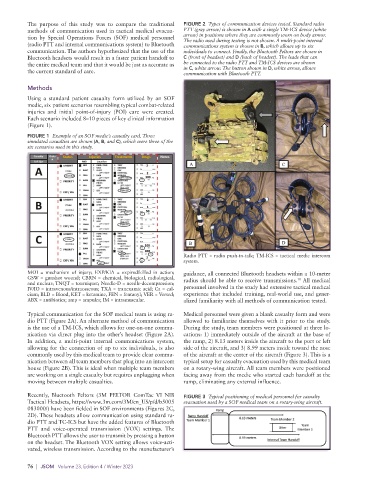
The purpose of this study was to compare the traditional   FIGURE 2  Types of communication devices tested. Standard radio
          methods of communication used in tactical medical evacua-  PTT (gray arrow) is shown in A with a single TM-ICS device (white
          tion by Special Operations Forces (SOF) medical personnel   arrow) in positions where they are commonly worn on body armor.
                                                             The radio used during testing is not shown. A multi-point internal
          (radio PTT and internal communications system) to Bluetooth   communications system is shown in B, which allows up to six
          communication. The authors hypothesized that the use of the   individuals to connect. Finally, the Bluetooth Peltors are shown in
          Bluetooth headsets would result in a faster patient handoff to   C (front of headset) and D (back of headset). The leads that can
          the entire medical team and that it would be just as accurate as   be connected to the radio PTT and TM-ICS devices are shown
          the current standard of care.                      in C, white arrow. The button shown in D, white arrow, allows
                                                             communication with Bluetooth PTT.
          Methods
          Using a standard patient casualty form utilized by an SOF
          medic, six patient scenarios resembling typical combat-related
          injuries and initial point-of-injury (POI) care were created.
          Each scenario included 8–10 pieces of key clinical information
          (Figure 1).
          FIGURE 1  Example of an SOF medic’s casualty card. Three
          simulated casualties are shown (A, B, and C), which were three of the
          six scenarios used in this study.


                                                             Radio PTT = radio push-to-talk; TM-ICS = tactical medic intercom
                                                             system.
          MOI = mechanism of injury; EXP/KIA = expired/killed in action;   guidance, all connected Bluetooth headsets within a 10-meter
          GSW = gunshot wound; CBRN = chemical, biological, radiological,   radius should be able to receive transmissions.  All medical
                                                                                                  11
          and nuclear; TNQT = tourniquet; Needle-D = needle-decompression;
          IV/IO = intravenous/intraosseous; TXA = tranexamic acid; Ca = cal-  personnel involved in the study had extensive tactical medical
          cium; BLD = Blood, KET = ketamine, FEN = fentanyl; VER = Versed;   experience that included training, real-world use, and gener-
          ABX = antibiotics; amp = ampules; IM = intramuscular.  alized familiarity with all methods of communication tested.
          Typical communication for the SOF medical team is using ra-  Medical personnel were given a blank casualty form and were
          dio PTT (Figure 2A). An alternate method of communication   allowed to familiarize themselves with it prior to the study.
          is the use of a TM-ICS, which allows for one-on-one commu-  During the study, team members were positioned at three lo-
          nication via direct plug into the other’s headset (Figure 2A).   cations: 1) immediately outside of the aircraft at the base of
          In addition, a multi-point internal communications system,   the ramp, 2) 8.13 meters inside the aircraft to the port or left
          allowing for the connection of up to six individuals, is also   side of the aircraft, and 3) 8.99 meters inside toward the nose
          commonly used by this medical team to provide clear commu-  of the aircraft at the center of the aircraft (Figure 3). This is a
          nication between all team members that plug into an intercom   typical setup for casualty evacuation used by this medical team
          house (Figure 2B). This is ideal when multiple team members   on a rotary-wing aircraft. All team members were positioned
          are working on a single casualty but requires unplugging when   facing away from the medic who started each handoff at the
          moving between multiple casualties.                ramp, eliminating any external influence.

          Recently, Bluetooth Peltors (3M PELTOR ComTac  VI NIB   FIGURE 3  Typical positioning of medical personnel for casualty
          Tactical Headsets, https://www.3m.com/3M/en_US/p/d/b5005   evacuation used by a SOF medical team on a rotary-wing aircraft.
          083000/) have been fielded in SOF environments (Figures 2C,
          2D). These headsets allow communication using standard ra-
          dio PTT and TC-ICS but have the added features of Bluetooth
          PTT and voice-operated transmission (VOX) settings.  The
          Bluetooth PTT allows the user to transmit by pressing a button
          on the headset. The Bluetooth VOX setting allows voice-acti-
          vated, wireless transmission. According to the manufacturer’s

          76  |  JSOM   Volume 23, Edition 4 / Winter 2023

