


Page 99 - JSOM Spring 2023
P. 99
personnel, the correlation between DXA determined body   Methods
              fat and BMI was 0.87.  When obesity was defined by BMI
                     2
              ≥30-kg/m , 37% of Servicemembers (SMs) were considered   The Preferred Reporting Items for Systematic Reviews and
              obese; however, when using >25% body fat to determine obe-  Meta-Analyses (PRISMA) guidelines were used to guide this
                                                                     53
                                    23
              sity (as recommend by Bray ), 67% were considered obese.   study.  Specific details of the review protocol are described
              Taken together, these data suggest that using a BMI cutoff of   below.
                    2
              30-kg/m  actually underestimates excess body fat (i.e., a high
              number of false negatives) in military populations. Despite   Study Selection and Data Extraction
              shortcomings, BMI does have utility as a general screening tool   National Library of Medicine’s PubMed and Cumulative In-
              to identify overweight and obesity. Nonetheless, it must be kept   dex to Nursing and Allied Health Literature (CINAHL) were
              in mind that the prevalence of obesity (defined as excess body   searched to find studies that had examined associations be-
                                                       2
              fat) is underestimated with the BMI cutoff of 30-kg/m .  tween BMI and injuries in military personnel. Keywords used
                                                                 in the search included the following: injury OR injured OR in-
                                                                 juries OR “wounds and injury” AND “body mass index” AND
              In the US, the overweight proportion of the adult population
              has remained relatively consistent from 1960 to about 1999,   military OR “military personnel.”  The reference lists of ob-
              but from 1999 through 2020 obesity increased from 31% to   tained articles, reviews identified in the search, and the authors’
              42% of the population. 24,25  In the US military, prevalence and   personal files were also examined for other articles not found
              trends are somewhat different. US military studies conducted   in the retrieval services. The final search was completed in Sep-
              between 1975 and 2015 indicate that BMI has been increas-  tember 2022. The selection process and results of the search
                                                                                                    53
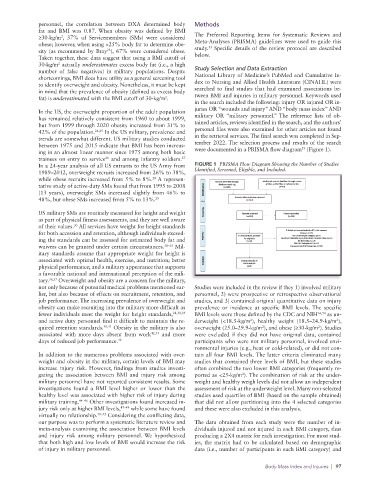
              ing in an almost linear manner since 1975 among both basic   were documented in a PRISMA flow diagram  (Figure 1).
              trainees on entry to service  and among infantry soldiers.
                                                            27
                                   26
              In a 24-year analysis of all US entrants to the US Army from   FIGURE 1  PRISMA Flow Diagram Showing the Number of Studies
              1989–2012, overweight recruits increased from 26% to 38%,   Identified, Screened, Eligible, and Included.
              while obese recruits increased from 5% to 8%.  A represen-
                                                   28
              tative study of active-duty SMs found that from 1995 to 2008
              (13 years), overweight SMs increased slightly from 46% to
              48%, but obese SMs increased from 5% to 13%. 29
              US military SMs are routinely measured for height and weight
              as part of physical fitness assessments, and they are well aware
              of their values.  All services have weight for height standards
                         30
              for both accession and retention, although individuals exceed-
              ing the standards can be assessed for estimated body fat and
              waivers can be granted under certain circumstances. 31–35  Mil-
              itary standards assume that appropriate weight for height is
              associated with optimal health, exercise, and nutrition; better
              physical performance; and a military appearance that supports
              a favorable national and international perception of the mili-
              tary. 36,37  Overweight and obesity are a concern for the military,
              not only because of potential medical problems mentioned ear-  Studies were included in the review if they 1) involved military
              lier, but also because of effects on recruitment, retention, and   personnel, 2) were prospective or retrospective observational
              job performance. The increasing prevalence of overweight and   studies, and 3) contained original quantitative data on injury
              obesity can make recruiting into the military more difficult as   prevalence or incidence at specific BMI levels.  The specific
              fewer individuals meet the weight for height standards, 28,38,39    BMI levels were those defined by the CDC and NIH 16,54  as un-
              and active duty personnel find it difficult to maintain the re-  derweight (<18.5-kg/m ), healthy weight (18.5–24.9-kg/m ),
                                                                                                               2
                                                                                   2
              quired retention standards. 40,41  Obesity in the military is also   overweight (25.0–29.9-kg/m ), and obese (≥30-kg/m ). Studies
                                                                                                         2
                                                                                       2
              associated  with  more  days  absent  from  work 42,43   and more   were excluded if they did not have original data, contained
              days of reduced job performance. 42                participants who were not military personnel, involved envi-
                                                                 ronmental injuries (e.g., heat or cold-related), or did not con-
              In addition to the numerous problems associated with over-  tain all four BMI levels. The latter criteria eliminated many
              weight and obesity in the military, certain levels of BMI may   studies that contained three levels of BMI, but these studies
              increase  injury  risk. However,  findings  from studies  investi-  often combined the two lower BMI categories (frequently re-
              gating the association between BMI and injury risk among   ported as <25-kg/m ). The combination of risk at the under-
                                                                                2
              military personnel have not reported consistent results. Some   weight and healthy weigh levels did not allow an independent
              investigations  found  a  BMI level higher  or  lower  than the   assessment of risk at the underweight level. Many non-selected
              healthy level was associated with higher risk of injury during   studies used quartiles of BMI (based on the sample obtained)
              military training. 44–46  Other investigations found increased in-  that did not allow partitioning into the 4 selected categories
              jury risk only at higher BMI levels, 47–49  while some have found   and these were also excluded in this analysis.
              virtually no relationship. 50–52  Considering the conflicting data,
              our purpose was to perform a systematic literature review and   The data obtained from each study were the number of in-
              meta-analysis examining the association between BMI levels   dividuals injured and not injured in each BMI category, thus
              and injury risk among military personnel. We hypothesized   producing a 2X4 matrix for each investigation. For most stud-
              that both high and low levels of BMI would increase the risk   ies, the matrix had to be calculated based on demographic
              of injury in military personnel.                   data (i.e., number of participants in each BMI category) and

                                                                                        Body Mass Index and Injuries  |  97

