


Page 96 - JSOM Spring 2023
P. 96
(IFN) knockout mice suggest the innate immune system plays   geographic distribution and enforce vigilant tick and insect
                                 19
          a key role in limiting disease. Reports have also shown that   control measures (DEET chemical repellent, long sleeves, and
          failure to mount a humoral immune response (IgG/IgM) cor-  daily tick checks) in the deployed environment. Additionally,
          relates with fatal disease. 18,19                  SOF providers should counsel their operators on the viral life
                                                             cycle and transmissibility of CCHFV from livestock. In the
                                                             evaluation of any patient with suspected viral hemorrhagic fe-
          Clinical Disease and Diagnosis
                                                             ver in the deployed environment, the highest level of personal
          The incubation period of CCHF lasts one to three days af-  protective equipment available should be maintained. 2,3,27  Any
          ter  tick  exposure,  and  5–6  days  after  blood  exposure. 1,2,24    patients exposed should be quarantined for 14 days and con-
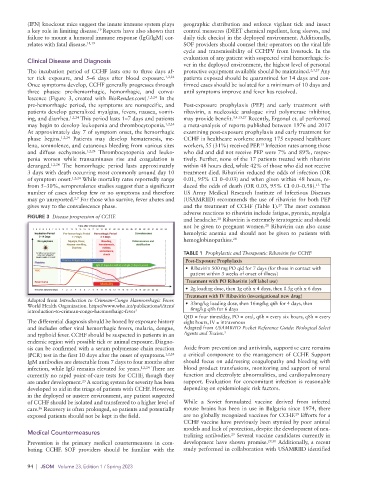
          Once symptoms develop, CCHF generally progresses through   firmed cases should be isolated for a minimum of 10 days and
          three phases: pre-hemorrhagic, hemorrhagic, and conva-  until symptoms improve and fever has resolved.
          lescence (Figure 3, created with  BioRender.com). 1,2,24  In the
          pre- hemorrhagic period, the symptoms are nonspecific, and   Post-exposure prophylaxis (PEP) and early treatment with
          patients develop generalized myalgias, fevers, nausea, vomit-  ribavirin, a nucleoside analogue viral polymerase inhibitor,
          ing, and diarrhea. 1,2,24  This period lasts 1–7 days and patients   may provide benefit. 3,4,13,27  Recently, Ergonul et. al performed
          may begin to develop leukopenia and thrombocytopenia. 1,2,24    a meta-analysis of reports published between 1976 and 2017
          At approximately day 7 of symptom onset, the hemorrhagic   examining post-exposure prophylaxis and early treatment for
          phase begins. 1,2,24  Patients may develop hematemesis, me-  CCHF in healthcare workers: among 175 exposed healthcare
                                                                                      13
          lena, somnolence, and cutaneous bleeding from various sites   workers, 55 (31%) received PEP.  Infection rates among those
          and diffuse ecchymosis. 1,2,24   Thrombocytopenia and leuko-  who did and did not receive PEP were 7% and 89%, respec-
          penia worsen while transaminases rise and coagulation is   tively. Further, none of the 17 patients treated with ribavirin
          deranged. 1,2,24   The hemorrhagic period lasts approximately   within 48 hours died, while 42% of those who did not receive
          3 days with death occurring most commonly around day 10   treatment died. Ribavirin reduced the odds of infection (OR
          of symptom onset. 1,2,24  While mortality rates reportedly range   0.01, 95% CI 0–0.03) and when given within 48 hours, re-
          from 5–30%, seroprevalence studies suggest that a significant   duced the odds of death (OR 0.03, 95% CI 0.0–0.58).  The
                                                                                                        13
          number of cases develop few or no symptoms and therefore   US  Army Medical Research Institute of Infectious Diseases
                         2,7
          may go unreported.  For those who survive, fever abates and   (USAMRIID) recommends the use of ribavirin for both PEP
          gives way to the convalescence phase.              and the treatment of CCHF (Table 1).  The most common
                                                                                            27
                                                             adverse reactions to ribavirin include fatigue, pyrexia, myalgia
          FIGURE 3  Disease progression of CCHF.                        28
                                                             and headache.  Ribavirin is extremely teratogenic and should
                                                                                        28
                                                             not be given to pregnant women.  Ribavirin can also cause
                                                             hemolytic anemia and should not be given to patients with
                                                             hemoglobinopathies. 28
                                                             TABLE 1  Prophylactic and Therapeutic Ribavirin for CCHF
                                                              Post-Exposure Prophylaxis
                                                              •  Ribavirin 500 mg PO qid for 7 days (for those in contact with
                                                               patient within 3 weeks of onset of illness)
                                                              Treatment with PO Ribavirin (off label use)
                                                              •  2g loading dose, then 1g q6h x 4 days, then 0.5g q6h x 6 days
                                                              Treatment with IV Ribavirin (investigational new drug)
          Adapted from Introduction to Crimean-Congo Haemorrhagic Fever.
          World Health Organization. https://www.who.int/publications/i/item/  •  33mg/kg loading dose, then 16mg/kg q6h for 4 days, then
          introduction-to-crimean-congo-haemorrhaigc-fever 1   8mg/kg q8h for 6 days
                                                             QID = four times/day, PO = oral, q6h = every six hours, q8h = every
          The differential diagnosis should be honed by exposure history   eight hours, IV = intravenous
          and includes other viral hemorrhagic fevers, malaria, dengue,   Adapted from USAMRIID Pocket Reference Guide: Biological Select
          and typhoid fever. CCHF should be suspected in patients in an   Agents and Toxins. 3
          endemic region with possible tick or animal exposure. Diagno-
          sis can be confirmed with a serum polymerase chain reaction   Aside from prevention and antivirals, supportive care remains
          (PCR) test in the first 10 days after the onset of symptoms. 1,2,24    a critical component to the management of CCHF. Support
          IgM antibodies are detectable from 7 days to four months after   should focus on addressing coagulopathy and bleeding with
          infection, while IgG remains elevated for years. 1,2,24  There are   blood product transfusions, monitoring and support of renal
          currently no rapid point-of-care tests for CCHF, though they   function and electrolyte abnormalities, and cardiopulmonary
          are under development.  A scoring system for severity has been   support. Evaluation for concomitant infection is reasonable
                            25
          developed to aid in the triage of patients with CCHF. However,   depending on epidemiologic risk factors.
          in the deployed or austere environment, any patient suspected
          of CCHF should be isolated and transferred to a higher level of   While a Soviet formulated vaccine derived from infected
          care.  Recovery is often prolonged, so patients and potentially   mouse brains  has been in use  in Bulgaria since  1974,  there
              26
                                                                                                  29
          exposed patients should not be kept in the field.  are no globally recognized vaccines for CCHF.  Efforts for a
                                                             CCHF vaccine have previously been stymied by poor animal
                                                             models and lack of protection, despite the development of neu-
          Medical Countermeasures                            tralizing antibodies.  Several vaccine candidates currently in
                                                                             29
          Prevention  is the  primary medical  countermeasure  in  com-  development have shown promise. 29,30  Additionally, a recent
          bating CCHF. SOF providers  should be  familiar with the   study performed in collaboration with USAMRIID identified
          94  |  JSOM   Volume 23, Edition 1 / Spring 2023

