


Page 91 - JSOM Spring 2023
P. 91
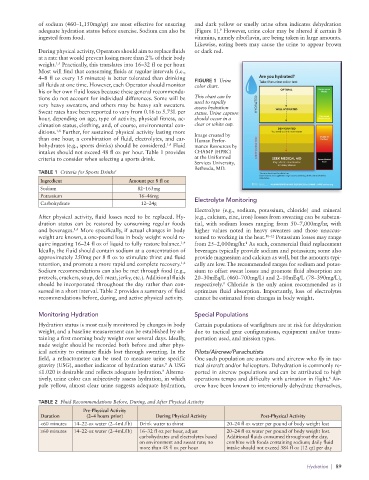
of sodium (460–1,150mg/qt) are most effective for ensuring   and dark yellow or smelly urine often indicates dehydration
                                                                         9
              adequate hydration status before exercise. Sodium can also be   (Figure 1).  However, urine color may be altered if certain B
              ingested from food.                                vitamins, namely riboflavin, are being taken in large amounts.
                                                                 Likewise, eating beets may cause the urine to appear brown
              During physical activity, Operators should aim to replace fluids   or dark red.
              at a rate that would prevent losing more than 2% of their body
              weight.  Practically, this translates into 16–32 fl oz per hour.
                   1,4
              Most will find that consuming fluids at regular intervals (i.e.,
              4–8 fl oz every 15 minutes) is better tolerated than drinking   FIGURE 1  Urine
              all fluids at one time. However, each Operator should monitor   color chart.
              his or her own fluid losses because these general recommenda-
              tions do not account for individual differences. Some will be   This chart can be
              very heavy sweaters, and others may be heavy salt sweaters.   used to rapidly
                                                                 assess hydration
              Sweat rates have been reported to vary from 0.16 to 5.73L per   status. Urine capture
              hour, depending on age, type of activity, physical fitness, ac-  should occur in a
              climation status, clothing, and, of course, environmental con-  clear or white cup.
              ditions.  Further, for sustained physical activity lasting more
                   1,8
              than one hour, a combination of fluid, electrolytes, and car-  Image created by
                                                                 Human Perfor-
                                                        1,4
              bohydrates (e.g., sports drinks) should be considered.  Fluid   mance Resources by
              intakes should not exceed 48 fl oz per hour. Table 1 provides   CHAMP (HPRC)
              criteria to consider when selecting a sports drink.  at the Uniformed
                                                                 Services University,
                                                                 Bethesda, MD.
              TABLE 1  Criteria for Sports Drinks 1
              Ingredient                   Amount per 8 fl oz
              Sodium                          82–163mg
              Potassium                       16–46mg            Electrolyte Monitoring
              Carbohydrate                     12–24g
                                                                 Electrolyte (e.g., sodium, potassium, chloride) and mineral
              After physical activity, fluid losses need to be replaced. Hy-  (e.g., calcium, zinc, iron) losses from sweating can be substan-
              dration status can be restored by consuming regular foods   tial, with sodium losses ranging from 50–7,000mg/hr, with
              and beverages.  More specifically, if actual changes in body   higher  values  noted  in  heavy  sweaters  and  those  unaccus-
                         1,4
              weight are known, a one-pound loss in body weight would re-  tomed to working in the heat. 10–12  Potassium losses may range
              quire ingesting 16–24 fl oz of liquid to fully restore balance.    from 25–2,000mg/hr.  As such, commercial fluid replacement
                                                                                 1
                                                            1,4
              Ideally, the fluid should contain sodium at a concentration of   beverages typically provide sodium and potassium; some also
              approximately 250mg per 8 fl oz to stimulate thirst and fluid   provide magnesium and calcium as well, but the amounts typi-
              retention, and promote a more rapid and complete recovery.    cally are low. The recommended ranges for sodium and potas-
                                                            1,4
              Sodium recommendations can also be met through food (e.g.,   sium to offset sweat losses and promote fluid absorption are
              pretzels, crackers, soup, deli meat, jerky, etc.). Additional fluids   20–30mEq/L (460–700mg/L) and 2–10mEq/L (78–390mg/L),
              should be incorporated throughout the day rather than con-  respectively.  Chloride is the only anion recommended as it
                                                                          1
              sumed in a short interval. Table 2 provides a summary of fluid   optimizes fluid absorption. Importantly, loss of electrolytes
              recommendations before, during, and active physical activity.  cannot be estimated from changes in body weight.
              Monitoring Hydration                               Special Populations

              Hydration status is most easily monitored by changes in body   Certain populations of warfighters are at risk for dehydration
              weight, and a baseline measurement can be established by ob-  due to tactical gear configurations, equipment and/or trans-
              taining a first morning body weight over several days. Ideally,   portation used, and mission types.
              nude weight should be recorded both before and after phys-
              ical activity to estimate fluids lost through sweating. In the   Pilots/Aircrew/Parachutists
              field, a refractometer can be used to measure urine specific   One such population are aviators and aircrew who fly in tac-
              gravity (USG), another indicator of hydration status.  A USG   tical aircraft and/or helicopters. Dehydration is commonly re-
                                                       9
              ≤1.020 is desirable and reflects adequate hydration.  Alterna-  ported in aircrew populations and can be attributed to high
                                                      9
              tively, urine color can subjectively assess hydration, in which   operations tempo and difficulty with urination in flight.  Air-
                                                                                                            6
              pale yellow, almost clear urine suggests adequate hydration,   crew have been known to intentionally dehydrate themselves,
              TABLE 2  Fluid Recommendations Before, During, and After Physical Activity
                            Pre-Physical Activity
              Duration       (2–4 hours prior)      During Physical Activity          Post-Physical Activity
              <60 minutes  14–22-oz water (2–4mL/lb)  Drink water to thirst   20–24 fl oz water per pound of body weight lost
              ≥60 minutes   14–22-oz water (2–4mL/lb)  16–32 fl oz per hour, adjust   20–24 fl oz water per pound of body weight lost.
                                               carbohydrates and electrolytes based   Additional fluids consumed throughout the day,
                                               on environment and sweat rate; no   combine with foods containing sodium; daily fluid
                                               more than 48 fl oz per hour  intake should not exceed 384 fl oz (12 qt) per day

                                                                                                     Hydration  |  89

