


Page 88 - JSOM Spring 2023
P. 88
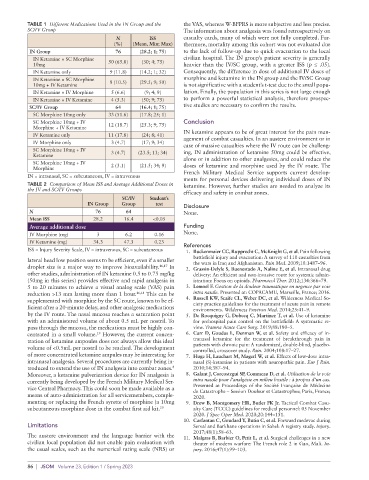
TABLE 1  Different Medications Used in the IN Group and the    the VAS, whereas W-BFPRS is more subjective and less precise.
          SC/IV Group                                        The information about analgesia was found retrospectively on
                                       N          ISS        casualty cards, many of which were not fully completed. Fur-
                                      (%)   (Mean, Min; Max)  thermore, mortality among this cohort was not evaluated due
           IN Group                    76      (28.2; 1; 75)  to the lack of follow-up due to quick evacuation to the local
            IN Ketamine + SC Morphine                        civilian hospital. The IN group’s patient severity is generally
            10mg                    50 (65.8)  (30; 4; 75)   heavier than the IV/SC group, with a greater ISS (p  ≤ .05).
            IN Ketamine only         9 (11.8)  (14.2; 1; 32)   Consequently, the difference in dose of additional IV doses of
            IN Ketamine + SC Morphine   8 (10.5)  (29.5; 9; 50)  morphine and ketamine in the IN group and the IV/SC Group
            10mg + IV Ketamine                               is not significative with a student’s t-test due to the small popu-
            IN Ketamine + IV Morphine   5 (6.6)  (9; 4; 9)   lation. Finally, the population in this series is not large enough
            IN Ketamine + IV Ketamine   4 (5.3)  (50; 9; 75)   to perform a powerful statistical analysis, therefore prospec-
           SC/IV Group                 64      (16.4; 1; 75)  tive studies are necessary to confirm the results.
            SC Morphine 10mg only   33 (51.6)  (17.8; 25; 1)
            SC Morphine 10mg + IV                            Conclusion
            Morphine + IV Ketamine  12 (18.7)  (25.3; 9; 75)
            IV Ketamine only        11 (17.8)  (24; 8; 41)   IN ketamine appears to be of great interest for the pain man-
                                                             agement of combat casualties. In an austere environment or in
            IV Morphine only         3 (4.7)   (17; 9; 34)   case of massive casualties where the IV route can be challeng-
            SC Morphine 10mg + IV    3 (4.7)  (23.5; 13; 34)  ing, IN administration of ketamine 50mg could be effective,
            Ketamine                                         alone or in addition to other analgesics, and could reduce the
            SC Morphine 10mg + IV    2 (3.1)   (21.5; 34; 9)  doses of ketamine and morphine used by the IV route. The
            Morphine
          IN = intranasal, SC = subcutaneous, IV = intravenous  French Military Medical Service supports current develop-
                                                             ments for personal devices delivering individual doses of IN
          TABLE 2  Comparison of Mean ISS and Average Additional Doses in   ketamine. However, further studies are needed to analyze its
          the IV and SC/IV Groups
                                                             efficacy and safety in combat zones.
                                         SC/IV    Student’s
                              IN Group   Group      test     Disclosure
           N                    76        64                 None.
           Mean ISS             28.2      16.4     <0.05
           Average additional dose                           Funding
           IV Morphine (mg)      3        6.2       0.16     None.
           IV Ketamine (mg)     34.3      47.3      0.23     References
          ISS = Injury Severity Scale, IV = intravenous, SC = subcutaneous  1.  Buckenmaier CC, Rupprecht C, McKnight G, et al. Pain following
                                                                battlefield injury and evacuation: A survey of 110 casualties from
          lateral head low position seems to be efficient, even if a smaller   the wars in Iraq and Afghanistan. Pain Med. 2009;10:1487–96.
          droplet size is a major way to improve bioavailability. 16,17  In   2.  Grassin-Delyle S, Buenestado A, Naline E, et al. Intranasal drug
          other studies, administration of IN ketamine 0.5 to 0.75 mg/kg   delivery: An efficient and non-invasive route for systemic admin-
          (50mg in this series) provides effective and rapid analgesia in   istration: Focus on opioids. Pharmacol Ther. 2012;134:366–79.
          5 to 20 minutes to achieve a visual analog scale (VAS) pain   3.  Lemoel F. Gestion de la douleur traumatique en urgence par voie
          reduction >13 mm lasting more than 1 hour. 16,18  This can be   intra nasale. Presented at: COPACAMU, Marseille, France; 2016.
          supplemented with morphine by the SC route, known to be ef-  4.  Russell KW, Scaife CL, Weber DC, et al. Wilderness Medical So-
          ficient after a 20-minute delay, and other analgesic medications   ciety practice guidelines for the treatment of acute pain in remote
                                                                environments. Wilderness Environ Med. 2014;25:41–9.
          by the IV route. The nasal mucosa reaches a saturation point   5.  De Rocquigny G, Dubecq C, Martinez T, et al. Use of ketamine
          with an administered volume of about 0.5 mL per nostril. To   for prehospital pain control on the battlefield: A systematic re-
          pass through the mucosa, the medications must be highly con-  view. Trauma Acute Care Surg. 2019;88:180–5.
          centrated in a small volume.  However, the current concen-  6.  Carr D, Goudas L, Denman W, et al. Safety and efficacy of in-
                                 19
          tration of ketamine ampoules does not always allow this ideal   tranasal ketamine for the treatment  of breakthrough pain in
          volume of <0.5mL per nostril to be reached. The development   patients with chronic pain: A randomized, double-blind, placebo-
                                                                controlled, crossover study. Pain. 2004;108:17–27.
          of more concentrated ketamine ampules may be interesting for   7.  Huge H, Lauchart M, Magerl W, et al. Effects of low-dose intra-
          intranasal analgesia. Several procedures are currently being in-  nasal (S)-ketamine in patients with neuropathic pain. Eur J Pain.
                                                         8
          troduced to extend the use of IN analgesia into combat zones.    2010;14:387–94.
          Moreover, a ketamine pulverization device for IN analgesia is   8.  Galant J, Corcostegui SP, Commeau D, et al. Utilisation de la voie
          currently being developed by the French Military Medical Ser-  intra nasale pour l’analgésie en milieu hostile : à propos d’un cas.
          vice Central Pharmacy. This could soon be made available as a   Presented  at  Proceedings  of  the  Société  Française  de  Médecine
                                                                de Catastrophe – Session Douleur et Catastrophes; Paris, France;
          means of auto-administration for all servicemembers, comple-  2020.
          menting or replacing the French syrette of morphine (a 10mg   9.  Drew B, Montgomery HR, Butler FK Jr. Tactical Combat Casu-
          subcutaneous morphine dose in the combat first aid kit. 20  alty Care (TCCC) guidelines for medical personnel: 05 November
                                                                2020. J Spec Oper Med. 2020;20:144–151.
                                                             10.  Carfantan C, Goudard Y, Butin C, et al. Forward medevac during
          Limitations                                           Serval and Barkhane operations in Sahel: A registry study. Injury.
                                                                2017;48(1):58–63.
          The  austere  environment  and  the  language  barrier  with  the   11.  Malgras B, Barbier O, Petit L, et al. Surgical challenges in a new
          civilian local population did not enable pain evaluation with   theater of modern warfare: The French role 2 in Gao, Mali. In-
          the usual scales, such as the numerical rating scale (NRS) or   jury. 2016;47(1):99–103.

          86  |  JSOM   Volume 23, Edition 1 / Spring 2023

