


Page 87 - JSOM Spring 2023
P. 87
Study Population                                   FIGURE 1  Flow chart.
              As part of a deployment in the Middle East, medical teams
              from the French Military Medical Service were deployed for           259 patients
              4-month rotations from August 2017 to March 2019. These
              medical teams experienced care of multiple combat casualties,               Lack of information
                                                                                          ≥48 patients excluded
              close to the frontline settled in Role 1 casualties’ collection
              points (CCP) in austere conditions. They took care of French,        211 patients
              coalition, or local forces, civilians, and even wounded enemies.            W-BFPRS* <7, or no
              To perform early and quick  analgesia, those  medical teams                 analgesia done ≥71 patients
              sometimes used the IN route with the Mucosal Atomization            140 inclusions
              Device (MAD) nasal device. Adapted for use with a syringe,
              the MAD nasal device (Teleflex, https://www.teleflex.com/usa/
              en/product-areas/anesthesia/atomization/mad-nasal-device/   NATO Categorization of these 140 Patients
              index.html) provides better bioavailability due to atomiza-     T1    T2     T3    T4    Total
              tion of 300-μm droplets. This MAD nasal device was used   N     50     79    8      3    140
              for administration of IN ketamine prepared in a Luer Lock   %  35,7   56,4   5,7   2,1   100
              type syringe containing 50 mg/mL. Contraindications for the
              use of the IN route for ketamine administration were uncon-
              sciousness and craniofacial trauma. For this series due to the
              language barrier, which mostly comprised Kurdish or Malian   IN Group**        SC/IV Group***
              casualties, the medical teams did not use a numeric rating   N=76                  N=76
              scale (NRS) to evaluate and monitor pain severity. Instead,
              the medical teams used the  Wong-Baker Faces Pain Rating   *W-BFPRS: Wong–Baker Faces Pain Rating Scale from 0 to 10
              Scale(W-BFPRS) from 0 to 10 before and 10–15 minutes after   **IN Group: Patients treated by intranasal ketamine
              administration of analgesia. Patients presenting penetrating or   ***SC/IV Group: Patients not treated by intranasal ketamine
                                                                 SC = subcutaneous, IV = intravenous, IN = intranasal, NATO = North
              blast trauma and W-BFPRS >7 were retrospectively included.   Atlantic Treaty Organization
              They were treated either with regular analgesia protocol in-
              cluding opioids (SC/IV Group) or with IN ketamine 50mg   FIGURE 2  Mechanism of injury for the 76 patients treated with
              at the Role 1 CCP, before placement of a peripheral venous   intranasal (IN) ketamine.
              access (IN group). This IN ketamine 50mg dose was admin-
              istered alone, or concomitantly with a SC morphine 10mg in-
              jection from the personal first aid kit by a combat medic. Pain
              was considered as controlled with W-BFRS < 3. If necessary,
              IN analgesia was completed with IV medications (ketamine
              or opioids). The forward medical card was filled out by the
              physician at the point of care, and statistical analysis was per-
              formed retrospectively. Patients with an uncompleted casualty
              card (lack of dose, route, or W-BFRS, or without analgesia
              needed) were excluded.

              This retrospective study has been successfully submitted to the
              French health service ethical committee (Comité d’évaluation
              éthique de la direction de la formation, de la recherche et de
              l’innovation (C2E-DFRI)).
                                                                 *RPG: Rocket propelled grenade

              Results                                            dizziness, which was successfully treated with another dose of
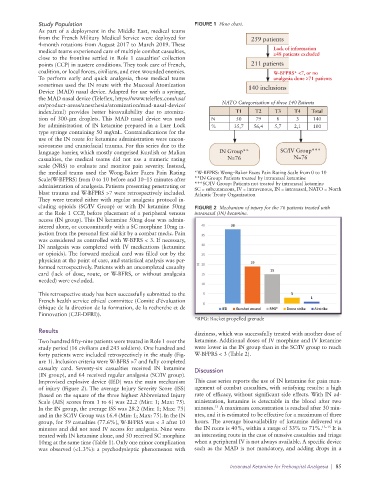
              Two hundred fifty-nine patients were treated in Role 1 over the   ketamine. Additional doses of IV morphine and IV ketamine
              study period (16 civilians and 243 soldiers). One hundred and   were lower in the IN group than in the SC/IV group to reach
              forty patients were included retrospectively in the study (Fig-  W-BFPRS < 3 (Table 2).
              ure 1). Inclusion criteria were W-BFRS >7 and fully completed
              casualty card. Seventy-six casualties received IN ketamine   Discussion
              (IN group), and 64 received regular analgesia (SC/IV group).
              Improvised explosive device (IED) was the main mechanism   This case series reports the use of IN ketamine for pain man-
              of injury (Figure 2). The average Injury Severity Score (ISS)   agement of combat casualties, with satisfying results: a high
              (based on the square of the three highest Abbreviated Injury   rate of efficacy, without significant side effects. With IN ad-
              Scale (AIS) scores from 1 to 6) was 22.2 (Min: 1; Max: 75).   ministration, ketamine is detectable in the blood after two
                                                                       13
              In the IN group, the average ISS was 28.2 (Min: 1; Max: 75)   minutes.  A maximum concentration is reached after 30 min-
              and in the SC/IV Group was 16.4 (Min: 1; Max: 75). In the IN   utes, and it is estimated to be effective for a maximum of three
              group, for 59 casualties (77.6%), W-BFPRS was < 3 after 10   hours. The average bioavailability of ketamine delivered via
              minutes and did not need IV access for analgesia. Nine were   the IN route is 40%, within a range of 33% to 71%. 13–15  It is
              treated with IN ketamine alone, and 50 received SC morphine   an interesting route in the case of massive casualties and triage
              10mg at the same time (Table 1). Only one minor complication   when a peripheral IV is not always available. A specific device
              was observed (<1.3%): a psychodysleptic phenomenon with   such as the MAD is not mandatory, and adding drops in a

                                                                            Intranasal Ketamine for Prehospital Analgesia  |  85

