


Page 66 - JSOM Spring 2023
P. 66
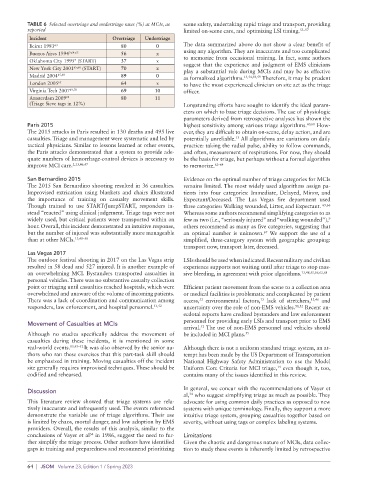
TABLE 6  Selected overtriage and undertriage rates (%) at MCIs, as   scene safety, undertaking rapid triage and transport, providing
          reported                                           limited on-scene care, and optimizing LSI timing. 53–57
           Incident                   Overtriage  Undertriage
           Beirut 1983 63                80         0        The data summarized above do not show a clear benefit of
           Buenos Aires 1994 9,64,65     56         x        using any algorithm. They are inaccurate and too complicated
                         9
           Oklahoma City 1995  (START)   37         x        to memorize from occasional training. In fact, some authors
                                                             suggest that the experience and judgment of EMS clinicians
           New York City 2001 65,66  (START)  70    x        play a substantial role during MCIs and may be as effective
           Madrid 2004 65,68             89         0        as formalized algorithms. 13,54,58,59  Therefore, it may be prudent
           London 2005 65                64         x        to have the most experienced clinician on site act as the triage
           Virginia Tech 2007 69,70      69         10       officer.
           Amsterdam 2009                80         11
                       22
           (Triage Sieve tags in 12%)                        Longstanding efforts have sought to identify the ideal param-
                                                             eters on which to base triage decisions. The use of physiologic
                                                             parameters derived from retrospective analyses has shown the
          Paris 2015                                         highest sensitivity among various triage algorithms. 60,61  How-
          The 2015 attacks in Paris resulted in 130 deaths and 495 live   ever, they are difficult to obtain on-scene, delay action, and are
          casualties. Triage and management were systematic and led by   potentially unreliable.  All algorithms are variations on daily
                                                                              13
          tactical physicians. Similar to lessons learned at other events,   practice: taking the radial pulse, ability to follow commands,
          the Paris attacks demonstrated that a system to provide ade-  and often, measurement of respirations. For now, they should
          quate numbers of hemorrhage-control devices is necessary to   be the basis for triage, but perhaps without a formal algorithm
          improve MCI care. 2,13,46,47                       to memorize. 62–64

          San Bernardino 2015                                Evidence on the optimal number of triage categories for MCIs
          The 2015 San Bernardino shooting resulted in 36 casualties.   remains limited. The most widely used algorithms assign pa-
          Improvised  extrication  using  blankets  and  chairs  illustrated   tients  into four  categories:  Immediate,  Delayed, Minor,  and
          the importance of training on casualty movement skills.   Expectant/Deceased.  The Las  Vegas fire department used
          Though trained to use START/JumpSTART, responders in-  three categories: Walking wounded, Litter, and Expectant.  65,66
          stead “reacted” using clinical judgement. Triage tags were not   Whereas some authors recommend simplifying categories to as
          widely used, but critical patients were transported within an   few as two (i.e., “seriously injured” and “walking wounded”),
                                                                                                            9
          hour. Overall, this incident demonstrated an intuitive response,   others recommend as many as five categories, suggesting that
          but the number of injured was substantially more manageable   an optimal number is unknown.  We support the use of a
                                                                                       67
          than at other MCIs. 13,48–50                       simplified, three-category system with geographic grouping:
                                                             transport now, transport later, deceased.
          Las Vegas 2017
          The outdoor festival shooting in 2017 on the Las Vegas strip   LSIs should be used when indicated. Recent military and civilian
          resulted in 58 dead and 527 injured. It is another example of   experience supports not waiting until after triage to stop mas-
          an overwhelming MCI. Bystanders transported casualties in   sive bleeding, in agreement with prior algorithms. 13,48,55,56,62,68
          personal vehicles. There was no substantive casualty collection
          point or triaging until casualties reached hospitals, which were   Efficient patient movement from the scene to a collection area
          overwhelmed and unaware of the volume of incoming patients.   or medical facilities is problematic and complicated by patient
          There was a lack of coordination and communication among   access,   environmental  factors,   lack  of  stretchers, 13,46   and
                                                                                      13
                                                                  52
          responders, law enforcement, and hospital personnel. 51,52  uncertainty over the role of non-EMS vehicles. 50,52  Recent an-
                                                             ecdotal reports have credited bystanders and law enforcement
          Movement of Casualties at MCIs                     personnel for providing early LSIs and transport prior to EMS
                                                                   52
                                                             arrival.  The use of non-EMS personnel and vehicles should
          Although no studies specifically address the movement of   be included in MCI plans. 55
          casualties during these incidents, it is mentioned in some
            real-world events. 13,43–52  It was also observed by the senior au-  Although there is not a uniform standard triage system, an at-
          thors who ran these exercises that this part-task skill should   tempt has been made by the US Department of Transportation
          be emphasized in training. Moving casualties off the incident   National Highway Safety  Administration to use the Model
          site generally requires improvised techniques. These should be   Uniform Core Criteria for MCI triage,  even though it, too,
                                                                                            14
          codified and rehearsed.                            contains many of the issues identified in this review.

          Discussion                                         In general, we concur with the recommendations of Vayer et
                                                             al,  who suggest simplifying triage as much as possible. They
                                                               34
          This literature review showed that triage systems are rela-  advocate for using common daily practices as opposed to new
          tively inaccurate and infrequently used. The events referenced   systems with unique terminology. Finally, they support a more
          demonstrate the variable use of triage algorithms. Their use   intuitive triage system, grouping casualties together based on
          is limited by chaos, mortal danger, and low adoption by EMS   severity, without using tags or complex labeling systems.
          providers. Overall, the results of this analysis, similar to the
          conclusions of Vayer et al  in 1986, suggest the need to fur-  Limitations
                              34
          ther simplify the triage process. Other authors have identified   Given the chaotic and dangerous nature of MCIs, data collec-
          gaps in training and preparedness and recommend prioritizing   tion to study these events is inherently limited by retrospective

          64  |  JSOM   Volume 23, Edition 1 / Spring 2023

