


Page 64 - JSOM Spring 2023
P. 64
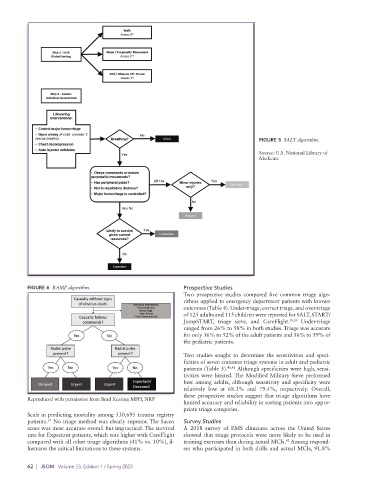
FIGURE 5  SALT algorithm.
                                                                                      Source: U.S. National Library of
                                                                                      Medicine


          FIGURE 6  RAMP algorithm.                          Prospective Studies
                                                             Two prospective studies compared five common triage algo-
                                                             rithms applied to emergency department patients with known
                                                             outcomes (Table 4). Under-triage, correct triage, and over-triage
                                                             of 125 adults and 115 children were reported for SALT, START/
                                                             JumpSTART, triage  sieve, and CareFlight. 38,39    Under-triage
                                                             ranged from 26% to 58% in both studies. Triage was accurate
                                                             for only 36% to 52% of the adult patients and 56% to 59% of
                                                             the pediatric patients.

                                                             Two studies sought to determine the sensitivities and speci-
                                                             ficities of seven common triage systems in adult and pediatric
                                                             patients (Table 5). 40,41  Although specificities were high, sensi-
                                                             tivities were limited. The Modified Military Sieve performed
                                                             best  among adults,  although sensitivity  and  specificity  were
                                                             relatively low at 68.3% and 79.4%, respectively. Overall,
                                                             these prospective studies suggest that triage algorithms have
          Reproduced with permission from Brad Keating MPH, NRP
                                                             limited accuracy and reliability in sorting patients into appro-
                                                             priate triage categories.
          Scale in predicting mortality among 530,695 trauma registry
          patients.  No triage method was clearly superior. The Sacco   Survey Studies
                 37
          score was most accurate overall but impractical. The survival   A 2018 survey of EMS clinicians across the United States
          rate for Expectant patients, which was higher with CareFlight   showed that triage protocols were more likely to be used in
                                                                                              42
          compared with all other triage algorithms (41% vs. 10%), il-  training exercises than during actual MCIs.  Among respond-
          lustrates the critical limitations to these systems.  ers who participated in both drills and actual MCIs, 91.8%

          62  |  JSOM   Volume 23, Edition 1 / Spring 2023

