


Page 70 - JSOM Spring 2023
P. 70
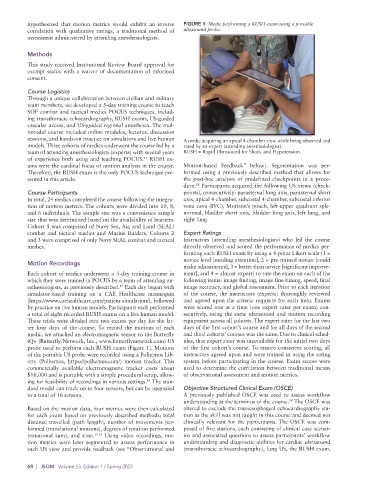
hypothesized that motion metrics would exhibit an inverse   FIGURE 1  Medic performing a RUSH exam using a portable
          correlation with qualitative ratings, a traditional method of   ultrasound probe.
          assessment administered by attending anesthesiologists.

          Methods
          This study received Institutional Review Board approval for
          exempt status with a waiver of documentation of informed
          consent.

          Course Logistics
          Through a unique collaboration between civilian and military
          team members, we developed a 5-day training course to teach
          SOF combat and tactical medics POCUS techniques, includ-
          ing transthoracic echocardiography, RUSH exams, US-guided
          vascular access, and US-guided regional anesthesia. The mul-
          timodal course included online modules, lectures, discussion
          sessions, and hands-on practice on simulators and live human   A medic acquiring an apical 4-chamber view while being observed and
          models. Three cohorts of medics underwent the course led by a   rated by an expert (attending anesthesiologist).
          team of attending anesthesiologists (experts) with several years   RUSH = Rapid Ultrasound for Shock and Hypotension.
                                                11
          of experience both using and teaching POCUS.  RUSH ex-
          ams were the cardinal focus of motion analysis in the course.   Motion-based Feedback” below). Segmentation was per-
          Therefore, the RUSH exam is the only POCUS technique pre-  formed using a previously described method that allows for
          sented in this article.                            the post-hoc analysis of predefined checkpoints in a proce-
                                                             dure.  Participants acquired the following US views (check-
                                                                 18
          Course Participants                                points), consecutively: parasternal long axis, parasternal short
          In total, 24 medics completed the course following the integra-  axis, apical 4-chamber, subcostal 4-chamber, subcostal inferior
          tion of motion metrics. The cohorts were divided into 10, 8,   vena cava (IVC), Morison’s pouch, left-upper quadrant sple-
          and 6 individuals. The sample size was a convenience sample   norenal, bladder short axis, bladder long axis, left lung, and
          size that was determined based on the availability of learners.   right lung.
          Cohort 1 was comprised of Navy Sea, Air, and Land (SEAL)
          combat and tactical medics and Marine Raiders. Cohorts 2   Expert Ratings
          and 3 were comprised of only Navy SEAL combat and tactical   Instructors (attending anesthesiologists) who led the course
          medics.                                            directly observed and scored the performance of medics per-
                                                             forming each RUSH exam by using a 4-point Likert scale (1 =
                                                             novice level [needing attention], 2 = pre-trained novice [could
          Motion Recordings
                                                             make adjustments], 3 = better than novice [significant improve-
          Each cohort of medics underwent a 5-day training course in   ment], and 4 = almost expert) to rate the exam on each of the
          which they were trained in POCUS by a team of attending an-  following items: image finding, image fine-tuning, speed, final
                                        11
          esthesiologists, as previously described.  Each day began with   image accuracy, and global assessment. Prior to each iteration
          simulator-based training on a CAE Healthcare mannequin   of the  course,  the instructors  (experts)  thoroughly  reviewed
          (https://www.caehealthcare.com/patient-simulation/), followed   and agreed upon the criteria requisite for each item. Exams
          by practice on live human models. Participants each performed   were scored one at a time (one expert rater per exam) con-
          a total of eight recorded RUSH exams on a live human model.   secutively, using the same ultrasound and motion recording
          These trials were divided into two exams per day for the lat-  equipment across all cohorts. The expert rater for the last two
          ter four days of the course.  To record the motions of each   days of the first cohort’s course and for all days of the second
          medic, we attached an electromagnetic sensor to the Butterfly   and third cohorts’ courses was the same. Due to clinical sched-
          iQ+ (Butterfly Network, Inc., www.butterflynetwork.com) US   ules, that expert rater was unavailable for the initial two days
          probe used to perform each RUSH exam (Figure 1). Motions   of the first cohort’s course. To ensure consistent scoring, all
          of the portable US probe were recorded using a Polhemus Lib-  instructors agreed upon and were trained in using the rating
          erty (Polhemus,  https://polhemus.com/) motion tracker.  This   system before participating in the course. Exam scores were
          commercially available electromagnetic tracker costs about   used to determine the correlation between traditional means
          $16,000 and is portable with a simple procedural setup, allow-  of observational assessment and motion metrics.
          ing for feasibility of recordings in various settings.  The stan-
                                                 16
          dard model can track up to four sensors, but can be upgraded   Objective Structured Clinical Exam (OSCE)
          to a total of 16 sensors.                          A previously published OSCE was used to assess workflow
                                                             understanding at the terminus of the course.  The OSCE was
                                                                                                19
          Based on the motion data, four metrics were then calculated   altered to exclude the transesophageal echocardiography sta-
          for each exam based on previously described methods: total   tion as the skill was not taught in this course and deemed not
          distance travelled (path length), number of movements per-  clinically relevant for the participants. The OSCE was com-
          formed (translational motions), degrees of rotation performed   posed of five stations, each consisting of clinical case scenar-
          (rotational sum), and time. 17,18  Using video recordings, mo-  ios and associated questions to assess participants’ workflow
          tion metrics were later segmented to assess performance in   understanding and diagnostic abilities for cardiac ultrasound
          each US view and provide feedback (see “Observational and   (transthoracic echocardiography), lung US, the RUSH exam,

          68  |  JSOM   Volume 23, Edition 1 / Spring 2023

