


Page 128 - JSOM Spring 2023
P. 128
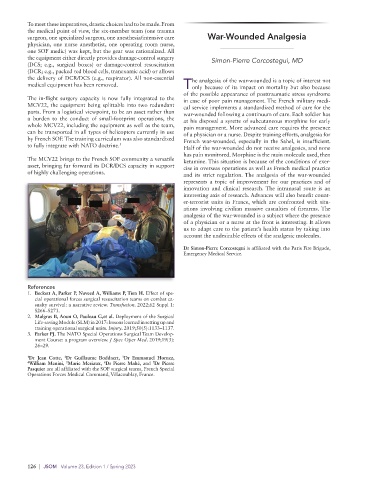
To meet these imperatives, drastic choices had to be made. From
          the medical point of view, the six-member team (one trauma
          surgeon, one specialized surgeon, one anesthesia/ intensive care   War-Wounded Analgesia
          physician, one nurse anesthetist, one operating room nurse,
          one SOF medic) was kept, but the gear was rationalized. All
          the equipment either directly provides damage-control surgery   Simon-Pierre Corcostegui, MD
          (DCS; e.g., surgical boxes) or damage-control resuscitation
          (DCR; e.g., packed red blood cells, tranexamic acid) or allows
          the delivery of DCR/DCS (e.g., respirator). All non- essential   he analgesia of the war-wounded is a topic of interest not
          medical equipment has been removed.                Tonly because of its impact on mortality but also because
                                                             of the possible appearance of posttraumatic stress syndrome
          The in-flight surgery capacity is now fully integrated to the   in case of poor pain management. The French military medi-
          MCV22, the equipment being splittable into two redundant   cal service implements a standardized method of care for the
          parts. From a logistical viewpoint, to be an asset rather than   war-wounded following a continuum of care. Each soldier has
          a burden to the conduct of small-footprint operations, the   at his disposal a syrette of subcutaneous morphine for early
          whole MCV22, including the equipment as well as the team,   pain management. More advanced care requires the presence
          can be transported in all types of helicopters currently in use   of a physician or a nurse. Despite training efforts, analgesia for
          by French SOF. The training curriculum was also standardized   French war-wounded, especially in the Sahel, is insufficient.
          to fully integrate with NATO doctrine. 3           Half of the war-wounded do not receive analgesics, and none
                                                             has pain monitored. Morphine is the main molecule used, then
          The MCV22 brings to the French SOF community a versatile   ketamine. This situation is because of the conditions of exer-
          asset, bringing far forward its DCR/DCS capacity in support   cise in overseas operations as well as French medical practice
          of highly challenging operations.                  and its strict regulation. The analgesia of the war-wounded
                                                             represents  a  topic  of improvement  for our  practices  and  of
                                                             innovation and clinical research. The intranasal route is an
                                                             interesting axis of research. Advances will also benefit count-
                                                             er-terrorist  units in France, which are confronted with situ-
                                                             ations involving civilian massive casualties of firearms. The
                                                             analgesia of the war-wounded is a subject where the presence
                                                             of a physician or a nurse at the front is interesting. It allows
                                                             us to adapt care to the patient’s health status by taking into
                                                             account the undesirable effects of the analgesic molecules.

                                                             Dr Simon-Pierre Corcostegui is affiliated with the Paris Fire Brigade,
                                                             Emergency Medical Service.


          References
          1.  Beckett A, Parker P, Naveed A, Williams P, Tien H. Effect of spe-
            cial operational forces surgical resuscitation teams on combat ca-
            sualty survival: a narrative review. Transfusion. 2022;62 Suppl 1:
            S266–S273.
          2.  Malgras B, Aoun O, Pauleau G,et al. Deployment of the Surgical
            Life-saving Module (SLM) in 2017: lessons learned in setting up and
            training operational surgical units. Injury. 2019;50(5):1133–1137.
          3.  Parker PJ. The NATO Special Operations Surgical Team Develop-
            ment Course: a program overview. J Spec Oper Med. 2019;19(3):
            26–29.
                      2
                                         3
          1 Dr Jean Cotte,  Dr Guillaume Boddaert,  Dr Emmanuel Hornez,
          4 William Menini,  Marie Meriaux,  Dr Pierre Mahé, and  Dr Pierre
                                                   7
                                   6
                       5
          Pasquier are all affiliated with the SOF surgical teams, French Special
          Operations Forces Medical Command, Villacoublay, France.


          126  |  JSOM   Volume 23, Edition 1 / Spring 2023

