


Page 125 - JSOM Spring 2023
P. 125
4
              Results                                            Defence Medicine (Research and Academia), Birmingham, UK.  AM
                                                                 Marsden is affiliated with the Academic Department of Military Sur-
              From 2004–2014, 2,413 UK personnel were injured in Afghan-  gery and Trauma, Royal Centre for Defence Medicine (Research and
              istan; 448 died, for a combat fatality rate (CFR) of 18.6%. Of   Academia), Birmingham, UK, and the Centre for Trauma Sciences,
                                                                                                              5
              the 448 deaths, 390 (87.1%) died pre-hospital (n=348 KIA,   Blizard Institute, Queen Mary University of London, London, UK.  Dr
              n=42 killed in non-enemy action).                  Hepper is affiliated with the Ministry of Defence, Defence Statistics
                                                                                6
                                                                 (Health), Bristol, UK.  Dr Wright is affiliated with the Academic De-
                                                                 partment of Military Emergency Medicine, Royal Centre for Defence
              Complete timeline data were available for 303 (87.1%) KIA:   Medicine (Research and Academia), Birmingham, UK.
              Injury Severity Score (ISS), 75.0 (55.5–75.0). Improvised
              explosive device (IED) (n=166; 54.8%) was the predomi-
              nant mechanism, followed by gunshot wound (GSW) (n=96;
              31.7%), explosive non-IED (n=40; 13.2%), and aircraft inci-  Medical Support of High-Altitude
              dent (n=1). The head was the most prevalent primary injury   Military Parachuting
              (n=124; 40.9%),  then  the thorax  (n=57), lower  extremity
              (n=34), abdomen (n=27), neck (n=27), and  “whole body”
              (n=21).
                                                                                 Gabriel M, MD
              In the KIA cohort, the median time to death was 0.0 (0.0–21.8)
              minutes; 173 (57.1%) died instantaneously (zero minutes).
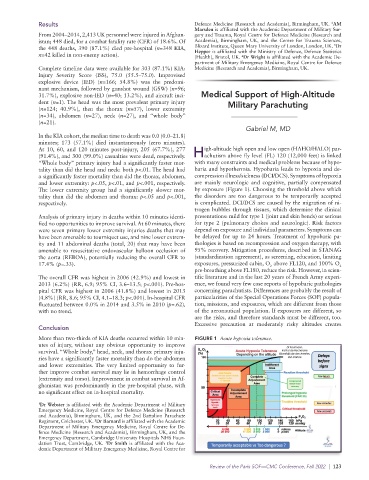
              At 10, 60, and 120 minutes post-injury, 205 (67.7%), 277   igh-altitude high open and low open (HAHO/HALO) par-
              (91.4%), and 300 (99.0%) casualties were dead, respectively.  Hachutism above fly level (FL) 120 (12,000 feet) is linked
              “Whole body” primary injury had a significantly faster mor-  with many constraints and medical problems because of hypo-
              tality than did the head and neck: both p<.01. The head had   baria and hypothermia. Hypobaria leads to hypoxia and de-
              a significantly faster mortality than did the thorax, abdomen,   compression illness/sickness (DCI/DCS). Symptoms of hypoxia
              and lower extremity: p<.05, p<.01, and p<.001, respectively.   are mainly neurologic and cognitive, partially compensated
              The lower extremity group had a significantly slower mor-  by exposure (Figure 1). Choosing the threshold above which
              tality than did the abdomen and thorax: p<.05 and p<.001,   the disorders are too dangerous to be temporarily accepted
              respectively.                                      is complicated. DCI/DCS are caused by the migration of ni-
                                                                 trogen bubbles through tissues, which determine the clinical
              Analysis of primary injury in deaths within 10 minutes identi-  presentations: mild for type 1 (joint and skin bends) or serious
              fied no opportunities to improve survival. At 60 minutes, there   for type 2 (pulmonary chokes and neurologic). Risk factors
              were seven primary lower extremity injuries deaths that may   depend on exposure and individual parameters. Symptoms can
              have been amenable to tourniquet use, and nine lower extrem-  be  delayed  for  up  to  24  hours. Treatment  of  hypobaric  pa-
              ity and 11 abdominal deaths (total, 20) that may have been   thologies is based on recompression and oxygen therapy, with
              amenable to resuscitative endovascular balloon occlusion of   95% recovery. Mitigation procedures, described in STANAG
              the aorta (REBOA), potentially reducing the overall CFR to   (standardization agreement), as screening, education, limiting
              17.4% (p=.33).                                     exposures, pressurized cabin, O  above FL120, and 100% O
                                                                                         2
                                                                                                                2
                                                                 pre-breathing above FL180, reduce the risk. However, in scien-
              The overall CFR was highest in 2006 (42.9%) and lowest in   tific literature and in the last 20 years of French Army experi-
              2013 (6.2%) (RR, 6.9; 95% CI, 3.6–13.5; p<.001). Pre-hos-  ence, we found very few case reports of hypobaric pathologies
              pital CFR was highest in 2006 (41.8%) and lowest in 2013   concerning parachutists. Differences are probably the result of
              (4.8%) (RR, 8.6; 95% CI, 4.1–18.3; p<.001). In-hospital CFR   particularities of the Special Operations Forces (SOF) popula-
              fluctuated between 0.0% in 2014 and 3.5% in 2010 (p=.62),   tion, missions, and exposures, which are different from those
              with no trend.                                     of the aeronautical population. If exposures are different, so
                                                                 are the risks, and therefore standards must be different, too.
                                                                 Excessive precaution at moderately risky altitudes creates
              Conclusion
              More than two-thirds of KIA deaths occurred within 10 min-  FIGURE 1  Acute hypoxia tolerance.
              utes of injury, without any obvious opportunity to improve
              survival. “Whole body,” head, neck, and thorax primary inju-
              ries have a significantly faster mortality than do the abdomen
              and lower extremities. The very limited opportunity to fur-
              ther improve combat survival may lie in hemorrhage control
              (extremity and torso). Improvement in combat survival in Af-
              ghanistan was predominantly in the pre-hospital phase, with
              no significant effect on in-hospital mortality.

              1 Dr Webster is affiliated with the Academic Department of Military
              Emergency Medicine, Royal Centre for Defence Medicine (Research
              and Academia), Birmingham, UK, and the 2nd Battalion Parachute
              Regiment, Colchester, UK.  Dr Barnard is affiliated with the Academic
                                2
              Department of Military Emergency Medicine, Royal Centre for De-
              fence Medicine (Research and Academia), Birmingham, UK, and the
              Emergency Department, Cambridge University Hospitals NHS Foun-
                                   3
              dation Trust, Cambridge, UK.  Dr Smith  is affiliated with the Aca-
              demic Department of Military Emergency Medicine, Royal Centre for
                                                                     Review of the Paris SOF—CMC Conference, Fall 2022  |  123

